

This is the second article in the Perspectives on Retail Media Series brought to you by the Retail Media Council.
Written by Cameron Porter, Commerce Planning Director ANZ, Mars United Commerce
__________________________
The market inflection: from capability build to effectiveness proof
Across the last few years, retail media in ANZ has been in a foundation building phase, focused on establishing retail media as a credible channel. But as retail media has become established, the centre of gravity shifts. The question is no longer “can retail media work?” — it is “what outcomes does it deliver, how consistently, and how efficiently can we execute across a growing set of networks?”
The truth of the matter is that in ANZ, retail media has moved beyond being experimental. The channel is now a core part of the media mix and with that shift comes a very real operational challenge: advertisers are managing more networks, more formats, and more reporting models than ever before.
This is where the ANZ Retail Media Report Card becomes useful beyond benchmarking. It highlights that the “next era” of retail media in ANZ is defined less by raw capability expansion and more by effectiveness including the depth of measurement, self-serve opportunity, integration pathways, and operational clarity required to turn retail media investment into repeatable outcomes.
The encouraging signal from this edition is that progress is not slowing. Networks are responding to advertiser expectations in tangible ways, particularly across measurement, self-serve operability, offsite expansion, and AI-enabled efficiency.
What is the Retail Media Report Card?
The Report Card was designed as a benchmarking tool to assist advertisers (and networks) to evaluate retail media opportunities through observable capabilities. The Report Card tracks the pulse of this fast-evolving ecosystem where networks are expanding into new touchpoints, strengthening measurement, developing self-serve tooling, and increasingly using AI to improve efficiency and shopper relevance.
The IAB Retail Media State of the Nation 2025 reported that 77% of advertisers are now working with three or more retail media networks, which makes cross-network comparison and operational consistency a bigger determinant of success than any single on-platform optimisation tactic. The Report Card helps advertisers compare networks objectively, identify core effectiveness strengths, and drive productive conversations with agencies and retail media teams about full-funnel planning and impact through a moment in time snapshot of network changes and priorities for the last 6 months.
What's in this edition?
This sixth edition reviews 17 retail media networks across Australia and New Zealand, including:
- New Zealand-only networks: Briscoe Group Retail Media (NEW), Foodstuffs Precision Media, Market Media.
- Australia & New Zealand: Cartology (AU & NZ have distinct capability reporting), THE ICONIC Media (NEW).
- Australia-only networks: Amazon Ads, AVC Experience Plus, Coles 360, CommBank Connect (NEW), David Jones Amplify, DoorDash Ads (NEW), MixIn, PetAds, Priceline Pharmacy Retail Media (NEW), TWC Connect, Uber Advertising.
This edition assesses networks against 84 evaluation criteria across: Targeting, Measurement & Reporting, Media Opportunities, Innovation, and Partnership. There are four new capabilities; API or Direct Data Feeds, Brand Lift Study, Managed Offsite Programmatic Display and Self‑Serve Offsite Display.
Where retail media is at right now: the top themes from this edition
There are several trends that have emerged through this iteration of the report card, some are long-term trends, some are newer trends that reflect the current market dynamics. These trends include:
Scale and expansion: new touchpoints beyond onsite
Retail media networks are expanding beyond standard onsite placements and into higher-impact touchpoints across in-store, video, experiential, and large-format environments. In practice, this looks like networks broadening the places brands can show up across the shopper journey. Not just where shoppers convert, but where they discover and decide. Examples include Market Media expanding shoppable video formats, and CommBank Connect scaling physical screen environments and integrated content ecosystem touchpoints.

Content in commerce: more human ways to win discovery and evaluation
Retail media is becoming more “native” in how it influences shoppers. Networks are leaning into creators, trusted voices, and contextual storytelling formats that fit modern discovery behaviours.
The Report Card’s Capability Spotlight on creators reflects that this is no longer an outlier approach. Different networks are approaching it in different ways, from creator networks to staff-led expertise formats. Examples include Coles 360 enabling advertiser briefs into creator networks, PetAds using trusted staff/expert-led content formats and Amazon Ads Twitch Creator Program providing live shopping potential.

Measurement is maturing and 'proof' is becoming a differentiator
Measurement remains central, but what matters is changing: advertisers are moving from “can we measure performance?” to “can we prove incrementality, compare outcomes, and connect impact across the funnel?”
This is reflected in the Report Card’s inclusion of Brand Lift Study as a new capability to reflect that retail media is being asked to justify value beyond sales-only metrics, and to help bridge brand and trade investment conversations.
It also aligns with the IAB’s ongoing push for measurement consistency and confidence in the category. Currently this capability is self-reported against the Australian Retail Media Measurement and Guidance Principles.

Self-serve is shifting from an nice-to-have to operational necessity
As managing multiple networks becomes harder, the operational burden is moving up the agenda. Networks are increasingly expected to provide advertiser control, faster turnaround, and more repeatable “test-and-learn” execution.
This edition explicitly captures that shift through the addition of Self‑Serve Offsite Display — reflecting growing demand for brands to activate beyond retailer-owned environments without adding layers of manual process.
Examples include Cartology evolving its centralised self-serve Ads Manager, now with paid search integration, and DoorDash Ads investing in portal upgrades and expanded self-serve functionality.

Offsite advertising is a major growth lever, but accountability expectations remain high
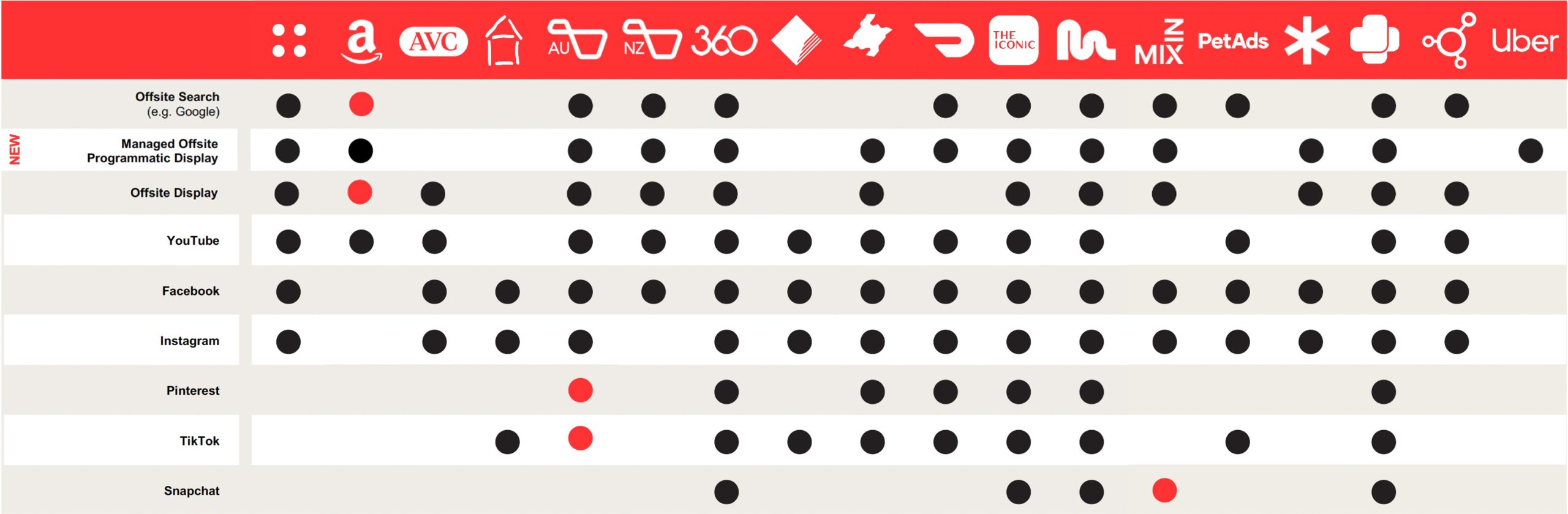
Offsite activation is increasingly central to the “full-funnel” retail media pitch: extending first-party audiences into social, video, and programmatic environments while retaining as much accountability as possible.
This is why the Report Card now distinguishes between advertiser-controlled and network-managed offsite models, including the addition of Managed Offsite Programmatic Display.
AI is becoming practical infrastructure not just experimentation
AI is showing up in two ways: improving advertiser efficiency (planning, optimisation, insights) and reshaping the shopper experience through more guided, conversational discovery journeys.
The Report Card reflects this as both an innovation criterion and a broader market force, with examples like Amazon Ads embedding AI into campaign management and automation.
Criteo expands on the potential of AI in retail media and commerce as part of the Technology Spotlight.
Retail media fragmentation is increasing, and clear differentiation will be needed
Finally, as the ecosystem expands (and as new entrants bring new operating models), fragmentation increases — and that raises the bar for clarity. Networks must be able to articulate not only what they offer, but the role they play in a media plan and how they support consistent execution and measurement across an increasingly complex landscape.
For example, AVC Experience+ has a clear differentiation point around experiences in cultural moments, David Jones Amplify clearly positions its offering to target a highly premium audience in premium shopping environments, and PetAds has clear positioning around the trust it has built supporting pet parent education and confidence. All networks will increasingly need a clear narrative for advertisers, backed up by delivering relevant capabilities.
In summary
Overall, the report card has once again underscored the quick pace at which retail media is moving. Many of these trends aren’t going anywhere and are expected to be a mainstay in industry conversation over the next few years.
There are plenty more findings and updates to be uncovered in the full report. You can download the full Report Card here: Download the ANZ Retail Media Report Card (H1 2026). The seventh edition will be released later this year, providing an updated snapshot of trends and development.
_________
Bio:
Cameron Porter is Commerce Planning Director ANZ at Mars United Commerce ANZ (Publicis Groupe), working at the intersection of creative, media, and commerce to shape how brands show up across the shopper journey. He is the lead author of the Retail Media Report Card, now in its sixth edition, which has become a widely referenced benchmarking tool for advertisers navigating the evolving retail media landscape. Cameron brings a practical, shopper-first perspective, grounded in what drives real outcomes in retail environments.