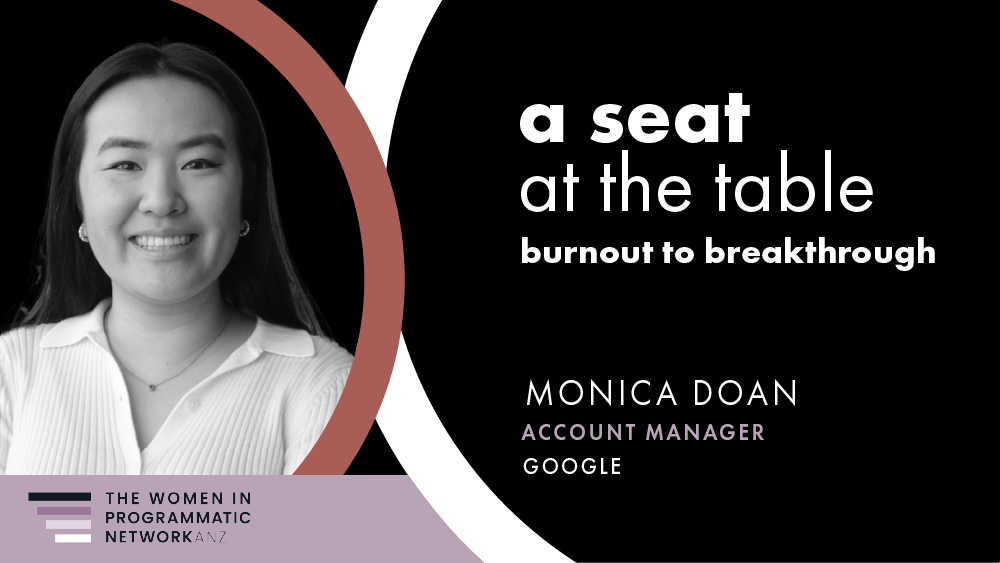
IAB Australia has partnered with The Women in Programmatic Network (TWIPN) to launch the A Seat at The Table Series. The series will dive into the personal stories and professional perspectives of those from the local advertising community, and give these role models a seat at the table to share their story. Each article will feature a different topic and guest speaker.
A recent industry-wide survey from the Mentally Healthy Change Group and UnLtd revealed a stark truth: 70% of media professionals faced burnout in the 12 months preceding the survey, a figure that sits well above the Australian workforce average of 53%. Behind that headline lies an even more troubling pattern: women in particular report higher levels of work-related psychological distress and burnout, exacerbated by disproportionate exposure to harassment, discrimination and other psychosocial risks. Coupled with entrenched industry norms – from the normalisation of overwork to the undervaluing of women’s contributions – the data paints a clear picture of why the mental health burden falls more heavily on women across the media landscape.
Yet within these confronting numbers lies an unexpected opportunity. Burnout, while deeply uncomfortable, often forces a reckoning: with our workload, our boundaries, our values and the systems we’ve been operating within. When approached deliberately, that reckoning can spark meaningful change – helping us rebuild routines, reshape our priorities and pursue success in ways that are not only more sustainable, but more aligned with who we are and how we want to work.
We spoke with Monica Doan, Account Manager at Google, about her own journey through burnout and the practical ways she’s learned to transform it into growth and new opportunities.
—–
Q: Firstly, we’d love readers to get to know you and how you got to where you are today.
A: I’m an Account Manager and digital strategist currently driving growth within the Financial Services sector at Google. My experience spans hands-on activation through to high-level strategic portfolio management across clients in finance, retail, and automotive.
Burnout has shown up at multiple stages of my career. I started working in programmatic in late 2019, and my unhealthy work habits became more pronounced during COVID. I was grateful to keep my job – but I also did nothing but work. When restrictions were lifted, I didn’t reset or build a healthier routine. I stayed in that “always-on” mode, which eventually led to burnout.
Burnout looks different for everyone, but for me it showed up physically, mentally, and emotionally. Physically, I had low energy, got sick often, and struggled with sleep. Mentally, I found it hard to concentrate. Emotionally, I felt irritable and constantly frustrated. It actually became unusual not to feel stressed – stress was my baseline.
Over time, a pattern emerged. I was consistently choosing work over everything else – dinner with friends, the gym, even basic downtime. When you repeatedly prioritise work over your wellbeing, that’s when you know something isn’t right.
Q: What early warning signs have you learned to watch for – and how can others tune into their own before hitting a breaking point?
A: For me, it starts with tracking my energy levels and regularly checking in on how I feel physically and mentally. I didn’t do this alone – I leaned heavily on my support system, including family, friends, and medical professionals. They helped me understand what my “baseline” should feel like and recognise when I’m off track.
I’ve always been quite self-aware, but tools like the Myers-Briggs Type Indicator also helped me better understand how I operate. Learning that I’m an introvert, for example, helped me recognise that I need time alone to recharge.
Once you know yourself well, the warning signs become clearer – and you can plan ahead. For example, if I know I have a busy work week with travel, client meetings, and social events, I won’t schedule anything that weekend. I’ll intentionally block time to recharge – usually something low-key, like relaxing at home with my dogs.
Working with my GP and psychologist also helped me identify work as my main stressor. I began to recognise that constantly getting sick was a sign I needed to slow down. Not properly recovering was only prolonging the cycle.
Q: What’s been your best tool/strategy to diffuse burnout?
A: My calendar is my best friend. If it’s not in the calendar, then it’s probably not going to happen because I will forget, or, I won’t prioritise it. Everything gets scheduled into a calendar so I can see how I am spending my time both in my work life and my personal life.
I like to schedule commitments into my calendar and look ahead so then I know the percentage of time spent per week on work; socialising; and health and wellbeing. If there isn’t a balance in these 3 areas of my life, I know I will lean towards burnout.
Q: Studies show younger professionals, especially those under 30, report significantly higher levels of anxiety and burnout. Why do you think burnout is hitting younger generations so hard – and does that reflect what you’re seeing around you?
A: That definitely resonates with my experience. My situation isn’t unique, in that I am a first-born child, Vietnamese-Australian with immigrant parents who do not have standard careers.
My parents worked any and all jobs to put my siblings and I through school and put food on the table. So I grew up with my own goal to succeed in my career so I would not have to rely on my parents financially. I have put a lot of pressure on myself to take care of myself financially, independently, and be in a position to one day repay my parents for providing for me.
I think burnout hits more for younger generations because there is a lot of noise online and offline talking about how difficult it is to succeed in life because money makes the world go around but none of us can seem to get any.
This affects how optimistic we feel about our future. Such as our ability to buy a home or live on our own even if we’re renting. It is becoming increasingly more difficult to plan for a future that is not clear and the path to success becomes more difficult.
Q: Was there a particular moment or shift that pushed you to take burnout seriously and start making changes?
A: Unfortunately, I had to hit my rock bottom to realise that the life that I was living was not sustainable for me. In a previous role, I remember having no social life and no personal life – it was all about work. I worked long hours getting to the office first, staying back late, going home and working more. It really was work, eat, sleep, repeat. I thought I had to do this in order to get recognised at work so I would eventually be considered for a promotion.
All this really did was show the business that I could do the work of a team for one salary. This led to me gaining weight, constantly being sick, panic attacks when I couldn’t consistently meet expectations and timelines, and lack of sleep because I would have stress dreams waking me in the middle of the night.
This was rock bottom 1.0. I remember feeling really lonely because I would see my friends on social media posting about how much fun they were all having with their Friday and Saturday night plans. While I was keeping myself in bed, working on any report or trafficking another campaign. I kept telling myself that it would all be worth it when I got promoted. However, that promotion never came.
I did leave that business for another but I don’t think I made enough changes to take care of myself so history repeated itself. So, I got really sick when I started the new job. I was away from work for 4-6 weeks because of pneumonia. This was rock bottom 2.0.
I had never experienced being sick like this before – I was bed ridden for weeks where I couldn’t eat anything without feeling ill, I could only take sips of water or juice, and I had no energy to do anything.
My new workplace was very supportive of me and gave me the support and time needed to recover. I was welcomed back to work once I made a recovery but I knew that I could not continue to work at the pace that I was in previous roles. I did not want to feel that sick ever again so I made the decision to put myself first and started to put boundaries up to protect my wellbeing. This was the beginning of the breakthrough.
Q: Burnout can feel like a setback, but it can also be a catalyst for change. How have you used those tough periods to refocus, build better habits or create new opportunities?
A: Going through burnout helped me realise I needed to set realistic expectations and boundaries for myself so that I could actually achieve work-life balance. The most practical and workable solutions were:
- Ruthless prioritisation: When I write a to-do list for each day, there aren’t more than 3 things on there. If there has to be more than 3 things, look at how long the 4th and onwards task is going to take. If it’s going to take more than 30 minutes to do then ask yourself: Can someone help me with it? Can I delegate it? And if it is that urgent, why isn’t it in the top 3 tasks to do?
- Set boundaries: Most of the time, I leave my laptop at the office. I can’t work overtime if I leave my laptop at the office. In my current role, I have the privilege of a separate work phone so I can check emails on the train ride home or pick up calls/texts from clients if they do contact me. However, after a certain time, that work phone stays in my work bag and I don’t check it until the next morning. If I only had one phone, I wouldn’t have my work emails. I also wouldn’t have other work related apps on that phone. If you have to work overtime, set a time to work until. For example, I’m going to work until 7pm and then log off; and actually log off. If you cannot do any of these things without feeling guilty, that is a red flag. Don’t overstep your own boundaries. Be realistic about what you can and cannot do.
- Ask for support: You don’t have to do this yourself. Ask your line manager or team or friend/colleague for assistance with prioritisation. My village helped support me by keeping me accountable for the new habits I put in place in terms of boundaries to avoid burnout.
Q: From your perspective, what can organisations do better to support employees dealing with burnout — particularly in fast-paced environments like tech and media?
A: From my perspective, organisations can do better to support employees dealing with burnout by recognising it is a real problem and people experience it in lots of different ways. Managers also need to recognise that time off for employees only works if workloads are properly managed. Having employees return from leave to a backlog of unaddressed tasks negates the benefit of taking leave.
In Australia, we have great advantages like annual leave, sick leave, and other leave to support our personal lives whilst still being able to stay afloat financially.
I am a big advocate for using all of my paid time off balance. I almost always have a holiday booked so my annual leave balance is minimal.
It would be ideal to see organisations and management move beyond simply offering annual leave to actively advocating for their team members to use their leave balances. It has the strategic benefit for employers of long-term retention and higher productivity.
I’m also on the lookout for green flags for work-life balance when I’m interviewing employers. Some questions you can ask include: “How do you take care of your employees?”, “How do managers on this team support sustainable workloads for their reports?” or “How does the team approach flexibility when someone needs to adjust their schedule?”
You’re listening for answers that point to fair distribution of work, a detailed process for workload planning beyond “we just push through”, and signs that being responsive outside of work hours are truly optional.
Q: For anyone currently feeling depleted or overwhelmed, what guidance would you offer to help them reset and move forward with intention?
A: If you’re reading this article in hopes to help yourself get out of burnout or prevent it from happening again, that’s a great start. Acknowledging the issue at hand and looking for ways to solve it is a great attitude and is why you will most likely overcome burnout.
The first step is to ask for help. It can feel scary, but I say be afraid and do it anyway. It could be someone you trust at work, a friend or family member, or your GP. I’m living life on the other side of asking for – and getting – that help and I am confident I can still meet my goals without compromising my wellbeing.
In my current role, I am happy to say that I have great work-life balance. I hold true to my work boundaries and ensure that I put my wellbeing first. There are definitely times that I still work overtime but I know that it is short-term and it is my choice to work late or weekends.
Going through this has led to some aspects of personal and professional growth. I now feel confident and comfortable talking to my manager about how work is going and asking for help if I need support. I am consistent with check-ins with my health professionals to ensure I don’t fall back into old habits. I lean on my support group to help keep me accountable on my habits and boundaries. Building these skills and connections helped me get out of burnout and stop me from falling back into it.
Five boundaries to implement this week:
Leave work at work. Keep your laptop at the office, or out of sight if working from home.
If you don’t have any leave booked in, schedule some now so you know when you’ll have time to disconnect from work and recharge. Ensure these chances come up frequently across the year.
Review your calendar to ensure it accurately reflects your priorities and allows you time throughout the day for breaks.
Learn to delegate tasks and negotiate/reassess additional responsibilities when your plate is already full.
Explore your employer’s ability to accommodate flexible work arrangements or remote work options to better suit your lifestyle.
If you believe you’re heading towards burnout, use the Beyond Blue Burnout Check-in Tool to see how you’re doing.