IAB Australia has partnered with The Women in Programmatic Network (TWIPN) to launch the ‘A Seat at The Table Series’. The series will dive into the personal stories and professional perspectives of those from the local advertising community, and give these role models a seat at the table to share their story. Each article will feature a different topic and guest speaker.
Australia’s parental leave system has seen incremental reform in recent decades, but many employees still face barriers to accessing adequate paid leave, and a lack of flexibility and support required to successfully reintegrate into their roles following parental leave.
According to the latest data from the Workplace Gender Equality Agency (WGEA), only a small proportion of employers offer progressive policies like gender-neutral parental leave or non-transferable ‘use-it-or-lose-it’ provisions that encourage shared caregiving, with women overwhelmingly taking on the role of primary carer (90-95% of cases according to multiple data sources)1. Meanwhile, the government-funded Paid Parental Leave scheme (recently expanded to 26 weeks) still lags behind international standards.
To better understand how parental leave policies influence career decisions and progression in our industry, we engaged our passionate TWIPN community through a dedicated Parental Leave & Career Decisions Survey. We received an incredible 74 responses, offering rich insights into the experiences and perspectives of women in our industry.
Explore the key findings in the graphic below.
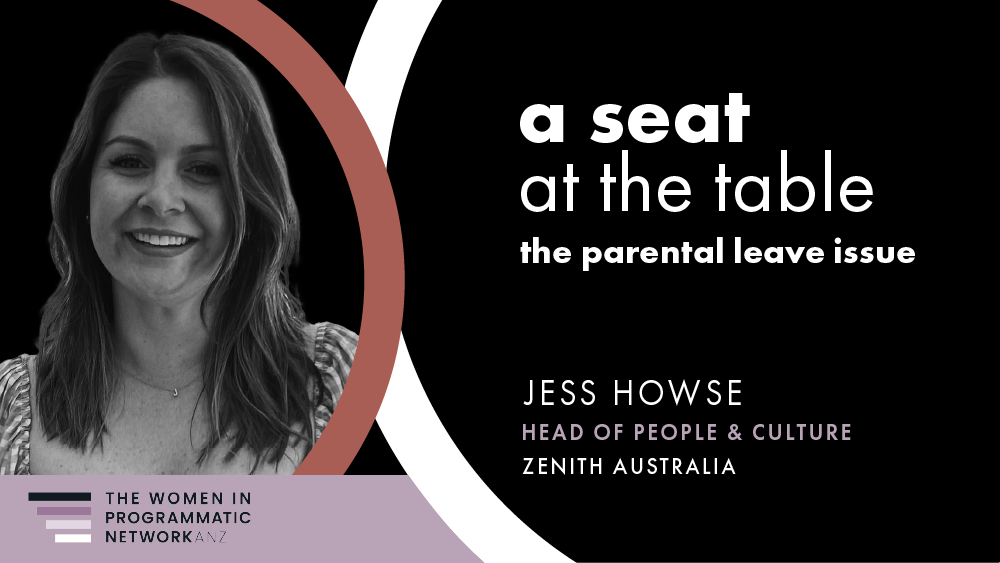
Now, we’re sitting down with an HR leader to get their perspective on the topic. We’re thrilled to welcome Jess Howse, Head of People & Culture at Zenith Australia, to the table to discuss this important topic from both a professional and personal perspective.
Q: Firstly, we’d love to start by getting to know Jess, why this topic is important to you and what compelled you to speak out about it.
A: Thank you for inviting me into this conversation, it’s one I feel deeply passionate about. Professionally, I’ve spent over 14 years working in People and Culture roles across media, sport and entertainment, both in Australia and globally. I’ve held leadership roles including National Head of People at a leading media agency, People Strategy Lead at Football Australia, and I’m currently Head of People & Culture at Zenith Australia.
But my advocacy for parental leave isn’t just professional, it’s personal. I have two young children, now five and two. Like so many parents, I’m living the daily reality of balancing a full‑time career with raising small humans. I’ve taken parental leave and returned to work twice, and neither experience was entirely seamless or aligned with what I had expected or planned.
My first period of parental leave occurred during the COVID-19 pandemic, while I was working overseas in a remote location. With global lockdowns and limited medical support for potential complications, my husband and I made the decision to return to Australia for the birth and my parental leave period. What followed was an experience I know many parents will recognise: initial flexibility and goodwill that didn’t translate into lasting, workable arrangements upon return. Ultimately, the role was no longer viable for me, and I moved on.
During my second period of parental leave, my role was made redundant while still on leave – my daughter was just four months old. Restructures happen, and I understood the broader business context. What stayed with me, though, was how common it is for the human side of these decisions – the planning, timing, and communication – to fall short of what parents navigating one of life’s biggest transitions genuinely need.
These experiences were different, but the underlying issues were similar: insufficient workforce planning and a lack of genuine consideration for flexible, supported reintegration. Unfortunately, this remains a far too common experience for women and, increasingly, for all primary carers.
What compels me to share my experience is that these outcomes are rarely inevitable. In my current role, I’m fortunate to be in a position where I can influence decision‑making earlier, before new parents head off on leave. This ensures they are treated as a valued part of the workforce, not an afterthought. This responsibility matters to me, because no one should have to choose between growing their family and sustaining a meaningful career.
Q: In your experience, what are the main factors that prevent employers from adopting more progressive parental leave policies – is it primarily cost, company culture, concerns about productivity or something else?
A: Cost is often the headline concern, particularly for smaller organisations or those operating on tight margins. There can be a perception that more generous parental leave is an expense, rather than an investment. What’s interesting, though, is that research from multiple markets shows the productivity impact of parental leave is often neutral or even positive. Because organisations adapt. They backfill differently, redistribute work, and benefit from higher retention and engagement when employees return.
Company culture is usually the bigger, quieter barrier. In workplaces where long hours, presenteeism or ‘always on’ leadership norms still dominate, parental leave can be seen subconsciously as a disruption or a risk – particularly for senior roles. That’s often compounded by lingering bias about who will take leave and what it signals about ambition or commitment, especially for women.
Productivity concerns also come up, but I’d say they’re more about planning confidence than actual output. Leaders may worry about loss of momentum, client continuity, or capability gaps, particularly if they haven’t previously navigated parental leave well. Where organisations struggle, is usually because leave hasn’t been built into workforce planning, succession thinking, or job design, rather than because the policy itself is flawed.
The other factor I see often is complexity and uncertainty. Organisations can be unsure how to design policies that balance being equitable, gender‑neutral, and operationally workable, especially when government entitlements, superannuation treatment, and hybrid work models are all evolving at once. That hesitation can lead to incrementalism instead of bold change.
The shift to organisations adopting more progressive parental leave happens when the conversation moves from, “Can we afford this?” to “What does it cost us not to?”, in regard to attrition, leadership diversity, burnout, and long‑term capability. Once leaders make that mindset shift and role‑model the behaviour, the cultural and productivity fears tend to fall away quite quickly.
Q: How would you say the media industry’s stance on parental leave policies and support compares to that of other industries? We know you’re passionate about Publicis Groupe’s approach to parental leave policies, can you take us through what aspects of Publicis’ framework you think organisations can learn from?
A: Compared to many industries, the media and marketing sector sits on an interesting middle ground. On the one hand, it’s generally more progressive than traditionally male‑dominated industries when it comes to offering paid parental leave and flexible work, largely because it has a younger, more gender‑diverse workforce and strong competition for talent. Industry‑wide data shows female‑dominated and professional services sectors are more likely to offer paid and gender‑neutral parental leave.
Where media sometimes lags behind other industries, like banking, consulting or tech, is in consistency and depth. Policies exist, but cultural support doesn’t always keep pace. Long hours, client pressure and ‘always on’ expectations can still make taking leave, or taking it equally across genders, feel risky in practice.
The organisations in media that are really leading are the ones treating parental leave not as a standalone benefit, but as part of a broader approach to flexibility, leadership role‑modelling and sustainable performance.
At Zenith, as part of Publicis Groupe, our approach is centred around supporting employees through parental leave as an important life transition, rather than simply a period away from work. Alongside paid parental leave policies and flexible return-to-work options, we’ve introduced additional coaching and transition support to help employees navigate key caregiving transitions, including preparing for leave and returning to work.
The approach is intentionally inclusive and designed to support employees through the practical and emotional realities of balancing career progression with caring responsibilities. Publicis Groupe also actively supports phased returns, flexible hours, part-time transitions, hybrid work and personalised flexibility plans, rather than a one-size-fits-all model.
Q: The survey revealed a strong call for gender-neutral parental leave policies – specifically, equal paid leave entitlements for all parents regardless of gender, and better alignment between leave provisions for primary and secondary carers. Do you think we’ve made progress in this area? Is there still work to be done in demonstrating the commercial and business benefits of adopting such policies to employers?
A: I do think we’ve made meaningful progress, particularly in the last five years. We’re seeing far more organisations move toward gender‑neutral language and greater flexibility in how leave can be taken and shared. That shift alone matters. It signals that caregiving is not a ‘women’s issue’, but a normal part of working life for all parents.
That said, progress has been uneven. While policy design has improved, utilisation hasn’t always kept pace, especially among men and secondary carers. That tells us culture and leadership permission still play a big role. Equal entitlements on paper don’t automatically translate to equal uptake unless leaders actively role‑model, encourage take‑up, and remove barriers to stepping away.
There’s also definitely more work to do in articulating the commercial case. The evidence is strong: gender‑neutral policies support retention, reduce regretted attrition, improve workforce participation, and strengthen leadership pipelines over time. But often those benefits are framed in abstract or long‑term ways, while employers fixate on short‑term cost or disruption.
What’s been most effective in my experience is moving the conversation away from ‘fairness versus affordability’ and toward talent risk and sustainability. When organisations look at the cost of lost experience, stalled progression, or skewed leadership representation, equal parental policies become a strategic lever not a ‘nice‑to‑have’.
Q: A number of responses in the Parental Leave & Career Decisions Survey highlighted the importance of flexibility when returning to work. What examples have you seen of this done well? What can we learn from these companies?
A: Flexibility is the single biggest determinant of whether a return‑to‑work experience feels successful or stressful, and the best examples I’ve seen all share one thing in common: they treat return‑to‑work as a transition, not a fixed date.
Organisations that do this well typically offer phased returns, where parents gradually ramp up hours or responsibilities over time, rather than expecting an immediate return to ‘business as usual’. That might mean part‑time arrangements initially, flexible start and finish times, or a short‑term reduction in workload while routines are re‑established.
Another strong example is providing paid transition support, such as dedicated return‑to‑work leave days that acknowledge the emotional and logistical reality of coming back. At Publicis Groupe, for example, our Cub Care leave gives parents five paid days to use within their first year back. This recognises that reintegration doesn’t end on day one.
The key lesson for employers is that flexibility works best when it’s co‑designed, not prescribed. Clear frameworks matter, but listening to employees, agreeing review points, and training managers to have confident, empathetic return‑to‑work conversations is what builds trust, retention and long‑term engagement.
Q: Parental leave can have a long-term impact on financial security, particularly superannuation balances – a gap that disproportionately affects women, who continue to take on the majority of caregiving responsibilities. Even with upcoming reforms to include superannuation on government-paid parental leave, women still retire with around 25% less super than men. From your perspective, what more can employers or policymakers do to address the superannuation penalty associated with taking time out for caring?
A: The decision to introduce superannuation on government‑funded Paid Parental Leave from 1 July 2025 has been a genuinely important reform, and it deserves recognition. For the first time, parents receiving Parental Leave Pay receive a super contribution at the Superannuation Guarantee rate, paid by the ATO into their super fund. That sends a strong signal that caring work should be recognised for its long‑term economic value, not just with short‑term income support.
However, it’s also clear this reform alone won’t close the gender super gap. The reality is women in Australia still retire with around 25% less super than men, largely because super is contribution‑based and closely tied to continuous, full‑time work. A model that doesn’t reflect the decades of unpaid and part‑time care undertaken by women.
From an employer perspective, there are a few practical actions that can make a meaningful difference. One potential move is to pay super on employer‑funded parental leave, not just government leave. Another is enabling, and normalising, secondary carers taking extended paid leave, which helps distribute both caring time and super impacts more evenly across genders.
Employers can also allow or actively encourage super top‑ups or catch‑up contributions when employees return from caring breaks, particularly where roles shift from part‑time back to full‑time. While individuals technically have access to concessional catch‑up rules, many parents simply don’t have the financial headroom to use them without employer support or education.
On the policy side, there’s still scope to go further. Offering secondary carer swap programs, recognising unpaid care in the super system over longer caring periods, and continuing to lift women’s earnings more broadly – through pay equity, workforce participation and career progression – are all essential if we want to address the problem at its source.
Ultimately, closing the superannuation gap requires us to stop treating care as a career interruption and start treating it as a shared social contribution. Lasting change will come when both employers and policymakers design systems that reflect how Australians actually work, care and build careers over a lifetime.
Q: With the pace of change in the media industry, workforce planning becomes critical when employees take extended leave. How can organisations plan for both business continuity and a smooth reintegration experience when employees return from parental leave?
A: In an industry like media, where change is constant and client expectations are high, the organisations that do this well treat parental leave as a foreseeable workforce event, not an operational disruption.
The first lever is early, deliberate planning. That means having structured leave conversations well before an employee steps away, clarifying scope, documenting knowledge, and identifying the real impact of absence, rather than assuming risk sits with a single role or individual. Organisations that invest in handovers, shared client ownership and clear decision rights are far better positioned to maintain continuity.
The second is building bench strength and flexibility into the system. Cross‑training, short‑term contracts, internal secondments or freelance support allow businesses to cover capability gaps without reshaping entire teams or prematurely redesigning roles. This approach protects the work while also preventing the unintended penalty of ‘job change by absence’ for someone on parental leave.
Just as important is how organisations plan for return, not just leave. Reintegration takes time. Clear re‑onboarding plans, phased returns, realistic workload ramp ups and agreed review points help returning parents rebuild confidence and momentum while giving leaders visibility over capacity and performance. What differentiates leading organisations is that this isn’t left to individual managers to negotiate informally. Frameworks, tools and manager capability matter. When leaders are supported to have thoughtful return‑to‑work conversations about hours, flexibility, role scope and progression, organisations reduce attrition risk and retain critical capability that would be far more costly to replace.
Ultimately, effective workforce planning during parental leave is about designing resilient teams, not perfect coverage. When continuity and return‑to‑work are planned together, organisations protect their business in the short-term and their talent pipeline in the long-term, which is essential in an industry where experience, relationships and judgement are hard to replace.
Q: What advice would you give to our readers/community members who want to take action and advocate for improvements to their company’s parental leave policy?
A: My biggest piece of advice is to be data‑led in your thinking, and deeply human in your approach. Begin by understanding what’s possible, both legally and commercially. Familiarise yourself with minimum entitlements and industry benchmarks. That context helps shift the conversation from ‘Is this reasonable?’ to ‘Are we keeping pace?’
From there, anchor your advocacy in evidence and lived experience. Use employee feedback, survey results or retention data to show how parental leave policies influence attraction, engagement and return‑to‑work outcomes. Stories matter just as much as statistics as they help decision‑makers understand the real impact behind the policy.
Frame the conversation in business terms, not just fairness. The most effective advocacy positions parental leave as a talent, risk and sustainability issue, not a ‘nice‑to‑have’. Link it to things leaders already care about: continuity, capability, diversity, leadership pipelines and reputation. It’s also important to think incrementally. Change doesn’t happen in one leap. Proposing pilots, phased enhancements or trial programs can lower resistance and create proof points that build momentum over time.
Finally, don’t underestimate the power of collective action. Joining or forming employee groups, speaking with leaders or members of your People & Culture team, and elevating voices respectfully but consistently can move conversations much further than going it alone.
Q. As an HR leader, how do you see your role in driving change around parental leave policies within your organisation? How do you navigate the balance between advocating for progress and working within organisational constraints?
A: I see my role as both a change agent and a translator. Part of the job is advocating for policies that genuinely reflect our values and support people through all stages of life. Another part is translating those needs into outcomes leaders understand and can stand behind.
At the same time, I’m very realistic about organisational constraints. Budgets, client demands and operational complexity are real, particularly in fast‑paced industries. The balance is found by phasing change and demonstrating impact over time. You don’t always get to fix everything at once, but you can keep raising the bar.
I also think P&C’s role is to equip leaders, not just write policy. Policies succeed or fail at the point of execution. That means investing in manager capability, setting clear expectations around return‑to‑work experiences, and role‑modelling behaviours that normalise care, flexibility and shared responsibility. Perhaps most importantly, P&C has to hold the line when it matters. That includes asking hard questions when decisions risk disproportionately affecting people on parental leave, challenging outdated assumptions about productivity or commitment, and ensuring parental leave is treated as a legitimate part of a career, not a detour from it.
Progress rarely comes from pushing harder alone; it comes from bringing decision-makers on the journey. By staying evidence‑led, commercially grounded and deeply human, P&C can advocate for meaningful change while still operating responsibly within the broader business context. That’s where lasting impact is created.
Sources:
WGEA: https://www.wgea.gov.au/newsroom/its-the-luck-of-the-draw-for-parental-leave
ABS: https://www.abs.gov.au/statistics/people/people-and-communities/gender-indicators-australia/nov-2019