Wednesday 20th May 2026: As Australian businesses accelerate their use of AI across marketing and advertising, IAB Australia has released a new framework to help the industry use generative AI more safely, consistently and effectively.
Built by the industry for the industry, and developed by IAB Australia’s AI Working Group, the vendor-agnostic LLM Prompting Framework provides practical guidance for marketers, publishers, creative teams and adtech companies using AI across briefs, planning, content development, campaign analysis, audience segmentation and technical and commercial workflows.
The release comes as AI use shifts from individual experimentation to more structured business adoption across marketing and advertising teams. While LLMs can help speed up tasks such as briefing, planning, content development, audience analysis and reporting, inconsistent prompting can also create risks around accuracy, privacy, brand safety and commercial decision-making.
The Framework is designed to help businesses improve the quality and consistency of AI outputs while reducing risks linked to privacy, brand safety, errors, hallucinated data and misaligned creative work.
The Framework includes five editions: a General LLM Prompting Edition for foundational techniques, a Buy Side Edition for brand marketers, media agencies and planning teams, a Sell Side Edition for publishers and sales houses, a Creative Edition for creative and content teams, and an AdTech Edition for technical and commercial teams building digital advertising infrastructure.
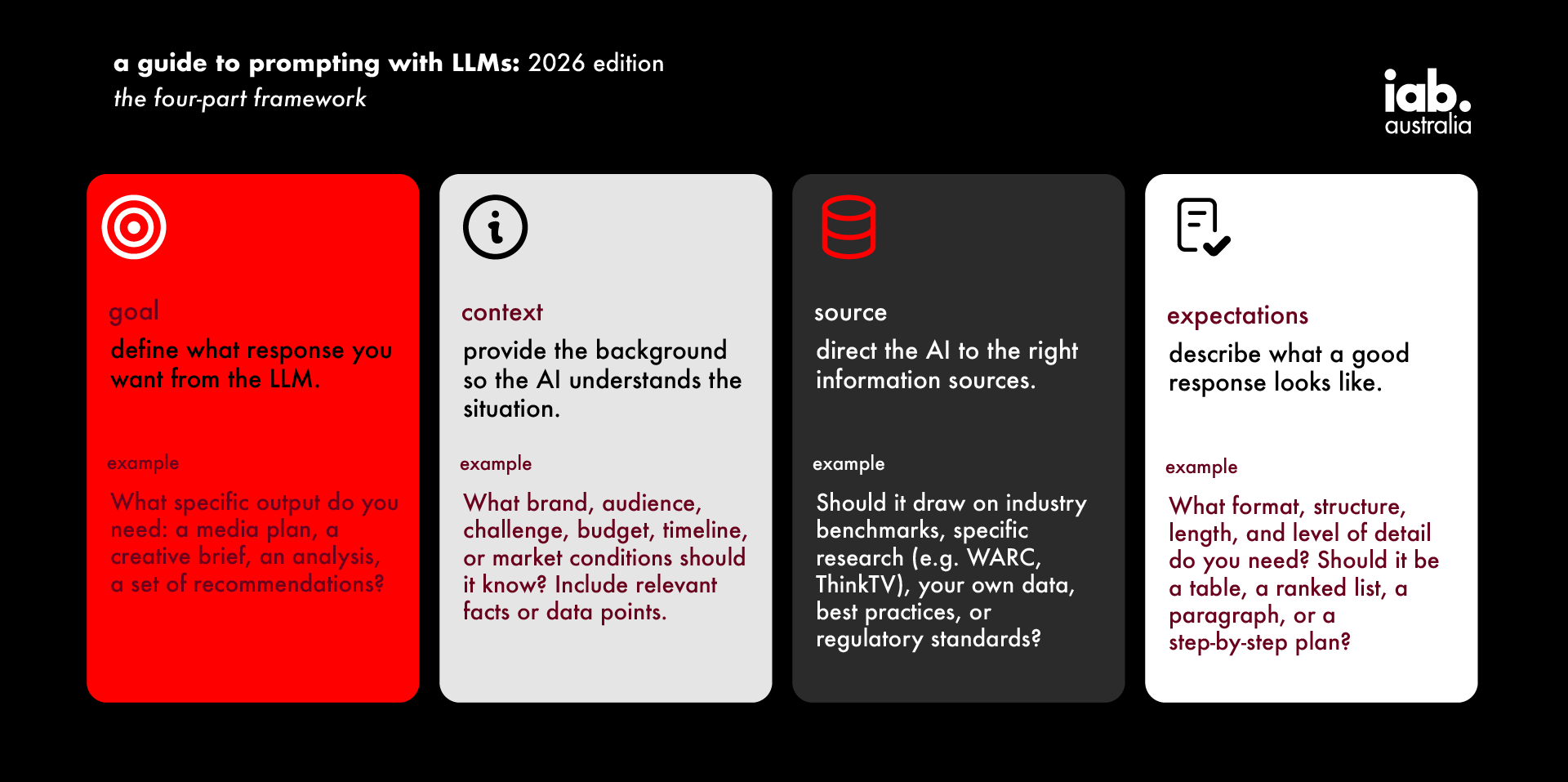
Each edition includes practical examples that can be adapted for common workflows, including media strategy, audience segmentation, campaign analysis, sponsorship proposals, RFP responses, creative concepting, technical documentation and privacy-safe data architecture.
According to Jonas Jaanimagi, Tech Lead at IAB Australia, in 2026 digital advertising is moving from a world of manual AI experimentation to one of enterprise-scale orchestration.
“This LLM Prompting Framework and dedicated guides are designed to be the connective tissue between strategic human intent and autonomous machine execution. It is no longer enough to simply write better prompts; businesses must now manage entire agentic workflows within rigorous, industry-standard guardrails for privacy, brand safety, and transparency.
“The IAB Australia AI Working Group is very keen to ensure that as AI tools become more deeply embedded in media planning, inventory discovery and technical infrastructure they remain interoperable and fully compliant with both the requirements of sophisticated marketers and also the ever-evolving regulatory landscape here in Australia,” said Jannimagi.
Mark Titley, Senior Commercial Data Strategist, Paramount and AI Working Group member commented: “Developing practical AI prompting guidance for the Australian advertising industry required genuine cross-functional collaboration. The collective expertise from Laurence Demousselle, June Cheung, Adam Goodman, and Simon Thomas, spanning agency strategy, agentic solutions, enterprise platforms, and creative production, was vital in ensuring this guidance is both technically rigorous and commercially practical for Australian publishers, agencies, creatives, adtech vendors, and brands.
“It was a privilege to work with such a diverse group of experts to help our industry move from AI curiosity to confident, everyday use and we look forward to evolving them as AI capabilities and our industry continue to advance,” said Titley.
IAB Australia’s AI Working Group is made up of members from Adobe, Bench Media, Criteo, Elastic Group, Google, Half Dome, Integral Ad Science, Mars, Microsoft, MiQ, Mirakl, News Corp Australia, OMD, Paramount, Prophet, Reddit, Scope3, Seven Network, Spark Foundry, Strikesocial, Suncorp, WPP Media, Yahoo, Youi, Zenith Media.
The five LLM Prompting Framework editions are:
The General LLM Prompting Edition offers foundational prompting techniques for all roles. It covers effective prompting when working with briefs, images, documents and data, outlining essential and advanced techniques with real-world marketing examples.
The Buy Side Edition is designed for brand marketers, media agencies and planning teams. It focuses on Media Mix Modelling and audience segmentation, including prompts for developing media strategies, building channel plans, writing briefs, analysing campaign performance, defining audiences and justifying investment to stakeholders.
The Sell Side Edition is designed for publishers, broadcasters and sales houses. It focuses on yield optimisation and contextual signals, including prompts for building sponsorship proposals, translating audience data into advertiser-ready insights, positioning against competitors, developing new ad products and responding to RFPs.
The Creative Edition is designed for creative directors, copywriters, art directors, designers, social content creators and creative agencies. It focuses on brand voice and visual metaphors, including prompts for developing campaign concepts, writing copy across platforms, adapting creative for different channels and formats, building content strategies and refining work through iteration.
The AdTech Edition is tailored to engineers, product managers, data scientists, solutions architects and commercial teams building the platforms, tools and infrastructure that power digital advertising. It focuses on system interoperability and schema mappings, including prompts to support privacy-safe data architecture, technical documentation, product specifications, compliance frameworks, go-to-market strategies and communication of complex concepts to non-technical stakeholders.
/ Ends