Created by the IAB Australia AI Working Group
Vendor-agnostic guidance for brand marketers, media agencies, publishers, creative agencies, and adtech stakeholders
Introduction
Generative AI is reshaping the advertising industry. Marketers conduct competitor research and map market positioning; planners brainstorm media plans and automate workflows; analysts summarise performance data; creatives draft social captions and storyboards; publishers match audiences with content. However, getting the most out of Large Language Models (LLMs) requires understanding how to prompt effectively. Poorly phrased questions yield generic answers; well-structured prompts guide the model toward actionable, marketing-specific insights.
This guide provides an educational, non-technical overview of best prompting practices. It presents a framework for structuring requests, outlines essential and advanced techniques, and illustrates each with real-world marketing examples. It is purposely vendor-agnostic.
Once you have read through this general guidance, there are four further editions that we recommend you working through – each dedicated to, and designed specifically for, those working in sell-side, buy-side, AdTech and Creative roles within our industry. Links to these editions can be found at the bottom of this guidance, but we do recommend that you work through this general guidance before reviewing these dedicated editions.
Prompting is a skill – the more you practise, the better you’ll get at guiding the model.
Section 1
A Four-Part Framework
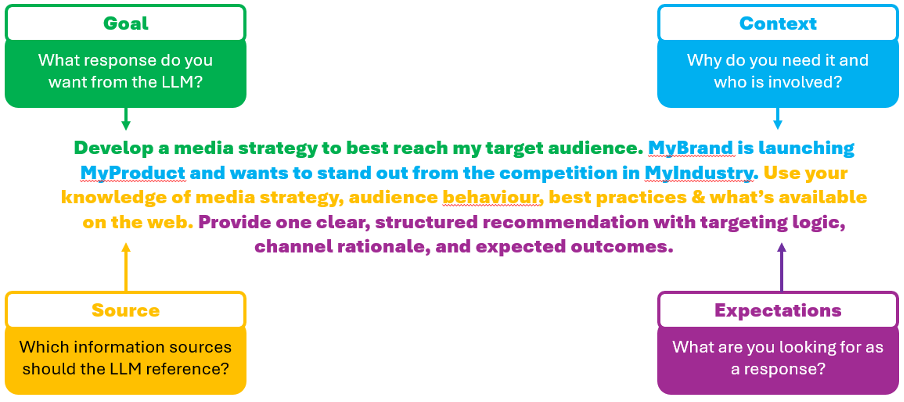
There are many prompting frameworks available today and most share the same core principles. Try a few and choose the one that fits you best. Before crafting a prompt, think about four components. This simple checklist helps you structure the request so the AI can respond appropriately.
| Step | Purpose | Example Considerations |
|---|---|---|
| Goal | Define what response you want from the LLM. | What specific output do you need: a media plan, a creative brief, an analysis, a set of recommendations? |
| Context | Provide the background so the AI understands the situation. | What brand, audience, challenge, budget, timeline, or market conditions should it know? Include relevant facts or data points. |
| Source | Direct the AI to the right information sources. | Should it draw on industry benchmarks, specific research (e.g. WARC, ThinkTV), your own data, best practices, or regulatory standards? |
| Expectations | Describe what a good response looks like. | What format, structure, length, and level of detail do you need? Should it be a table, a ranked list, a paragraph, or a step-by-step plan? |
Other popular frameworks for reference:
- ChatGPT GRACE: Goal → Role → Assets → Constraints → Expectation
- Google: Persona + Task + Context + Format
- Anthropic: Role → Context → Instructions → Constraints → Revision
- Perplexity: Question → Context → Action → Format
Section 2
Must-Have Prompt Techniques
The following techniques are essential for reliable AI outputs. Each tip includes a marketing-related example showing how clarity and context change the result.
Be Clear and Specific About the Goal
A clear task description and desired output will cut down unnecessary back-and-forth.
✕ Bad prompt
“Create a media plan for our new product.”
✓ Good prompt
“Act as a media strategist. Draft a channel role map for Brand X launching in Australia. Objective: increase awareness among parents of children aged 5–12. Budget: A$1.5M. Outline each channel’s role, primary KPI, flighting schedule, test ideas and risks.”
Provide Context and Data
LLMs perform better when given relevant background information. Include why you’re doing the task and any important facts. When the task involves numbers, include the data you want analysed.
✕ Bad prompt
“Explain why platform ROAS doesn’t match sales.”
✓ Good prompt
“As a measurement specialist, reconcile our platform ROAS with actual sales for the Q3 campaign. Platform metrics: impressions = 5M, conversions = 35k, reported ROAS = 3.5. Sales data: revenue = A$1.2M, spend = A$400K. Explain why platform metrics overstate performance, suggest triangulation methods (e.g. MMM), and provide a short recommendation.”
Assign a Role
Telling the AI to adopt a persona helps guide its style and depth of expertise. In marketing, that role could be “product manager”, “data strategist”, “programmatic buyer”, or “creative director”.
✕ Bad prompt
“Create an audience for my campaign.”
✓ Good prompt
“You are a data strategist for an FMCG brand. Define a target audience for our loyalty programme using IP-address data and second-party segments from retail partners. Describe the audience composition, privacy compliance considerations, and the best way to activate this audience in an adtech stack.”
Specify Format and Constraints
Formatting instructions make outputs easier to use. Specify tone, length, and structure. You can ask for a specific word count, number of bullet points, a table with named columns, or JSON output.
✕ Bad prompt
“Plan my social posts.”
✓ Good prompt
“Act as a creative director. Generate a monthly content calendar for Brand Y across Instagram, YouTube, and TikTok. Include three themes (product education, UGC, offers) and a hero–hub–help cadence. Present as a table with columns for week, theme, platform, format, and one-line objective.”
Double-Check Facts and Respect Limitations
Large language models can occasionally generate convincing but inaccurate information. To reduce the risk:
- Check credibility. Ask the model to cite its sources, then verify those references against reliable data.
- Protect confidentiality. Don’t include proprietary or sensitive material unless you have explicit approval.
- Stay concise. Overly long prompts may be cut off or misinterpreted; focus on clarity over length.
- Iterate deliberately. Begin with a focused prompt, review the response, and refine step by step.
Section 3
Advanced Prompting Techniques
Once you’ve mastered the fundamentals, these advanced techniques can significantly improve the quality, accuracy, and consistency of LLM outputs. They are especially useful for complex, multi-step tasks common in advertising and marketing.
Chain-of-Thought (CoT) Prompting
Chain-of-Thought prompting encourages the model to break a complex problem into intermediate reasoning steps before arriving at a final answer. This is particularly powerful for analysis, budget allocation, attribution modelling, or strategic recommendations where the reasoning matters as much as the answer.
How to use it: The simplest approach (Zero-Shot CoT) is to add “Let’s think through this step by step” to your prompt. For more complex tasks, provide an example of the reasoning steps you expect (Few-Shot CoT).
Zero-Shot CoT Example
“Our Q4 BVOD campaign achieved 12M impressions, 45k completed views, and 2,800 site visits. Our target was a 0.5% CTR and 15% VCR. Analyse the campaign performance step by step: first calculate the actual CTR and VCR, then compare against benchmarks, identify what’s working and what isn’t, and finally recommend three specific optimisations for Q1.”
Few-Shot CoT Example
“Here’s how I want you to evaluate a media channel: Step 1: State the channel and its role in the funnel. Step 2: List the KPIs we’re measuring. Step 3: Compare actual vs target. Step 4: Diagnose the gap. Step 5: Recommend an action. Now apply this framework to evaluate our programmatic display, social video, and connected TV channels using the data below…”
When to use CoT: Any task requiring multi-step reasoning — budget allocation, attribution analysis, competitive benchmarking, campaign post-mortems, or strategic planning.
Few-Shot Prompting
Few-Shot prompting involves providing the model with a small number of examples (typically two to five) of the input-output pattern you expect. This is invaluable when you need consistent formatting, tone, or analytical structure across multiple outputs.
Example
“I need you to write channel summaries in a specific format. Here are two examples:
Channel: BVOD | Role: Upper-funnel awareness driver | Key metric: VCR | Recommendation: Increase frequency cap from 3 to 5 for high-performing creatives
Channel: Programmatic Display | Role: Mid-funnel consideration | Key metric: CTR | Recommendation: Shift 20% of budget to contextual targeting
Now write the same format for: Paid Social, Connected TV, and Digital Audio using the campaign data below…”
When to use Few-Shot: When you need consistent output format across repeated tasks — client reports, audience personas, creative briefs, or competitive analyses.
Zero-Shot vs Few-Shot: When to Use Which
| Approach | What it means | Best for |
|---|---|---|
| Zero-Shot | No examples given. Describe the task and let the model figure out the format. | Simple, well-defined tasks. Quick questions. Exploring without a template. |
| Few-Shot (2–5 examples) | Provide examples of the input–output pattern you expect. | Consistent formatting. Repeated tasks. Training on your brand voice or reporting style. |
| Zero-Shot CoT | No examples, but ask the model to reason step by step. | Complex analytical tasks. When you need to see the model’s working. |
| Few-Shot CoT | Provide examples that include reasoning steps, not just the answer. | The most demanding tasks. When both process and format need to be precise. |
Self-Consistency Sampling
Self-consistency involves asking the model to generate multiple answers to the same question, then selecting the most common or consistent result. Useful for tasks with multiple valid approaches (such as audience segmentation or budget splits).
Example
“Generate three independent media budget allocations for a $2M awareness campaign targeting 25–44 year-olds across BVOD, social, digital audio, and OOH. For each version, explain your reasoning. Then compare the three and highlight where they agree and where they diverge.”
Step-Back Prompting
Step-Back prompting asks the model to first consider the broader principles or context before diving into the specific question. This helps avoid narrow thinking and produces more strategically grounded answers.
Example
“Before recommending channels for our summer campaign, first outline the key principles of effective reach-building for a new FMCG product in Australia. What does the research say about optimal channel mix for awareness? Then, using those principles, recommend a channel plan for our $1.5M budget.”
Tree-of-Thought Prompting
Tree-of-Thought takes Chain-of-Thought further by exploring multiple reasoning paths simultaneously. The model considers several possible approaches, evaluates each, and selects the most promising — excellent for strategic decisions with genuinely different viable approaches.
Example
“We need a measurement strategy for a cross-platform campaign. Consider three approaches: (1) a pure first-party data approach using our CDP, (2) a panel-based approach using third-party research, and (3) a hybrid model combining both. For each, outline the methodology, data requirements, limitations, and estimated cost. Then recommend the best approach.”
Structured Prompting
Structured prompting uses clear labels, delimiters, or markup (XML-style tags, markdown headers, or bracketed sections) to separate different parts of a prompt. In advertising workflows, you’re often combining briefing documents, performance data, brand guidelines, and instructions — without clear structure the model may confuse your instructions with data, or miss constraints entirely.
Example
ROLE: You are a senior media strategist.
CONTEXT: We are planning a H2 campaign for a premium automotive brand targeting high-income professionals 35–54 in metro Australia.
DATA:
– Budget: $3.2M | Channels: BVOD, premium digital, CTV, digital audio, OOH
– Previous campaign: 68% reach at 4.2 average frequency
CONSTRAINTS:
– Brand-safe environments only | Minimum 60% video investment | 10% test-and-learn allocation
TASK: Recommend a channel allocation with rationale, expected reach, and a measurement framework. Present as a table.
When to use Structured Prompting: Any prompt combining instructions with data, context documents, or multiple constraints.
Multimodal Prompting
Most major LLMs now accept images, PDFs, spreadsheets, and other files alongside your text prompt. Key use cases for advertising:
- Upload a competitor’s ad creative and ask for a strategic analysis of their messaging and target audience.
- Attach a campaign performance export (CSV or Excel) and ask the model to identify trends, anomalies, and optimisation opportunities.
- Share brand guidelines (PDF) so the model understands tone, visual identity, and messaging pillars before writing copy.
- Upload a storyboard or mock-up and ask for feedback on alignment with the creative brief.
- Provide a media plan spreadsheet and ask the model to sense-check budget allocation against industry benchmarks.
Example
[Attach: Q4_campaign_results.xlsx]
This spreadsheet contains weekly performance data for our Q4 BVOD campaign across three creative variants. Analyse the data: which creative performed best by completion rate? Was there a point where performance declined, and if so, what might explain it? Recommend whether we should refresh creative for Q1 or continue with the top performer.
Tip: Always include a text prompt that tells the model what the file contains and what you want it to do with it.
Section 4
Nice-to-Have Techniques
These approaches aren’t mandatory, but they can elevate the quality, relevance, and consistency of AI-generated work.
Treat the AI as a Collaborator
Use an iterative, multi-turn process. Start with a base prompt, review the response, then refine it — adjusting tone, adding missing details, or asking for new angles.
Example: “Good start — now make it more concise and include three alternative taglines.”
Define Rules and Guardrails
If there are words, topics, or claims the output should avoid, make that clear early. Setting these boundaries helps maintain brand safety and alignment.
Example: “Draft a social caption for our energy drink launch. Avoid any references to alcohol, nightlife, or extreme sports. Keep the tone confident but inclusive.”
Provide Examples or Inspiration
Show the AI what “good” looks like. Share snippets of past campaigns, preferred tone of voice, or sample copy to steer output toward your desired style.
Example: “Here’s an example of the tone we use: ‘Smarter energy, designed for everyday athletes.’ Now write three alternative headlines for our new flavour launch using the same voice.”
Let the AI Interview You
Encourage the model to ask clarifying questions before it answers. This helps it fill information gaps and tailor the response more precisely.
Example: “Before suggesting audience segments or messaging, ask me up to three questions to clarify who my target customers are. Once you have my answers, propose tailored audience personas with key insights.”
Use Reusable Variables
Write flexible prompts using placeholders like {brand}, {audience}, or {budget}. This lets you repurpose and scale prompts across different clients or campaigns without rewriting them each time.
Template: “Write a {length}-word product description for {brand}, targeting {audience}. Highlight how {product feature} helps solve {customer problem}.”
Build Your Own Prompt Library
Save versions that consistently deliver strong results. A curated set of tested prompts becomes a powerful reference for future projects and training new team members. Store prompts in the AI platform, a pinned chat, or a shared spreadsheet with columns for category, prompt, and use case.
Section 5
Putting It All Together
Start with the Four-Part Framework for every prompt, layer in the must-have techniques as needed, and reach for the advanced techniques when the task demands deeper reasoning or consistency.
| Layer | Techniques | When to Use |
|---|---|---|
| Foundation (every prompt) | Four-Part Framework: Goal, Context, Source, Expectations | Always. This is your starting point for every interaction. |
| Essential techniques | Be specific, provide context/data, assign a role, specify format, fact-check | Every prompt should incorporate at least two or three of these. |
| Advanced techniques | Chain-of-Thought, Few-Shot, Self-Consistency, Step-Back, Tree-of-Thought, Structured Prompting, Multimodal Prompting | Complex analysis, multi-step reasoning, consistent output across repeated tasks, prompts combining data with instructions. |
| Workflow techniques | Iterate, set guardrails, provide examples, let AI interview you, use variables, build a library | Ongoing practice. These improve over time as you build experience. |
Conclusion
We’ve covered the best practices of effective prompting — starting with a simple checklist (Goal, Context, Source, Expectations), followed by essential and advanced techniques such as Chain-of-Thought reasoning, Few-Shot pattern-setting, Structured Prompting for complex briefs, and Multimodal Prompting for working with images, documents, and data. Always fact-check outputs.
Prompting is a skill – the more you practise, the better the outcome.
Take the next step: Commit 10 minutes a day to crafting and refining prompts. Try one new technique each week for a month. Regular practice will demystify AI interactions and help you build a prompting habit that delivers tangible results.
Useful Links
- Anthropic — Prompt Engineering
- Anthropic — Building Effective Agents
- Microsoft Learn — Prompting
- Prompt Engineering Guide
- Prompt Buddy (Microsoft Teams)
Explore the full guide
Edition Guides by Role
For publishers and broadcasters
Sell Side Edition
Sponsorship Proposals, audience insights, RFP responses, and yield optimisation prompts.
Read edition →
For brand marketers & agencies
Buy Side Edition
Media strategy, audience planning, campaign analysis, and investment justification prompts.
Read edition →
For creative & content teams
Creative Edition
Campaign concepting, copy adaptation, content calendars, and script writing prompts.
Read edition →
For engineers, product & data
AdTech Edition
System architecture, privacy compliance, product specs, and go-to-market strategy prompts.
Read edition →