AdTech Edition — For engineers, product managers, data scientists & commercial teams
A companion to ‘A Guide to Prompting with LLMs: 2026 Edition’
Introduction
This guide is designed specifically for the advertising technology sector — the engineers, product managers, data scientists, solutions architects, and commercial teams building the platforms, tools, and infrastructure that power digital advertising. It builds on the A Guide to Prompting with LLMs: 2026 Edition, which covers the core framework and foundational techniques. If you haven’t read that guide yet, we recommend starting there.
What follows is tailored to your world: designing privacy-safe data architectures, writing technical documentation, building product specifications, navigating compliance frameworks, creating go-to-market strategies for technical products, and communicating complex concepts to non-technical stakeholders. Each section includes worked example prompts you can adapt and use immediately.
This guide assumes familiarity with the Goal / Context / Source / Expectations framework from the general guide. Every example prompt in this document follows that structure.
A note on AI in adtech: The adtech sector is unique in that many readers of this guide are themselves building AI-powered products. This guide is not about building AI systems — it’s about using LLMs as a thinking and productivity tool for the people who work in adtech. The prompts here help you design, document, communicate, and strategise more effectively, regardless of what your company’s products do.
Why Prompting Matters for AdTech
The adtech sector operates at the intersection of engineering complexity, regulatory pressure, and commercial urgency. Privacy legislation is evolving rapidly — the Australian Privacy Act reforms, IAB Tech Lab standards, and the shift to cookieless environments are all creating new requirements that demand both technical depth and clear communication. At the same time, adtech companies need to sell complex products to buyers who think in business outcomes, not data architectures.
This is where AI prompting becomes a genuine force multiplier. It’s not about replacing the deep technical knowledge your teams have — it’s about accelerating the work that surrounds that knowledge. A well-prompted LLM can help an engineer draft a system design document in a fraction of the time, help a product manager translate a technical capability into a client-facing value proposition, or help a compliance team map a new privacy regulation to existing data flows.
Where prompting creates the most value in adtech:
- Technical documentation: Producing architecture overviews, API documentation, integration guides, and system design documents faster and more consistently.
- Privacy and compliance: Mapping regulatory requirements to technical implementations, drafting compliance assessments, and keeping documentation current as regulations evolve.
- Product strategy: Translating technical capabilities into market positioning, competitive differentiation, and go-to-market narratives.
- Client communication: Turning complex technical concepts into clear explanations for agencies, publishers, and brands who need to understand what your product does without knowing how it works.
- Problem-solving: Using step-by-step reasoning to work through complex system design challenges, data flow questions, and integration trade-offs.
The adtech teams that build strong prompting habits today will ship documentation faster, communicate more clearly, and navigate the privacy landscape more confidently.
The Prompt Ingredients Framework: AdTech Edition
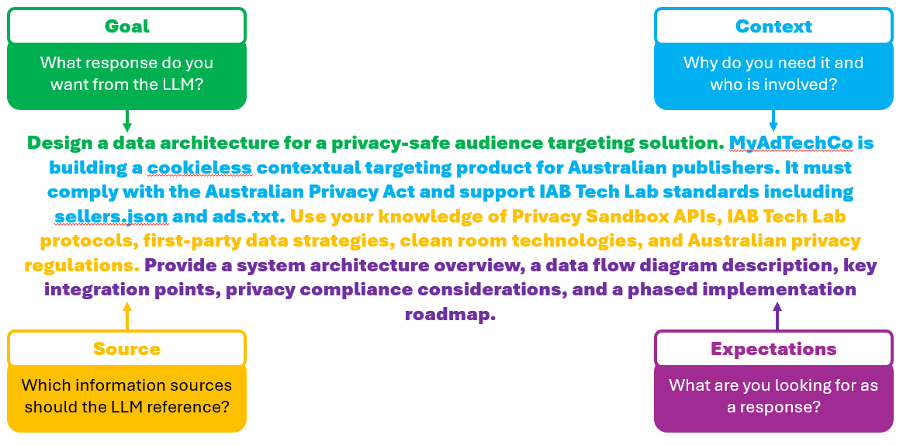
The general guide introduces a four-part framework for structuring every prompt: Goal, Context, Source, and Expectations. Here’s how that framework applies specifically to adtech workflows.
| Ingredient | General Question | AdTech Translation |
|---|---|---|
| Goal | What response do you want from the LLM? | What technical output do you need? A system architecture overview? A privacy compliance assessment? A product spec? An integration guide? A go-to-market positioning document? |
| Context | Why do you need it and who is involved? | What platform or system is involved? What is the technical environment? Who is the audience for this document — engineers, product managers, clients, regulators? What constraints exist (privacy, latency, scale)? |
| Source | Which information sources should the LLM reference? | Should it draw on Privacy Sandbox APIs, IAB Tech Lab protocols (OpenRTB, sellers.json, ads.txt), first-party data strategies, clean room technologies, Australian privacy regulations, or specific industry standards? |
| Expectations | What are you looking for as a response? | Should it deliver a system architecture overview with data flow descriptions? A compliance checklist? A phased implementation roadmap? Specify the technical depth, format, and whether the audience is technical or non-technical. |
Putting it together — an adtech example:
High-Impact Use Cases for AdTech
The following use cases represent the areas where AI prompting can deliver the most immediate value for adtech teams. Each includes a realistic scenario, a worked example prompt, and a description of what a strong output looks like.
System Architecture & Technical Design
Your engineering team is designing a new identity resolution service that works across multiple publisher environments without relying on third-party cookies. You need to produce a technical design document that captures the architecture, data flows, and integration requirements clearly enough for the engineering team to build from and for stakeholders to review.
Paste this example prompt directly into your LLM
GOAL: Produce a technical design document for a cross-publisher identity resolution service.
CONTEXT: MyAdTechCo is building a deterministic + probabilistic identity graph that resolves users across five major Australian publisher groups without third-party cookies. Inputs include hashed email (SHA-256), first-party publisher IDs, and contextual signals. The system must handle 50M+ match requests per day with sub-100ms latency. It will integrate with publisher CDPs via server-to-server API and expose a real-time lookup endpoint for DSP bid enrichment.
SOURCE: Draw on IAB Tech Lab’s Unified ID frameworks, privacy-preserving identity resolution approaches (clean rooms, differential privacy), Australian Privacy Act requirements for data matching, and distributed systems best practices for low-latency identity services.
EXPECTATIONS: Structure the document as: (1) Executive Summary (150 words, non-technical), (2) System Architecture Overview with component descriptions, (3) Data Flow — step-by-step description of a match request from publisher signal to resolved ID, (4) Privacy Architecture — how the system protects user data at each stage, (5) Integration Requirements for publishers and DSPs, (6) Scalability Considerations, and (7) Phased Implementation Roadmap (MVP, V1, V2). Approximately 1,500 words. Technical audience.
✓ What good looks like
The best outputs demonstrate genuine understanding of the trade-offs involved — for example, the tension between match rate and privacy, or between latency and graph completeness. Strong technical design documents separate the ‘what’ (architecture) from the ‘how’ (implementation detail) at the right level of abstraction. Watch for the model being vague on privacy architecture — this is where you’ll need to add your specific approach.
Privacy & Compliance Documentation
The Australian Privacy Act reforms are introducing new requirements for how adtech companies handle personal information. Your compliance team needs to map the new requirements to your existing data practices and produce an assessment that identifies gaps and recommends changes.
Paste this example prompt directly into your LLM
GOAL: Produce a privacy compliance gap analysis for our adtech platform against the Australian Privacy Act reforms.
CONTEXT: MyAdTechCo operates a programmatic SSP that processes bid requests containing device IDs, IP addresses (truncated), contextual page data, and publisher first-party segments. We serve Australian publishers and connect to global DSPs. Our current consent framework relies on IAB’s Transparency and Consent Framework (TCF) and we implement sellers.json and ads.txt. We need to assess our compliance against the proposed Australian Privacy Act reforms, particularly around: (a) the expanded definition of personal information, (b) requirements for targeting and profiling, (c) consent and transparency obligations, and (d) cross-border data transfer provisions.
SOURCE: Draw on the proposed Australian Privacy Act reform provisions, IAB Tech Lab’s Global Privacy Platform (GPP), the IAB AI Transparency and Disclosure Framework, existing TCF implementation standards, and privacy-preserving adtech architectures.
EXPECTATIONS: Structure as: (1) Executive Summary of key findings, (2) a compliance matrix table with columns for: regulatory requirement, our current practice, gap assessment (compliant / partial / gap), and recommended action, (3) a priority ranking of gaps by risk level (high / medium / low), and (4) a recommended remediation roadmap. Approximately 1,200 words. The audience is a mix of legal, product, and engineering — keep it clear but technically accurate.
✓ What good looks like
This is a natural fit for Chain-of-Thought prompting — ask the model to work through each regulatory requirement methodically. The best outputs clearly distinguish between requirements that are settled law, provisions that are proposed but not yet enacted, and areas of regulatory ambiguity. The compliance matrix table is where the real value is — it gives the team a structured view of their exposure. Always verify specific regulatory claims against primary sources.
Product Specifications & Roadmaps
Your product team is developing a new contextual targeting product that uses AI-powered content classification. You need a product requirements document (PRD) that captures the market opportunity, technical requirements, and go-to-market considerations in a single document that engineering, sales, and leadership can all use.
Paste this example prompt directly into your LLM
GOAL: Draft a product requirements document for a new AI-powered contextual targeting product.
CONTEXT: MyAdTechCo is building ‘ContextIQ’ — a contextual targeting solution that uses NLP to classify publisher page content into advertiser-friendly segments in real-time. It’s designed as a cookieless alternative to behavioural targeting. The product will integrate into our existing SSP via a pre-bid enrichment layer. Target customers are mid-to-large Australian publishers who want to increase programmatic yield without relying on third-party data. Early testing with two publisher partners shows a 22% increase in CPM for contextually enriched inventory versus standard run-of-site.
SOURCE: Draw on IAB Tech Lab content taxonomy standards, contextual targeting industry benchmarks, Australian programmatic market data, and best practices for adtech product development.
EXPECTATIONS: Structure the PRD as: (1) Problem Statement, (2) Market Opportunity, (3) Product Overview, (4) Technical Requirements, (5) Success Metrics, (6) Target Customer Profile, (7) Competitive Landscape, and (8) Phased Roadmap (MVP, V1, V2) with estimated timelines. Approximately 1,500 words. Mixed audience: product, engineering, and commercial.
✓ What good looks like
Strong PRDs balance market storytelling with technical precision. The best outputs articulate the ‘why’ compellingly enough for leadership while being specific enough on technical requirements for engineering to begin scoping. Watch for the model being too generic on competitive landscape — you’ll likely need to add your own knowledge of specific Australian competitors.
Client-Facing Technical Communication
Your sales engineering team needs to explain your clean room solution to a major agency group. The agency’s trading team is technically literate but not engineers — they need to understand what the product does, how it protects data, and why it’s better than alternatives, without getting lost in implementation details.
Paste this example prompt directly into your LLM
GOAL: Create a client-facing explainer document for our clean room data collaboration product.
CONTEXT: MyAdTechCo offers a clean room solution called ‘DataBridge’ that enables advertisers and publishers to match first-party audiences for targeting and measurement without either party seeing the other’s raw data. The product uses differential privacy and secure multi-party computation. It integrates with major DSPs and publisher CDPs. The audience for this document is an agency trading team evaluating clean room partners — they understand programmatic buying and audience data but are not engineers.
SOURCE: Draw on clean room technology best practices, IAB Tech Lab’s data collaboration standards, privacy-enhancing technologies (PETs) in advertising, and the Australian privacy landscape.
EXPECTATIONS: Structure as: (1) The Problem — why traditional data sharing no longer works (100 words), (2) How DataBridge Works — a non-technical explanation using a clear analogy, (3) a simple 4-step process description of a typical use case, (4) Privacy and Compliance — how data is protected at each step, (5) What Makes DataBridge Different — three key differentiators versus competitors, and (6) Getting Started — integration requirements and timeline. Approximately 800 words. Clear, confident, and jargon-free where possible — if a technical term is necessary, define it inline.
✓ What good looks like
The critical test is whether a non-engineer can read this and explain the product back to a colleague. The best outputs use a strong analogy to make the core concept click (‘imagine a room where two people can compare notes without showing each other their notebooks’) and then build from there. Technical precision matters — but accessibility matters more for this audience.
Integration Guides & API Documentation
You’ve built a new measurement API and need to produce integration documentation that publisher partners can follow to implement it. The documentation needs to be clear enough for a mid-level developer to implement without hand-holding, while also explaining the business context of what the API does.
Paste this example prompt directly into your LLM
GOAL: Draft an integration guide for our new attention measurement API.
CONTEXT: MyAdTechCo has built an API called ‘AttentionPulse’ that measures real-time attention signals on ad placements (viewability, dwell time, scroll depth, and interaction events). Publishers integrate via a lightweight JavaScript tag and a server-side event endpoint. The API returns an attention score (0–100) per impression that can be passed to DSPs in bid enrichment. Authentication is via API key. Rate limit: 10,000 requests/second. Response time SLA: <50ms at p95.
SOURCE: Draw on API documentation best practices, IAB Tech Lab’s Open Measurement SDK (OM SDK) standards, RESTful API design principles, and attention measurement methodology.
EXPECTATIONS: Structure the guide as: (1) Overview — what AttentionPulse does and why publishers should integrate it (200 words, non-technical), (2) Prerequisites, (3) Quick Start — a step-by-step integration path in 5 steps or fewer, (4) Authentication, (5) Client-Side Integration — tag implementation with a pseudocode example, (6) Server-Side Integration — event endpoint with request/response format examples, (7) Attention Score Specification, and (8) Troubleshooting — common integration issues and solutions. Approximately 1,200 words. Technical audience (developers) but include the business context at the start.
✓ What good looks like
The best API documentation balances completeness with clarity. Strong outputs include pseudocode examples that are realistic enough to be useful (not just ‘GET /api/score’), clearly define error responses, and anticipate common integration mistakes. The business context section at the start is what distinguishes great integration docs from purely functional ones — it helps the developer understand the ‘why’ behind the implementation.
Go-to-Market Strategy & Competitive Positioning
Your company is launching a new supply-path optimisation (SPO) product into the Australian market. The product team has built it, but the commercial team needs a go-to-market strategy that positions the product clearly against established competitors and articulates the value proposition for both publishers and agencies.
Paste this example prompt directly into your LLM
GOAL: Develop a go-to-market strategy for our new supply-path optimisation product in the Australian market.
CONTEXT: MyAdTechCo is launching ‘DirectPath’ — an SPO product that helps DSPs and agencies identify the most efficient and transparent paths to publisher inventory. Key features: real-time supply chain audit, automatic duplicate bid deduplication, carbon emissions per supply path, and transparent fee breakdowns. The Australian market has 3–4 established SPO solutions but none emphasise sustainability metrics. Our target buyers are agency trading desks and in-house brand programmatic teams.
SOURCE: Draw on the Australian programmatic market landscape, supply-path optimisation trends globally (particularly the UK and US), sustainability in adtech (Ad Net Zero, Scope3), IAB Tech Lab supply chain transparency standards (sellers.json, SupplyChain object), and competitive positioning frameworks.
EXPECTATIONS: Structure as: (1) Market Opportunity, (2) Competitive Landscape — a comparison table of DirectPath versus 3 key competitors across features, pricing model, and differentiation, (3) Value Proposition — separate value propositions for agencies and publishers (100 words each), (4) Target Customer Profiles, (5) Messaging Framework — headline, three supporting proof points, and an objection handler for ‘why switch from our current SPO tool,’ and (6) Launch Plan — phased approach for first 90 days. Approximately 1,200 words. Commercial audience.
✓ What good looks like
The strongest go-to-market outputs identify a genuine point of differentiation and build the entire strategy around it — in this case, the sustainability angle. The competitive comparison table needs to be fair and verifiable (flag where the model is inferring competitor capabilities). The separate value propositions for agencies and publishers show understanding that the same product needs different stories for different buyers.
Advanced Techniques & Recommended Practices for AdTech
The general guide covers advanced prompting techniques in detail. Here’s how to apply the most relevant ones specifically to adtech workflows.
Chain-of-Thought for System Design & Compliance
Adtech work frequently involves multi-step reasoning — tracing data flows through complex systems, evaluating privacy implications at each stage, or working through integration trade-offs. Always ask the model to reason step by step for these tasks. This produces transparent, auditable reasoning that your engineering and compliance teams can review and challenge.
Trigger phrase: “Walk through this step by step…” or “Trace the data flow from ingestion to output, evaluating the privacy implications at each stage…”
Best for: System design decisions, privacy impact assessments, data flow mapping, latency/throughput trade-off analysis, compliance gap assessments.
Few-Shot for Consistent Technical Documentation
Adtech companies produce large volumes of technical documentation — API docs, integration guides, product briefs, architecture decision records. Use Few-Shot prompting to lock in your company’s documentation style. Provide two or three examples of your best existing docs and ask the model to follow the same structure, depth, and conventions for new products or features.
Example: “Here are two examples of how we write integration guides at MyAdTechCo: [Example 1] [Example 2]. Now write an integration guide for our new frequency capping API following the same structure, format, and level of technical detail.”
Best for: API documentation, integration guides, architecture decision records, product release notes — any technical document produced repeatedly.
Structured Prompting for Complex Technical Briefs
Adtech prompts often combine multiple technical inputs: system specifications, regulatory requirements, performance constraints, and business objectives. Using clear labels is essential to prevent the model from confusing requirements with constraints, or treating specifications as suggestions.
Tip: “For system design prompts, separate: FUNCTIONAL REQUIREMENTS, NON-FUNCTIONAL REQUIREMENTS (latency, scale, uptime), PRIVACY CONSTRAINTS, INTEGRATION REQUIREMENTS, and BUSINESS CONTEXT. For compliance prompts, separate: REGULATION, OUR CURRENT IMPLEMENTATION, and WHAT I NEED.”
Multimodal Prompting for AdTech
File uploads are particularly powerful for adtech teams working with dense technical documents and specifications:
- Upload an IAB Tech Lab specification (PDF) and ask the model to summarise the key implementation requirements relevant to your product.
- Attach a system architecture diagram (image) and ask for a written description of the data flows for documentation purposes.
- Upload a competitor’s technical whitepaper and ask for a comparative analysis against your own approach.
- Share a log file or error output and ask the model to diagnose the issue and suggest a fix.
Adtech documentation is often dense. Uploading the source document and asking specific questions about it consistently produces better results than trying to summarise the document in your prompt.
Build an AdTech Prompt Library
Technical teams benefit enormously from shared prompt libraries. Save the prompts that produce strong technical documentation and refine them as your products evolve. This is especially valuable for onboarding new engineers and product managers who need to produce documentation quickly.
Suggested categories for an adtech prompt library:
| Category | Example Prompts to Save |
|---|---|
| System Architecture | Technical design document, Architecture decision record, Data flow description, Scalability assessment |
| Privacy & Compliance | Privacy impact assessment, Compliance gap analysis, Consent flow mapping, Cross-border data transfer review |
| Product & Roadmap | Product requirements document, Feature specification, Competitive positioning, Market opportunity analysis |
| Client Communication | Product explainer (non-technical), Clean room overview, Integration value proposition, FAQ for agencies |
| API & Integration | API integration guide, SDK documentation, Quick start guide, Troubleshooting guide |
| Go-to-Market | GTM strategy, Messaging framework, Objection handlers, Sales enablement one-pager |
Getting Started
You don’t need to overhaul your workflow to start seeing value from AI prompting. Here’s a practical path to building the habit:
- Today
Try it right now.
Every example prompt in this guide is ready to use. Start by running each one of them as they are into your LLM of choice. Then ask the model to turn the output into a slide deck or a PDF. The point is to feel what AI produces. The rest of this program will make immediate sense. - Week 1
Start with documentation.
Take a product or feature that needs documentation and use one of the prompts in this guide to generate a first draft. Compare it to what your team would normally produce. Focus on structure and coverage — you’ll add the proprietary specifics. - Week 2
Try a compliance assessment.
Pick a regulatory requirement your team is navigating and use Chain-of-Thought prompting to work through the implications for your product. The model won’t know your specific implementation, but it can help structure the assessment and flag considerations you might have missed. - Week 3
Translate for a non-technical audience.
Take a technical product you’ve built and ask the model to explain it for an agency trading team or a publisher commercial team. Compare the output to your existing client-facing materials. This is often where the biggest gap exists — and where AI adds the most value. - Week 4
Build your team’s library.
Collect the prompts that worked best from Weeks 1–3 and share them with your team. Start building a shared prompt library. New engineers and PMs should be able to pick up a prompt and produce documentation that meets your team’s standards from day one.
The adtech teams that build strong prompting habits today will document faster, communicate more clearly, and navigate the privacy landscape more confidently.
For foundational prompting techniques, see A Guide to Prompting with LLMs: 2026 Edition on the IAB Australia AI Hub.
Explore the full guide
Edition Guides by Role
Foundations
General Guidance
The core framework and foundational prompting techniques for all roles.
Read edition →
For brand marketers & agencies
Buy Side Edition
Media strategy, audience planning, campaign analysis, and investment justification prompts.
Read edition →
For publishers & broadcasters
Sell Side Edition
Sponsorship proposals, audience insights, RFP responses, and yield optimisation prompts.
Read edition →
For creative & content teams
Creative Edition
Campaign concepting, copy adaptation, content calendars, and script writing prompts.
Read edition →