Creative Edition — For creative directors, copywriters, designers & content creators
A companion to ‘A Guide to Prompting with LLMs: 2026 Edition’
Introduction
This guide is designed specifically for the creative side of the Australian advertising industry — creative directors, copywriters, art directors, designers, social content creators, and the creative agencies that employ them. It builds on the A Guide to Prompting with LLMs: 2026 Edition, which covers the core framework and foundational techniques. If you haven’t read that guide yet, we recommend starting there.
What follows is tailored to your world: developing campaign concepts, writing copy across platforms, adapting creative for different channels and formats, building content strategies, and refining work through iteration. Each section includes worked example prompts you can adapt and use immediately.
This guide assumes familiarity with the Goal / Context / Source / Expectations framework from the general guide. Every example prompt in this document follows that structure.
A note on AI and creativity: LLMs are not a replacement for creative talent. They don’t have taste, instinct, or cultural intuition. What they can do is accelerate the work around the creative process — generating starting points, exploring variations, pressure-testing ideas against a brief, and handling the volume demands of multi-platform campaigns. The best creative prompting treats the model as a capable but literal-minded junior: it needs clear direction, good references, and a strong creative lead.
Why Prompting Matters for Creatives
The creative landscape has shifted dramatically. Campaigns now span ten or more platforms, each with its own format requirements, aspect ratios, character limits, and audience expectations. A single campaign concept might need a hero TVC script, six social cutdowns, platform-native TikTok and Reels content, display banners in multiple sizes, audio scripts, and an influencer brief — all on deadline.
At the same time, production cycles are compressing. What once had weeks of development time now often has days. Clients expect more content, in more formats, faster — without compromising quality or strategic coherence.
This is where AI prompting becomes a creative team’s multiplier. Not by replacing the thinking, but by accelerating the execution that surrounds it. A well-prompted LLM can generate twenty headline variations in seconds (so you can pick the three worth developing), adapt approved copy across formats in minutes, or draft a content calendar that would take a junior half a day.
Where prompting creates the most value for creatives:
- Concept exploration: Rapidly generating and stress-testing multiple creative directions against a brief before committing to one.
- Copy volume: Producing platform-specific variations of approved messaging without losing the core idea.
- Content strategy: Building structured content plans, calendars, and editorial frameworks at speed.
- Brief interpretation: Translating client or agency briefs into clear creative territories and springboards.
- Iteration and refinement: Using the model as a sparring partner to tighten, rework, and explore alternatives.
The creative teams that build strong prompting habits today won’t just work faster — they’ll have more room to focus on the thinking that actually matters.
The Prompt Ingredients Framework: Creative Edition
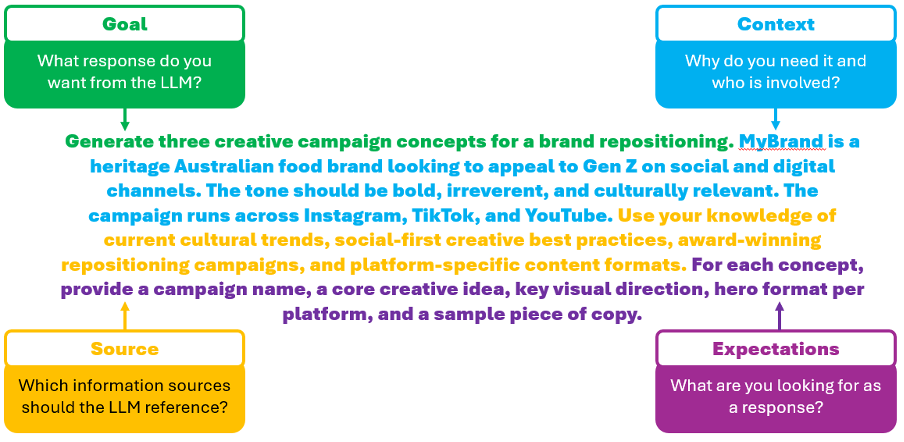
The general guide introduces a four-part framework for structuring every prompt: Goal, Context, Source, and Expectations. Here’s how that framework applies specifically to creative workflows.
| Ingredient | General Question | Creative Translation |
|---|---|---|
| Goal | What response do you want from the LLM? | What creative output do you need? Campaign concepts? Headline variations? A content calendar? Social copy? A script treatment? Art direction references? |
| Context | Why do you need it and who is involved? | What is the brand, what is the brief, who is the audience, what is the tone of voice? What has the brand done before? What are the platform requirements and format constraints? |
| Source | Which information sources should the LLM reference? | Should it draw on current cultural trends, social-first creative best practices, award-winning campaign references, platform-specific format specs, or the brand’s existing style guide? |
| Expectations | What are you looking for as a response? | How many concepts or variations? What level of detail for each — a headline and tagline, or a full concept with visual direction? What format — a script, a social post, a content matrix? |
Putting it together — a creative example:
High-Impact Use Cases for Creatives
The following use cases represent the areas where AI prompting can deliver the most immediate value for creative teams. Each includes a realistic scenario, a worked example prompt, and a description of what a strong output looks like.
Campaign Concepting & Ideation
You’ve received a brief for a brand repositioning campaign. The client wants three distinct creative territories to react to. You need to generate genuinely different concepts — not three variations of the same idea — each with enough detail to present in a tissue session.
Paste this example prompt directly into your LLM
GOAL: Generate three distinct creative campaign concepts for a brand repositioning.
CONTEXT: MyBrand is a 60-year-old Australian breakfast cereal brand that has strong awareness with over-45s but is virtually invisible to 18–30 year-olds. The brand’s heritage is ‘wholesome, Australian, family breakfast’ but the repositioning needs to make it relevant to younger adults who skip traditional breakfast. The campaign will run across Instagram, TikTok, YouTube, and OOH. Tone: the brand is open to being bold and self-aware — they know they’re seen as ‘daggy’ and are willing to own it.
SOURCE: Draw on successful brand repositioning campaigns (particularly heritage brands re-engaging younger audiences), current Gen Z cultural codes in Australia, social-first creative formats, and the tension between nostalgia and modernity in brand storytelling.
EXPECTATIONS: For each of the three concepts, provide: (1) a campaign name, (2) the core creative idea in one sentence, (3) a 100-word concept description explaining the strategic and creative logic, (4) key visual direction (mood, aesthetic, references), (5) a hero execution per platform (TikTok, Instagram, YouTube, OOH), and (6) two sample social post captions in the campaign’s voice. The three concepts should be genuinely different in tone and approach — not three flavours of the same idea.
✓ What good looks like
The critical test is whether the three concepts are actually distinct. The best outputs explore genuinely different creative territories — for example, one that leans into self-deprecating humour, one that creates a new cultural ritual around the product, and one that uses nostalgia as a strength. Weak outputs give you three versions of ‘fun, young, social-first’ with different names. The visual direction and sample copy are what bring each concept to life and make it presentable.
Copy Adaptation Across Platforms
The hero campaign concept is approved and the key messaging is locked. Now you need to adapt it across seven platforms, each with different character limits, tones, and audience expectations. This is the volume work that AI handles exceptionally well.
Paste this example prompt directly into your LLM
GOAL: Adapt our approved campaign messaging across multiple digital platforms.
CONTEXT: The approved campaign for [Brand] is called ‘Make It Yours.’ The core message is about personalisation and self-expression. Hero tagline: ‘No two are the same. Yours shouldn’t be either.’ The campaign targets 25–39 year-olds. Tone of voice: confident, warm, conversational — not corporate or try-hard. The brand never uses exclamation marks and prefers lowercase in social copy.
SOURCE: Reference platform-specific best practices for character counts, format conventions, and audience expectations for each channel.
EXPECTATIONS: Produce three copy variations for each of the following platforms, staying true to the campaign voice and adapting naturally to each platform’s conventions:
– Instagram feed post (caption, max 150 words, include CTA)
– Instagram Story (short, punchy, max 15 words per frame, 3 frames)
– TikTok (hook + caption, conversational tone, max 80 words)
– Facebook (slightly longer-form, 100–200 words, community-focused)
– YouTube pre-roll script (15 seconds, spoken word)
– Display banner (headline + subhead, max 10 words total)
– EDM subject line + preview text (3 options)
Label each platform section clearly.
✓ What good looks like
The best outputs maintain the campaign’s voice consistently while genuinely adapting to each platform — TikTok copy should feel native to TikTok, not like an Instagram caption re-formatted. Watch for the model defaulting to generic marketing language or ignoring the brand rules (like the ‘no exclamation marks’ constraint). Few-Shot prompting is especially powerful here: provide one approved example and the model will match the voice much more accurately.
Content Strategy & Editorial Calendars
You need to build a three-month content calendar for a brand’s social channels. The calendar needs to balance brand messaging, cultural moments, product pushes, and community engagement — and feel cohesive rather than random.
Paste this example prompt directly into your LLM
GOAL: Build a 12-week social content calendar for [Brand] across Instagram, TikTok, and LinkedIn.
CONTEXT: [Brand] is an Australian B2C fintech targeting 25–40 year-old professionals. Their brand pillars are: financial confidence, transparency, and ‘money without the jargon.’ They post 4x per week on Instagram, 3x on TikTok, and 2x on LinkedIn. The period covers April–June 2026. Key brand moments: product feature launch in May, EOFY messaging in June. Cultural moments to consider: Anzac Day, Mother’s Day, World Environment Day.
SOURCE: Draw on social content strategy best practices, the hero–hub–help content framework, Australian cultural calendar for Q2 2026, and fintech social media benchmarks.
EXPECTATIONS: Present as a table with columns for: week number, date range, platform, content pillar (hero/hub/help), topic or hook, format (Reel, carousel, static, TikTok trend, article), and a one-line caption concept. Include a brief (200-word) content strategy preamble explaining the overall editorial approach and how the pillars map to business objectives.
✓ What good looks like
Strong outputs show a genuine editorial rhythm — not just random topics assigned to dates. The best calendars build thematic arcs across weeks, balance content types, and connect cultural moments to the brand naturally rather than forcing it. The strategy preamble should articulate why the calendar is structured the way it is, not just describe it.
Creative Brief Interpretation & Springboards
The agency has sent a creative brief that’s well-intentioned but broad. Before developing concepts, you want to sharpen your understanding of the brief and generate creative springboards — provocative starting points that help the team think beyond the obvious.
Paste this example prompt directly into your LLM
GOAL: Interpret this creative brief and generate five creative springboard territories.
CONTEXT: The brief is for an Australian energy retailer launching a green energy plan targeting homeowners 35–55. The client’s single-minded proposition is: ‘Doing right by the planet shouldn’t cost you more.’ The tone guidelines say ‘optimistic, pragmatic, not preachy.’ The campaign will run across TV, BVOD, social, and OOH. Budget suggests two hero films and a suite of digital assets.
SOURCE: Draw on effective sustainability advertising (campaigns that avoided greenwashing), Australian attitudes to energy costs and climate, and creative approaches that have successfully balanced environmental messaging with financial pragmatism.
EXPECTATIONS: First, provide a brief interpretation (150 words) that identifies the core tension in the brief and what the creative needs to resolve. Then, generate five creative springboard territories. Each springboard should include: (1) a territory name, (2) a one-sentence creative provocation, and (3) a 50-word description of the creative world it opens up. The five territories should range from safe-but-effective to bold-and-unexpected. Label each on a spectrum from ‘evolutionary’ to ‘revolutionary.’
✓ What good looks like
The brief interpretation is where the real value is — a model that identifies the tension between ‘green credibility’ and ‘cost sensitivity’ has understood the brief better than one that simply restates it. The springboards should feel like genuine starting points for creative development, not finished ideas. The evolutionary-to-revolutionary spectrum helps the team see the range of possibilities and self-select their comfort level.
Script Writing & Treatments
You need to develop a script treatment for a 30-second brand film. The concept is approved but you need to bring it to life on the page — translating a creative idea into a narrative that a director and producer can respond to.
Paste this example prompt directly into your LLM
GOAL: Write a script treatment for a 30-second brand film.
CONTEXT: The campaign is ‘Small Wins’ for an Australian banking app targeting 22–35 year-olds. The creative concept is about celebrating the mundane financial moments that actually matter — paying rent on time, having enough in savings for an unexpected bill, buying coffee without checking your balance. The tone is warm, understated, and observational — think slice-of-life, not aspirational. The film will run as a BVOD pre-roll and social video. Music direction: lo-fi, acoustic, gentle.
SOURCE: Draw on award-winning slice-of-life advertising, Australian cultural references for young adults, and best practices for short-form brand film scripts.
EXPECTATIONS: Provide: (1) a one-paragraph creative rationale (why this approach works for the audience), (2) a scene-by-scene script treatment with visual descriptions and suggested dialogue or voiceover for a 30-second film, (3) casting notes (types, not names), (4) music and sound design direction, and (5) two alternative closing lines/taglines. Format the script treatment with VISUAL and AUDIO columns.
✓ What good looks like
The best script treatments make you see the film. Strong outputs use specific, concrete visual details (‘a hand hovering over the tap-and-go terminal, then tapping confidently’) rather than vague descriptions (‘person uses banking app’). The tone should come through in the writing itself — if the brief says ‘understated,’ the treatment shouldn’t be bombastic. The alternative closing lines give the creative director options to react to.
Creative Review & Iteration
You’ve drafted creative work but it’s not quite landing. Instead of starting from scratch, you want to use the model as a creative sparring partner to diagnose what’s not working and generate improved alternatives.
Paste this example prompt directly into your LLM
GOAL: Review and improve this draft campaign copy.
CONTEXT: We’re working on social copy for [Brand], an Australian outdoor gear company. Target audience: active 28–45 year-olds who spend weekends hiking, camping, and surfing. Brand voice: rugged, authentic, no-nonsense — never salesy or try-hard.
Here’s the current draft Instagram caption:
‘Ready for your next adventure? Our new Alpine range is here! Built tough for the trails that matter. Shop now and get 20% off your first order. Link in bio!’
SOURCE: Reference the brand voice guidelines above and best practices for authentic outdoor brand copywriting.
EXPECTATIONS: First, critique the draft in 100 words — identify specifically what’s not working against the brand voice (be direct, not diplomatic). Then provide three alternative versions that fix the identified issues while maintaining the key product and promotional information. Each alternative should take a slightly different approach. Explain in one sentence what each version does differently.
✓ What good looks like
The best critiques are specific and actionable — for example, identifying that ‘Ready for your next adventure?’ is a cliché, that exclamation marks contradict the ‘no-nonsense’ tone, and that ‘Shop now’ feels salesy. The alternatives should demonstrate the fix rather than just describing it. This iterative use of AI is where creative teams often find the most value — not for the first draft, but for making good work better.
Advanced Techniques & Recommended Practices for Creatives
The general guide covers advanced prompting techniques in detail. Here’s how to apply the most relevant ones specifically to creative workflows.
Few-Shot for Voice Consistency
This is the single most powerful technique for creative work. If you want the model to write in a specific brand voice, show it examples — don’t just describe the voice. Providing two or three approved copy examples teaches the model more about tone, rhythm, and vocabulary than any amount of adjectives.
Example: “Here are three approved Instagram captions for [Brand] that represent our voice perfectly: [Example 1] [Example 2] [Example 3]. Now write five new captions for our upcoming winter collection launch, matching this exact tone, sentence length, and style.”
Best for: Any copy task where brand voice matters — social content, headlines, scripts, EDMs, OOH copy. Always lead with examples over descriptions of tone.
Chain-of-Thought for Brief Interpretation
When working with complex briefs, ask the model to think through the brief step by step before generating creative work. This forces it to identify tensions, audience insights, and strategic truths that lead to stronger creative — rather than jumping straight to generic ideas.
Trigger phrase: “Before generating concepts, first analyse this brief: identify the core audience tension, the brand’s right to play in this space, and the single most important thing the creative needs to communicate. Then develop concepts that resolve the tension you identified.”
Best for: Campaign concepting, creative springboards, strategic creative development — any task where the thinking matters as much as the output.
Structured Prompting for Multi-Platform Briefs
Creative briefs often contain multiple layers: brand context, audience insight, messaging hierarchy, platform requirements, and format specs. Using clear labels prevents the model from confusing the brand story with the platform specs, or treating the messaging hierarchy as copy to reproduce rather than principles to apply.
Tip: “Separate your prompt into: BRAND CONTEXT, AUDIENCE, KEY MESSAGE, TONE OF VOICE, PLATFORM REQUIREMENTS, and WHAT I NEED. This is especially important when asking for work across multiple platforms in a single prompt.”
Multimodal Prompting for Creatives
Visual inputs are transformative for creative work. Most major LLMs now accept images and documents alongside text. For creative teams, the most powerful applications include:
- Upload a mood board or reference images and ask the model to articulate the visual direction in words — useful for writing art direction briefs for production partners.
- Share a competitor’s campaign creative and ask for an analysis of their messaging strategy, visual approach, and how your work could differentiate.
- Upload an existing brand style guide (PDF) as context before asking for copy, ensuring the model has the full picture of tone, terminology, and brand rules.
- Attach a storyboard or layout and ask for copy that fits the visual structure and pacing.
For creatives especially: the model responds to specificity. ‘Write something fun’ gets generic output. An uploaded mood board with ‘write copy that matches this energy’ gets something you can actually use.
Build a Creative Prompt Library
Creative teams benefit enormously from a shared prompt library organised by task type. Save the prompts that consistently produce strong starting points and refine them over time. New team members get up to speed faster, and the whole team benefits from shared learning about what works.
Suggested categories for a creative prompt library:
| Category | Example Prompts to Save |
|---|---|
| Concepting & Ideation | Campaign concept generator, Creative springboard territories, Brand repositioning concepts |
| Copywriting | Platform-specific copy adaptation, Headline variations, Tagline development, Long-form brand storytelling |
| Content Strategy | Social content calendar, Editorial framework, Content pillar development, Cultural moment mapping |
| Scripts & Treatments | TVC script treatment, Social video script, Radio/audio script, Pre-roll script (15s/30s) |
| Brief Interpretation | Brief analysis and tension identification, Creative springboard from brief, Territory mapping |
| Review & Iteration | Copy critique and improvement, Tone of voice alignment check, A/B copy variant generation |
Getting Started
You don’t need to overhaul your creative process to start seeing value from AI prompting. Here’s a practical path to building the habit:
- Today
Try it right now.
Every example prompt in this guide is ready to use. Start by running each one of them as they are into your LLM of choice. Then ask the model to turn the output into a slide deck or a PDF. The point is to feel what AI produces. The rest of this program will make immediate sense. - Week 1
Start with adaptation, not creation.
Don’t ask the model to come up with your big idea. Instead, take an approved piece of creative and ask it to adapt the copy across platforms, or generate headline variations. This is where AI adds value fastest with the least creative risk. - Week 2
Use it as a sparring partner.
Take a draft you’re working on and ask the model to critique it against the brief. Or ask it to generate five alternative approaches to a line you’re stuck on. Use it to push your own thinking, not replace it. - Week 3
Try concepting with examples.
Give the model a brief and two or three examples of the kind of work you admire. Ask it to generate concepts inspired by (not copying) those references. Evaluate what it produces — and notice what it gets right and wrong. - Week 4
Build your voice library.
Collect three to five approved copy examples that best represent each brand you work on. Save them as part of your prompt library. These examples become the foundation for every future copy task on that brand.
The best creative prompting doesn’t start with ‘write me something.’ It starts with showing the model what good looks like — then asking it to build from there.
For foundational prompting techniques, see A Guide to Prompting with LLMs: 2026 Edition on the IAB Australia AI Hub.
Explore the full guide
Edition Guides by Role
Foundations
General Guidance
The core framework and foundational prompting techniques for all roles.
Read edition →
For brand marketers & agencies
Buy Side Edition
Media strategy, audience planning, campaign analysis, and investment justification prompts.
Read edition →
For publishers & broadcasters
Sell Side Edition
Sponsorship proposals, audience insights, RFP responses, and yield optimisation prompts.
Read edition →