Sell Side Edition — For publishers, broadcasters & sales houses
A companion to ‘A Guide to Prompting with LLMs: 2026 Edition’
Introduction
This guide is designed specifically for the sell side of the Australian advertising industry — publishers, broadcasters, and sales houses. It builds on the A Guide to Prompting with LLMs: 2026 Edition, which covers the core framework and foundational techniques. If you haven’t read that guide yet, we recommend starting there.
What follows is tailored to your world: building sponsorship proposals, translating audience data into advertiser-ready insights, positioning against competitors, optimising yield, developing new ad products, and turning around RFP responses under pressure. Each section includes worked example prompts you can adapt and use immediately.
This guide assumes familiarity with the Goal / Context / Source / Expectations framework from the general guide. Every example prompt in this document follows that structure.
Why Prompting Matters for the Sell Side
The commercial reality for publishers and broadcasters is intensifying. Advertiser expectations are higher, pitch timelines are shorter, and the competitive landscape — across BVOD, streaming, social, and digital — is more crowded than ever. At the same time, sales teams are expected to deliver increasingly sophisticated, data-led proposals with smaller support teams.
This is where AI prompting becomes a genuine competitive advantage. It’s not about replacing the expertise of your commercial team — it’s about amplifying it. A well-prompted LLM can help a sales director draft a compelling sponsorship proposal in minutes rather than days, help a data analyst translate raw audience numbers into client-ready insights, or help an ad product manager benchmark a new offering against the market.
Where prompting creates the most value on the sell side:
- Speed to pitch: Turning around tailored proposals, one-pagers, and RFP responses faster than competitors.
- Depth of insight: Transforming first-party audience data into narratives that resonate with media buyers.
- Competitive positioning: Quickly analysing and articulating your strengths versus other publishers, platforms, and channels.
- Product innovation: Structuring the thinking around new ad products, sponsorship packages, and measurement solutions.
- Consistency at scale: Ensuring every pitch, regardless of which team member writes it, meets a high standard of quality and structure.
The sell-side teams that build strong prompting habits today will be the ones that win more briefs, pitch faster, and differentiate more effectively tomorrow.
The Prompt Ingredients Framework: Sell Side Edition
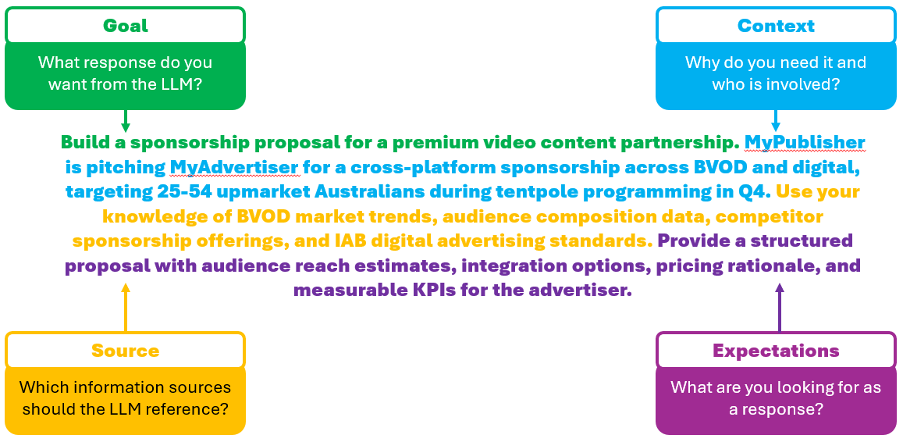
The general guide introduces a four-part framework for structuring every prompt: Goal, Context, Source, and Expectations. Here’s how that framework applies specifically to sell-side workflows.
| Ingredient | General Question | Sell Side Translation |
|---|---|---|
| Goal | What response do you want from the LLM? | What do you want the LLM to produce? A sponsorship proposal? An audience insight summary? A competitive positioning document? A pricing recommendation? |
| Context | Why do you need it and who is involved? | Who is the client or advertiser? What inventory or platforms are in play? What is the campaign objective, audience, timing, and budget? What does your sales team already know? |
| Source | Which information sources should the LLM reference? | Should it draw on BVOD market data, OzTAM/VOZ ratings, IAB standards, your first-party audience insights, competitive intelligence, or industry benchmarks? |
| Expectations | What are you looking for as a response? | Should it deliver a structured proposal with pricing? A one-page summary for a client meeting? A detailed competitive analysis in table format? Specify length, tone, and structure. |
Putting it together — a sell-side example:
High-Impact Use Cases for the Sell Side
The following use cases represent the areas where AI prompting can deliver the most immediate value for publishers and broadcasters. Each includes a realistic scenario, a worked example prompt, and a description of what a strong output looks like.
Sponsorship & Partnership Proposals
Your sales team has been invited to pitch a major FMCG advertiser on a tentpole sponsorship package for Q4. You need to build a compelling proposal that combines audience data, integration options, and a clear value story — and the pitch meeting is in 48 hours.
Paste this example prompt directly into your LLM
GOAL: Create a sponsorship proposal for [Advertiser] around our Q4 tentpole programming.
CONTEXT: [MyPublisher] is pitching [Advertiser] on a cross-platform sponsorship package. The advertiser is an FMCG brand targeting primary grocery buyers 25–54. Our tentpole program reaches 1.8M metro viewers weekly and indexes strongly against this demographic. The package should span linear broadcast, BVOD catch-up, social amplification, and on-site activations.
SOURCE: Use your knowledge of BVOD sponsorship best practices, attention-based metrics, Australian TV audience benchmarks, and integrated sponsorship models.
EXPECTATIONS: Deliver a structured proposal with: (1) an executive summary, (2) audience alignment rationale with data points, (3) a tiered integration menu (presenting, major, and supporting partner levels), (4) suggested KPIs and measurement approach, and (5) a pricing framework section with placeholder rate card ranges. Tone should be confident and client-facing. Approximately 1,500 words.
✓ What good looks like
The output should read like a first draft you could share with your sales director — structured with clear sections, written in a persuasive but professional tone, with audience data points woven into the rationale rather than dumped in a table. The tiered structure gives the advertiser options and creates a natural upsell pathway.
Audience Insights & Content Matching
A media agency has asked for audience insights to support a campaign targeting young professionals interested in travel and lifestyle. You have strong first-party data but need to translate it into a narrative that connects your content environment to their audience strategy.
Paste this example prompt directly into your LLM
GOAL: Translate our first-party audience data into a client-ready insight document that connects our content to the agency’s target audience.
CONTEXT: The agency is planning a campaign for a premium travel brand targeting professionals 25–39 with household income $120K+. Our platform data shows: 62% of our lifestyle content viewers are aged 25–39, average session duration is 18 minutes, and travel-related content has grown 34% YoY. We also have a ‘Frequent Flyer’ audience segment built from content consumption and registration data.
SOURCE: Draw on Australian digital audience benchmarks, first-party data best practices, and contextual targeting research. Reference the value of attention metrics and engaged time versus impressions.
EXPECTATIONS: Produce a 1-page insight summary (approximately 400 words) with a compelling headline, 3–4 key data points presented as callout stats, a narrative connecting our audience to the advertiser’s target, and a recommended activation approach. Tone should be insight-led and consultative, not salesy.
✓ What good looks like
The output should feel like a polished leave-behind for a client meeting — not a data dump. Strong outputs lead with an insight (not a platform description), use the data points as proof, and end with a clear recommendation that positions your inventory as the natural fit.
Competitive Intelligence & Positioning
You’re preparing for a major upfront presentation and need to articulate why advertisers should invest in your platform versus competitors. You need a clear, honest competitive positioning that acknowledges the landscape while making a compelling case for your strengths.
Paste this example prompt directly into your LLM
GOAL: Create a competitive positioning analysis for our BVOD platform against key competitors in the Australian market.
CONTEXT: We are [MyPublisher], one of the major Australian BVOD platforms. Our key competitors include [Competitor A], [Competitor B], and [Competitor C]. Our differentiators include: exclusive local content library, brand-safe premium environment, advanced contextual targeting through [Product Name], and integrated linear+digital reach. We need this for an upfront presentation to agency holding groups.
SOURCE: Use your knowledge of the Australian BVOD and streaming market, audience measurement frameworks (VOZ, OzTAM), industry reports on BVOD growth, and IAB Australia digital video standards.
EXPECTATIONS: Present as a comparison table with rows for: content proposition, audience reach, targeting capabilities, measurement/attribution, brand safety, and ad format innovation. Follow the table with a 300-word narrative summary that positions our platform’s strengths without disparaging competitors. Tone should be factual and confident.
✓ What good looks like
The best outputs balance objectivity with advocacy. The table should use verifiable differentiators (not marketing fluff), and the narrative should tell a story about why your platform’s combination of strengths matters, rather than simply listing features. Watch for hallucinated competitor data — always verify specific claims.
Yield Optimisation & Pricing Strategy
Your ad operations team is reviewing programmatic floor prices ahead of a major sporting event. You want to model different pricing scenarios and understand the trade-offs between fill rate, CPM, and total revenue.
Paste this example prompt directly into your LLM
GOAL: Analyse our programmatic floor pricing strategy and recommend adjustments for tentpole sporting inventory.
CONTEXT: We are a major Australian broadcaster. During our upcoming major sporting event (3-week window), we expect a 40% increase in BVOD ad impressions. Current programmatic floor prices: pre-roll $35 CPM, mid-roll $28 CPM. Last year’s event saw 85% fill rate at these floors. We have direct-sold commitments covering 60% of available inventory. We’re considering raising floors by 15–25% for the event window.
SOURCE: Draw on programmatic yield management best practices, supply-demand pricing principles, and Australian BVOD CPM benchmarks.
EXPECTATIONS: Walk through the analysis step by step. Model three scenarios: (1) no change, (2) 15% floor increase, (3) 25% floor increase. For each, estimate the likely impact on fill rate, effective CPM, and total revenue. Present scenarios in a table, then provide a recommendation with reasoning. Flag any risks.
✓ What good looks like
This is a natural fit for Chain-of-Thought prompting — asking the model to reason through each scenario step by step produces much stronger outputs than asking for a recommendation directly. The best outputs will clearly state assumptions, show the working, and flag that fill rate estimates are directional rather than precise.
Ad Product Development
Your product team is developing a new attention-based ad product and needs to create an internal brief that articulates the market opportunity, the product mechanics, and a go-to-market approach for the sales team.
Paste this example prompt directly into your LLM
GOAL: Draft an internal product brief for a new attention-based advertising offering.
CONTEXT: We are developing a premium ad product called ‘AttentionPlus’ that guarantees advertisers a minimum attention threshold (measured via Adelaide Metrics or Lumen) rather than selling on impressions alone. The product will initially be available on our BVOD pre-roll and high-impact display inventory. Our early testing shows attention scores 2.3x higher than standard pre-roll. The target buyer is brand advertisers and their agencies who are focused on effectiveness and media quality.
SOURCE: Use your knowledge of attention economy research, Adelaide Metrics methodology, attention-based buying models in international markets (UK, US), and the IAB’s digital measurement standards.
EXPECTATIONS: Structure the brief as: (1) Market Opportunity — why attention-based buying is growing, (2) Product Overview — what AttentionPlus is and how it works, (3) Proof Points — our testing data and supporting research, (4) Target Buyer Profile, (5) Sales Enablement — key objection handlers and talking points, and (6) Go-to-Market Timeline. Approximately 1,200 words. Internal-facing tone — clear and direct, not marketing copy.
✓ What good looks like
The output should give your product team a working first draft that captures the strategic rationale and practical detail. It won’t replace internal knowledge about your specific testing results or pricing, but it creates a structure and narrative that would take hours to build from scratch.
Sales Enablement & RFP Responses
Your sales team has received an RFP from a major agency with a 72-hour turnaround. The brief covers multiple channels and asks for audience data, creative formats, case studies, and pricing. You need to produce a comprehensive, polished response quickly.
Paste this example prompt directly into your LLM
GOAL: Draft an RFP response for [Agency] on behalf of [MyPublisher].
CONTEXT: The RFP is for a national retail advertiser targeting adults 25–49, with a focus on driving both brand awareness and online traffic. The campaign runs across Q1–Q2 with an estimated budget of $1.5M. The RFP specifically asks for: (1) audience reach and composition, (2) available ad formats with specifications, (3) targeting capabilities including contextual and first-party segments, (4) measurement and attribution approach, (5) a relevant case study, and (6) indicative pricing.
SOURCE: Use your knowledge of Australian digital advertising formats, IAB standard ad units, BVOD audience measurement, and retail advertising best practices. For the case study section, I will provide details of a previous campaign to include.
EXPECTATIONS: Produce a structured RFP response document addressing all six sections requested. Use a professional, consultative tone. Each section should be 150–250 words. Include placeholder markers [INSERT SPECIFIC DATA] where I’ll need to add our proprietary numbers. End with a brief ‘Why [MyPublisher]’ summary paragraph.
✓ What good looks like
The model won’t know your specific reach numbers, pricing, or case study details, so the best approach is to have it build the structure, narrative, and argumentation while clearly flagging where you need to insert proprietary data. This approach can cut RFP turnaround time from days to hours while maintaining a high-quality, consistent standard across your team.
Advanced Techniques & Recommended Practices for the Sell Side
The general guide covers advanced prompting techniques in detail. Here’s how to apply the most relevant ones specifically to sell-side workflows.
Chain-of-Thought for Yield & Pricing Analysis
When you’re working through pricing scenarios, audience trade-offs, or inventory allocation decisions, always ask the model to reason step by step. This produces more transparent, trustworthy outputs where you can check the logic at each stage.
Trigger phrase: “Walk through this step by step…” or “First calculate… then compare… then recommend…”
Best for: Floor price modelling, inventory forecasting, campaign pacing analysis, rate card benchmarking.
Few-Shot for Consistent Sales Materials
If your team produces a high volume of similar documents — client one-pagers, sponsorship summaries, post-campaign reports — use Few-Shot prompting to lock in a consistent format. Provide two or three examples of your best past outputs and ask the model to follow the same structure for new clients.
Example: “Here are two examples of how we write audience insight one-pagers for clients: [Example 1] [Example 2]. Now write one for [New Client] using the same format, tone, and level of detail. Data for the new one: [Insert data].”
Best for: Client one-pagers, audience summaries, sponsorship proposals, post-campaign reports — any document you produce repeatedly.
Structured Prompting for Complex Briefs
Sell-side prompts often combine multiple data inputs (audience numbers, inventory details, competitor info, client requirements) with specific instructions. Using clear labels — GOAL, CONTEXT, SOURCE, EXPECTATIONS, or even more granular ones like CLIENT BRIEF, OUR DATA, COMPETITIVE LANDSCAPE — prevents the model from confusing your data with your instructions.
Tip: “The more inputs you’re combining in a single prompt, the more important structure becomes. If your prompt is longer than a paragraph, label the sections.”
Multimodal Prompting for the Sell Side
Most major LLMs now accept file uploads alongside text. For sell-side teams, the most powerful applications include:
- Upload a competitor’s media kit or rate card (PDF) and ask for a comparative analysis against your own offerings.
- Attach an agency’s RFP brief (PDF or Word) and ask the model to extract the key requirements and draft a response structure.
- Upload a campaign performance report (Excel/CSV) and ask for a narrative summary highlighting wins and optimisation opportunities.
- Share a screenshot of a competitor’s ad product page and ask for a feature-by-feature comparison.
Always include a text prompt alongside any file upload. Tell the model what the file contains and what you want it to do — don’t just upload and hope.
Build a Sell-Side Prompt Library
The most effective teams don’t start from scratch every time. Build a shared prompt library organised by use case — proposals, audience insights, competitive analysis, RFP responses, product briefs. Store your best-performing prompts and iterate on them over time. This ensures consistency across the team and shortens ramp-up time for new hires.
Suggested categories for a sell-side prompt library:
| Category | Example Prompts to Save |
|---|---|
| Sponsorship Proposals | Tentpole sponsorship pitch, Integration partner proposal, Custom content partnership |
| Audience & Data | Audience insight one-pager, First-party segment description, Content-to-audience matching |
| Competitive Intelligence | BVOD competitor comparison, Platform positioning narrative, Upfront talking points |
| Yield & Pricing | Floor price scenario analysis, Rate card benchmarking, Inventory forecast model |
| Ad Products | New product internal brief, Sales enablement talking points, Product FAQ for agencies |
| RFP & Sales Enablement | RFP response template, Client meeting prep briefing, Objection handler scripts |
Getting Started
You don’t need to overhaul your workflow to start seeing value from AI prompting. Here’s a practical path to building the habit:
- Today
Try it right now.
Every example prompt in this guide is ready to use. Start by running each one of them as they are into your LLM of choice. Then ask the model to turn the output into a slide deck or a PDF. The point is to feel what AI produces. The rest of this program will make immediate sense. - Week 1
Pick one use case.
Choose the use case from this guide that matches your most frequent task — whether that’s writing proposals, building audience insights, or responding to RFPs. Adapt the example prompt to a real brief and compare the output to what you’d normally produce. - Week 2
Refine and iterate.
Take the output from Week 1 and improve it. Adjust the prompt, add more context, try specifying the format differently. Save the version that works best. - Week 3
Share and scale.
Share your best prompt with a colleague and ask them to try it on a different client or brief. Collect feedback. Start a shared prompt library. - Week 4
Add a second use case.
Now that you’ve built the muscle on one use case, pick a second. Layer in an advanced technique like Chain-of-Thought or Few-Shot. Keep iterating.
Prompting is a skill. The sell-side teams that invest in building it now will pitch faster, differentiate more effectively, and win more business.
For foundational prompting techniques, see A Guide to Prompting with LLMs: 2026 Edition on the IAB Australia AI Hub.
Explore the full guide
Edition Guides by Role
Foundations
General Guidance
The core framework and foundational prompting techniques for all roles.
Read edition →
For brand marketers & agencies
Buy Side Edition
Media strategy, audience planning, campaign analysis, and investment justification prompts.
Read edition →
For creative & content teams
Creative Edition
Campaign concepting, copy adaptation, content calendars, and script writing prompts.
Read edition →
For engineers, product & data
AdTech Edition
System architecture, privacy compliance, product specs, and go-to-market strategy prompts.
Read edition →