Buy Side Edition — For brand marketers, media agencies & planning teams
A companion to ‘A Guide to Prompting with LLMs: 2026 Edition’
Introduction
This guide is designed specifically for the buy side of the Australian advertising industry — brand marketers, media agencies, and planning teams. It builds on the A Guide to Prompting with LLMs: 2026 Edition, which covers the core framework and foundational techniques. If you haven’t read that guide yet, we recommend starting there.
What follows is tailored to your world: developing media strategies, building channel plans, writing briefs, analysing campaign performance, defining audiences, and justifying investment to stakeholders. Each section includes worked example prompts you can adapt and use immediately.
This guide assumes familiarity with the Goal / Context / Source / Expectations framework from the general guide. Every example prompt in this document follows that structure.
Why Prompting Matters for the Buy Side
The demands on media agencies and brand marketing teams have never been higher. Clients expect faster turnarounds, sharper insights, and stronger accountability for every dollar spent. At the same time, the media landscape is fragmenting — more channels, more data sources, more measurement complexity — while team sizes often stay flat or shrink.
This is where AI prompting becomes a genuine multiplier. It’s not about replacing the judgement of experienced planners or strategists — it’s about accelerating the work that surrounds that judgement. A well-prompted LLM can help a strategist draft a media plan framework in minutes rather than hours, help an analyst turn raw performance data into a client-ready narrative, or help a planner pressure-test a channel mix against industry benchmarks.
Where prompting creates the most value on the buy side:
- Strategic speed: Moving from brief to draft plan faster, leaving more time for refinement and client collaboration.
- Data-to-insight translation: Turning raw numbers — campaign reports, audience data, market research — into compelling narratives and recommendations.
- Brief quality: Writing tighter, more effective briefs that set campaigns up for success from the start.
- Cross-channel thinking: Quickly comparing channels, benchmarks, and allocation scenarios to build smarter plans.
- Stakeholder communication: Producing clear, well-structured documents that justify investment to CMOs, procurement, and finance teams.
The buy-side teams that build strong prompting habits today will plan faster, think more strategically, and deliver stronger results for their clients.
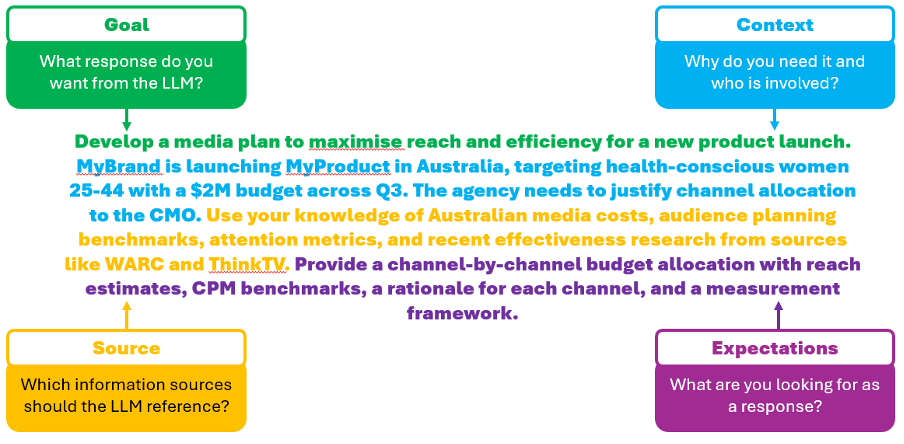
The general guide introduces a four-part framework for structuring every prompt: Goal, Context, Source, and Expectations. Here’s how that framework applies specifically to buy-side workflows.
| Ingredient | General Question | Buy Side Translation |
|---|---|---|
| Goal | What response do you want from the LLM? | What strategic output do you need? A media plan? A channel recommendation? A performance analysis? A client-ready presentation narrative? |
| Context | Why do you need it and who is involved? | Who is the brand, what is the campaign objective, who is the target audience, what is the budget and timeline? What does the agency or client already know? |
| Source | Which information sources should the LLM reference? | Should it draw on planning benchmarks, WARC effectiveness data, ThinkTV research, attention metrics, Roy Morgan or GWI audience data, or media cost benchmarks? |
| Expectations | What are you looking for as a response? | Should it deliver a channel-by-channel allocation with rationale? A measurement framework? A one-page summary for the CMO? Specify format, length, and level of detail. |
Putting it together — a buy-side example:
High-Impact Use Cases for the Buy Side
The following use cases represent the areas where AI prompting can deliver the most immediate value for clients and agencies. Each includes a realistic scenario, a worked example prompt, and a description of what a strong output looks like.
Media Strategy & Channel Planning
You’ve received a brief from a client launching a new product. The target audience, budget, and objectives are defined, but you need to build a channel plan that allocates spend effectively and tells a clear strategic story about why each channel is in the mix.
Paste this example prompt directly into your LLM
GOAL: Develop a channel plan with budget allocation and strategic rationale for a new product launch campaign.
CONTEXT: MyBrand is launching a premium skincare range in Australia targeting women 25–44 with household income $100K+. Campaign objective: build awareness and drive trials. Budget: $2.2M across Q3 (July–September). The client has a strong existing social presence but low awareness in broadcast and BVOD. This is the brand’s first above-the-line campaign.
SOURCE: Draw on Australian media cost benchmarks for 2025–26, BVOD and CTV audience growth data, attention metrics research (Adelaide, Lumen), ThinkTV effectiveness studies on video reach, and IAB digital advertising standards.
EXPECTATIONS: Deliver a channel-by-channel plan in table format with columns for: channel, role in the funnel, budget allocation ($), budget allocation (%), estimated reach, primary KPI, and strategic rationale. Follow the table with a 400-word narrative explaining the overall strategy. End with a recommended measurement framework. Tone should be strategic and client-facing.
✓ What good looks like
The output should read like a first-draft recommendation you could present in a planning meeting. Strong outputs connect each channel to a clear role (awareness, consideration, conversion), justify the allocation with data or reasoning, and present a measurement approach that ties back to the client’s business objectives — not just media metrics.
Audience Definition & Segmentation
Your planning team needs to move beyond basic demographics and develop richer audience segments that reflect real behaviours and motivations. The client brief says “young families” but you need to turn that into actionable segments with media implications.
Paste this example prompt directly into your LLM
GOAL: Develop three distinct audience segments for a family-focused campaign, with media implications for each.
CONTEXT: The client is a major Australian retailer launching a back-to-school campaign. The brief targets ‘young families’ but we need to go deeper. Budget is $1.8M across January–February. The campaign needs to drive both brand awareness and in-store traffic.
SOURCE: Use your knowledge of Australian family demographics, media consumption patterns by life stage, retail purchase behaviour research, and audience segmentation best practices.
EXPECTATIONS: For each of the three segments, provide: (1) a segment name, (2) a demographic and psychographic description (50–75 words), (3) key media behaviours (where they consume content, when, on what devices), (4) the most effective channels to reach them, and (5) a recommended messaging angle. Present as three clearly structured segment profiles. Conclude with a brief note on how these segments could be activated using first-party data and programmatic targeting.
✓ What good looks like
The best outputs go beyond demographics into genuine insight — distinguishing, for example, between time-poor dual-income parents who consume content on mobile during commutes versus stay-at-home parents with more daytime TV and social media engagement. Strong segment profiles lead directly to media implications rather than requiring a second step of interpretation.
Brief Writing & Refinement
You’re writing a media brief for a complex campaign that spans multiple channels and objectives. You need to ensure the brief is tight enough to guide partners effectively but comprehensive enough to capture the client’s ambitions.
Paste this example prompt directly into your LLM
GOAL: Draft a media brief for a multi-channel campaign.
CONTEXT: The client is an Australian health insurance provider running a brand repositioning campaign. They want to shift perception from ‘traditional and corporate’ to ‘modern and member-first.’ Target audience: Australians 30–49 considering switching providers. Budget: $3.5M across H2. The campaign includes a brand platform TVC, digital video, programmatic display, social, audio, and a search/SEM layer. The media brief will go to three publisher groups and two programmatic partners.
SOURCE: Draw on media briefing best practices, Australian health insurance advertising norms, and examples of effective repositioning campaigns.
EXPECTATIONS: Structure the brief with the following sections: (1) Background & Business Objective, (2) Campaign Objective, (3) Target Audience (primary and secondary), (4) Key Messages & Tone, (5) Channel Requirements, (6) Budget & Timing, (7) Mandatory Inclusions (brand safety, viewability, measurement requirements), and (8) Response Requirements (what partners should include in their proposals). Approximately 800 words. Tone should be clear, direct, and professional.
✓ What good looks like
A strong brief output is one that gives media partners enough context to respond intelligently without being so prescriptive that it limits creative thinking. Watch for the model over-specifying channel tactics where the brief should be leaving room for partner recommendations. The best outputs clearly separate ‘what we need’ from ‘what we’re open to.’
Campaign Performance Analysis
A campaign has just wrapped and you need to analyse the results across multiple channels, identify what worked, and build a narrative for the client that goes beyond “here are the numbers” to “here’s what we learned and what we’d do differently.”
Paste this example prompt directly into your LLM
GOAL: Analyse our Q2 campaign performance and produce a client-ready summary with optimisation recommendations.
CONTEXT: We ran a $1.5M awareness campaign for a fintech brand targeting professionals 25–44 across BVOD, programmatic display, paid social (Meta and TikTok), and digital audio. Here are the results:
– BVOD: 8.2M impressions, 72% VCR, $38 CPM
– Programmatic display: 15M impressions, 0.12% CTR, $12 CPM
– Meta: 6.5M impressions, 0.8% CTR, $18 CPM, 3.2% engagement rate
– TikTok: 4.1M impressions, 1.4% CTR, $14 CPM, 8.7% engagement rate
– Digital audio: 3.8M impressions, 96% listen-through rate, $22 CPM
Brand lift study: +6pp aided awareness, +4pp consideration.
SOURCE: Draw on Australian digital media benchmarks for 2025–26, attention and effectiveness research, and best practices for cross-channel campaign evaluation.
EXPECTATIONS: Walk through the analysis step by step. First, summarise the overall campaign performance against objectives. Then, evaluate each channel’s performance against benchmarks (flag whether each metric is above, at, or below industry average). Identify the top two performing channels and the one channel that underperformed. Provide three specific optimisation recommendations for the next campaign. Present as a structured report of approximately 600 words with a clear recommendation section. Client-facing tone.
✓ What good looks like
This is a natural fit for Chain-of-Thought prompting — asking the model to work through each channel step by step produces much more insightful analysis than asking for a summary directly. The best outputs contextualise the numbers (e.g. ‘TikTok’s 1.4% CTR is 2x the platform benchmark, suggesting strong creative resonance’) rather than just restating them.
Investment Justification & Stakeholder Communication
The CMO has asked for a clear explanation of why the recommended media plan allocates 35% of budget to BVOD when the previous campaign was primarily social-led. You need to build a persuasive case backed by evidence.
Paste this example prompt directly into your LLM
GOAL: Build a strategic rationale document justifying a significant budget shift from social to BVOD.
CONTEXT: Our recommended media plan for Brand X shifts allocation from 60% social / 15% BVOD (last campaign) to 40% social / 35% BVOD for the upcoming H2 campaign. The CMO is sceptical and has asked for evidence supporting this shift. The campaign objective is brand awareness among adults 25–49. Total budget is $2.5M.
SOURCE: Draw on ThinkTV research on video reach and effectiveness, attention metrics comparisons between social video and BVOD (Adelaide/Lumen data), Australian BVOD audience growth data, and WARC research on optimal channel mix for awareness objectives.
EXPECTATIONS: Structure the document as: (1) Executive Summary (100 words), (2) The Case for Rebalancing — three evidence-backed arguments for increasing BVOD investment, (3) Risk of Over-Indexing on Social — what the research shows about diminishing returns, (4) How the Channels Work Together — the complementary roles of BVOD and social, and (5) Recommended Next Steps. Approximately 800 words. The tone should be evidence-led and persuasive but not adversarial — this is a recommendation, not an argument.
✓ What good looks like
The best outputs lead with insight rather than data — for example, framing the shift as ‘reaching the 40% of your audience that social alone can’t access’ rather than listing CPM comparisons. Strong outputs also acknowledge the CMO’s concern and address it directly rather than ignoring it, which builds trust in the recommendation.
Competitive & Market Analysis
Your client is entering a new category and wants to understand how competitors are investing in media before finalising their own strategy. You need to pull together a competitive landscape overview quickly.
Paste this example prompt directly into your LLM
GOAL: Create a competitive media landscape analysis for a brand entering the Australian plant-based food category.
CONTEXT: Our client, a major food manufacturer, is launching a new plant-based range and wants to understand how key competitors are approaching media. The main competitors are [Brand A], [Brand B], and [Brand C]. The client wants to understand where competitors are spending, what channels they prioritise, what messaging themes they use, and where there might be gaps or opportunities.
SOURCE: Use your knowledge of the Australian FMCG advertising landscape, plant-based food market trends, and media investment patterns in the health and wellness food category.
EXPECTATIONS: Present a competitive overview with: (1) a summary table comparing competitors across estimated channel mix, primary media channels, messaging themes, and target audience positioning, (2) a 300-word analysis identifying patterns and white space opportunities, and (3) three strategic implications for our client’s media plan. Flag clearly where your analysis is based on general market knowledge versus specific verified data, so the team knows what needs further validation.
✓ What good looks like
The critical ‘what good looks like’ here is transparency. The model will not have access to actual competitor spend data, so the best outputs clearly distinguish between confident market observations (‘plant-based brands have significantly increased digital video investment’) and inferences (‘Brand A’s strong social presence suggests a digital-first strategy’). The flag at the end asking for verification is essential.
Advanced Techniques & Recommended Practices for the Buy Side
The general guide covers advanced prompting techniques in detail. Here’s how to apply the most relevant ones specifically to buy-side workflows.
Few-Shot for Consistent Agency Deliverables
Agencies produce a high volume of similar documents — media plans, campaign reports, client decks, briefing documents. Use Few-Shot prompting to lock in your agency’s house style. Provide two or three examples of your best past deliverables and ask the model to follow the same structure, tone, and level of detail for new clients.
Example: “Here are two examples of how we write campaign performance summaries for clients: [Example 1] [Example 2]. Now write one for [New Client] using the same format, tone, and level of detail. Campaign data: [Insert data].”
Best for: Monthly reporting, campaign wrap-ups, media plan presentations, briefing documents — any document you produce repeatedly across clients.
Structured Prompting for Complex Briefs & Plans
Buy-side prompts often combine multiple inputs: the client brief, campaign data, audience research, competitive context, and specific instructions. Using clear labels — GOAL, CONTEXT, SOURCE, EXPECTATIONS, or more granular ones like CLIENT BRIEF, CAMPAIGN DATA, AUDIENCE INSIGHT, COMPETITIVE LANDSCAPE — prevents the model from confusing your data with your instructions.
Tip: “The more inputs you’re combining, the more important structure becomes. If your prompt includes both a client brief and performance data, label them separately so the model knows which is context and which is the data to analyse.”
Chain-of-Thought for Performance Analysis & Planning
When you’re working through campaign performance data, budget allocation trade-offs, or reach/frequency modelling, always ask the model to reason step by step. This produces transparent analysis where you can check the logic at each stage — essential for client-facing work where you need to defend the reasoning.
Trigger phrase: “Walk through this step by step…” or “First evaluate each channel against benchmarks, then identify patterns, then recommend…”
Best for: Campaign post-mortems, budget scenario modelling, reach/frequency analysis, media mix optimisation.
Multimodal Prompting for the Buy Side
Most major LLMs now accept file uploads alongside text. For buy-side teams, the most powerful applications include:
- Upload a client’s media brief (PDF or Word) and ask the model to extract the key requirements, flag ambiguities, and draft a response structure.
- Attach a campaign performance report (Excel/CSV) and ask for a narrative analysis highlighting what worked, what didn’t, and recommended optimisations.
- Share a competitor’s ad creative (screenshot) and ask for an analysis of their messaging strategy, tone, and likely target audience.
- Upload a research report (PDF) and ask for a 200-word summary of the key findings relevant to your client’s category.
Always include a text prompt alongside any file upload. Tell the model what the file contains and what you want it to do — don’t just upload and hope.
Build a Buy-Side Prompt Library
The most effective agency teams don’t start from scratch every time. Build a shared prompt library organised by workflow stage — planning, briefing, activation, reporting, and client communication. Store your best-performing prompts and iterate on them. This ensures consistency across the team, speeds up onboarding of new planners, and builds institutional knowledge.
Suggested categories for a buy-side prompt library:
| Category | Example Prompts to Save |
|---|---|
| Strategy & Planning | Channel plan with allocation rationale, Media strategy narrative, Reach/frequency scenario model |
| Audience & Segmentation | Audience segment profiles, Persona development, Behavioural audience description for activation |
| Brief Writing | Media brief template, Creative brief structure, Partner/publisher brief |
| Performance & Reporting | Campaign post-mortem analysis, Monthly performance summary, Benchmark comparison report |
| Investment Justification | Budget shift rationale, Channel investment case, Measurement framework proposal |
| Competitive Analysis | Competitor media landscape overview, Category spending analysis, White space opportunity identification |
Getting Started
Getting Started
You don’t need to overhaul your workflow to start seeing value from AI prompting. Here’s a practical path to building the habit:
- Today
Try it right now.
Every example prompt in this guide is ready to use. Start by running each one of them as they are into your LLM of choice. Then ask the model to turn the output into a slide deck or a PDF. The point is to feel what AI produces. The rest of this program will make immediate sense. - Week 1
Pick one use case.
Choose the use case from this guide that matches your most frequent task — whether that’s writing media plans, analysing performance data, or drafting briefs. Adapt the example prompt to a real client brief and compare the output to what you’d normally produce. - Week 2
Refine and iterate.
Take the output from Week 1 and improve it. Adjust the prompt, add more context, try specifying the format differently. Save the version that works best. - Week 3
Share and scale.
Share your best prompt with a colleague and ask them to try it on a different client. Collect feedback. Start a shared prompt library for the team. - Week 4
Add a second use case.
Now that you’ve built the muscle on one use case, pick a second. Layer in an advanced technique like Chain-of-Thought or Few-Shot. Keep iterating.
Prompting is a skill. The buy-side teams that invest in building it now will plan faster, think more strategically, and deliver stronger results for their clients.
For foundational prompting techniques, see A Guide to Prompting with LLMs: 2026 Edition on the IAB Australia AI Hub.
Explore the full guide
Edition Guides by Role
Foundations
General Guidance
The core framework and foundational prompting techniques for all roles.
Read edition →
For publishers & broadcasters
Sell Side Edition
Sponsorship proposals, audience insights, RFP responses, and yield optimisation prompts.
Read edition →
For creative & content teams
Creative Edition
Campaign concepting, copy adaptation, content calendars, and script writing prompts.
Read edition →
For engineers, product & data
AdTech Edition
System architecture, privacy compliance, product specs, and go-to-market strategy prompts.
Read edition →