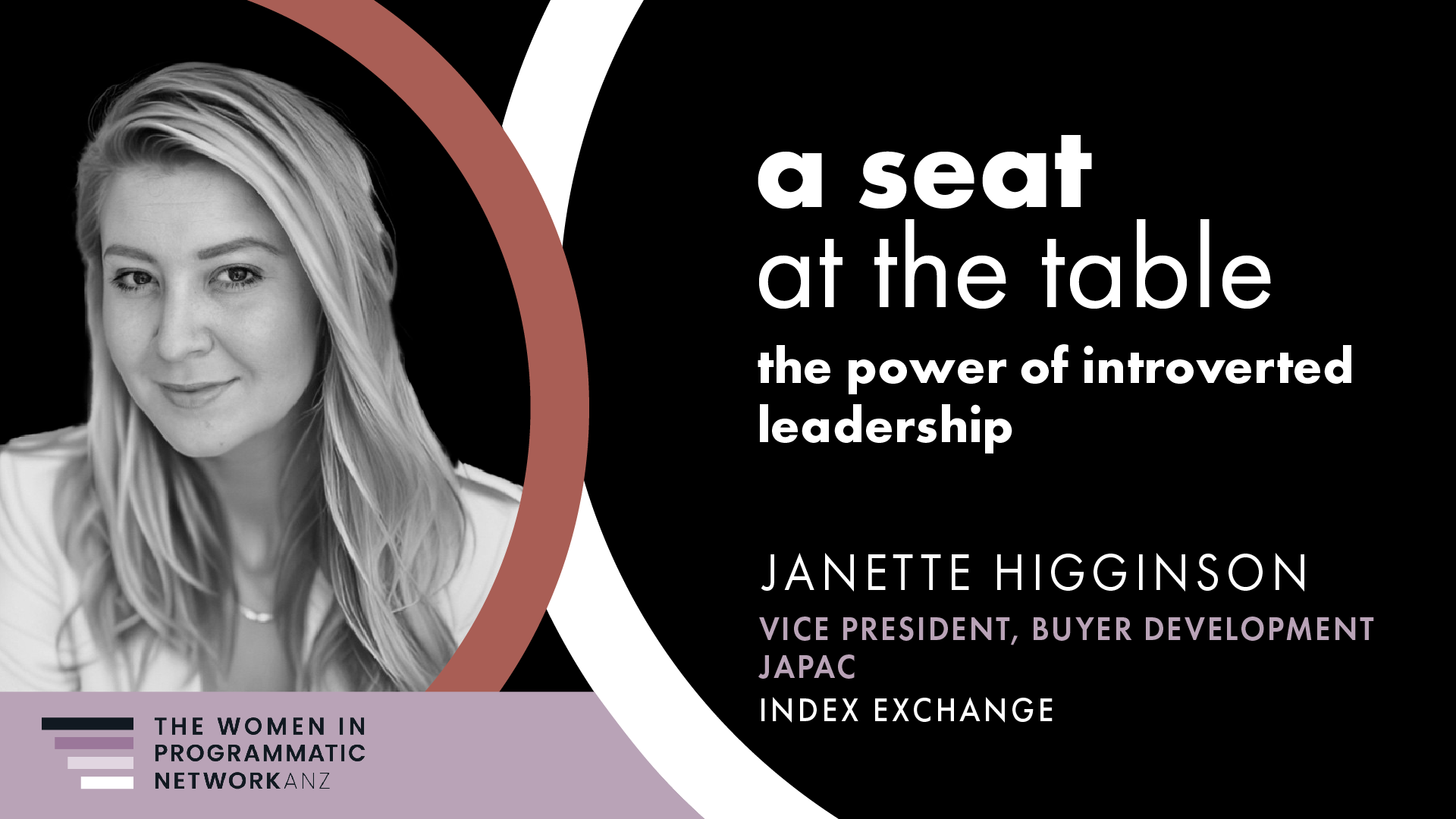
IAB Australia has partnered with The Women in Programmatic Network (TWIPN) to launch the A Seat at the Table series. The series showcases the perspectives of women in Australia’s advertising community and gives these role models a seat at the table to share their stories.
There is a version of leadership in our culture that is associated with being the loudest voice in the room and with dominance. In a corporate landscape that often rewards traits women are socially conditioned not to display, women face a double bind as they climb the ranks. When women are highly assertive, they risk being judged as aggressive and unapproachable. When they are collaborative and reserved, they risk being seen as lacking leadership presence.
Research from the Workplace Gender Equality Agency highlights that these gendered expectations around authority and leadership are among the key factors affecting the pipeline of women who are motivated and mentored to move into executive roles. Without a pipeline of women prepared for future leadership, achieving equity and representation at executive level becomes even more difficult.
Janette Higginson, Vice President, Buyer Development, JAPAC, at Index Exchange, joins us at the table to explore how energy management, authenticity and self-awareness are essential leadership disciplines, and why stepping into leadership doesn’t require becoming someone you’re not.
There is a version of me that most people see. She walks into rooms confidently, puts her hand up, takes up space and shows up for her team without hesitation. She runs a regional sales organisation and leads Index Women – a global diversity, equity and inclusion (DEI) group within Index Exchange that spans engineers, lawyers, finance professionals and sellers. If you told the people I work with that I identify as an introverted leader, most would be surprised.
I don’t lead despite my introversion. I lead because of it. But it has taken years, and a lot of honest self-examination, to understand what that means in practice. This is what I’ve learned, and I’m sharing it in the hope that it shortens the journey for our industry’s future women leaders.
What people misunderstand about introversion
Introversion is one of leadership’s greatest assets. It is also one of the most misunderstood. It is often conflated with shyness, a lack of confidence, or being the person who hangs back or goes quiet in a crowd. But that’s not what it is, and that’s not who I am.
The introversion—extroversion spectrum is about where your energy comes from, and what it costs you to spend it. Introversion is about the recovery time needed after expending social energy – the part nobody sees.
The labels are part of the problem. Terms such as introvert and extrovert are blunt instruments that suggest a binary most people don’t fit neatly into. There are hours when I am neither, and hours when I am both. I’ve sat through enough corporate personality workshops to know that many people leave those sessions feeling as though they fall through the cracks. They perform one way and feel another. And when the framework doesn’t hold them, they quietly conclude that something is wrong with them rather than with the framework.
Nothing is wrong with them. The framework is simply incomplete, and being an ambivert doesn’t fully explain the experience. So, when I use the word introvert in this piece, I use it as the closest available approximation, not a fixed identity. We are all more fluid than that.
How introversion shows up in my leadership
The ability to listen – really listen – in a world that rewards talking is a profound leadership skill. The capacity for self-awareness, for sitting with complexity before reacting, for observing a room before commanding it – these are not soft edges. They are sharp ones.
There is something that comes with that consistency that I think is underrated in leadership: predictability. Not in a boring sense, but in the sense that the people around me know what they’re going to get. My team, clients and peers know that when they come to me, I will have listened before I speak. They know I will show up the same way on a hard day as I do on an easy one. That reliability isn’t luck. It’s the natural outcome of a leadership style that is thoughtful by nature.
It has taken maturity to own this. There were years when I quietly wondered whether I needed to be louder, more instinctively gregarious or more effortlessly ‘on’. I still feel that pressure sometimes. As a leader, there are moments when you need to lift a room, carry a dinner conversation or shift the energy in a different direction. I want to be clear: that isn’t a chore. It’s a responsibility, and one I take seriously. But it comes at a cost. Understanding that cost has made me a better leader, not a worse one.
Nowhere is this more visible than in how I lead Index Women, our global DEI group. In this role, I lead engineers, lawyers, finance professionals and sellers simultaneously. There is no commercial hierarchy to lean on and no shared language of targets and pipelines. The only thing that works is genuine listening: making someone feel seen regardless of where they sit in the organisation, noticing who isn’t speaking, and creating enough safety that quieter voices feel comfortable contributing. That is introverted leadership in its purest form, and it is some of the most meaningful work I do.
Introverted leaders are also, in my experience, among the best storytellers in the room. Storytelling is no longer a soft skill. It is a commercial one. The ability to connect a product or partnership to something that matters to the person sitting across from you is what separates good from great in any client-facing role.
Why are introverts good at it? Because we’ve spent years genuinely listening. Not waiting to speak, but absorbing what people are saying – and, just as importantly, what they aren’t saying. The hesitation. The thing they almost said. The need beneath the need. Over time, those moments become a tapestry of real human conversations, and from that tapestry we can stitch stories grounded in genuine understanding. That isn’t something you can manufacture or fake. It is a profound commercial advantage.
Introversion in action: the real trade-offs
Anyone who works in tech or media knows the events. The ones with huge production budgets, where the music is loud enough to feel in your chest and the room is so full of people and noise that it becomes a sensory avalanche. People wear fairy wings and throw glitter in your face. They’re designed to be experienced – and to be seen at.
For an extrovert, they’re genuinely energising. I am not that person. I can be in that room. I can work it and hold my own. But given the choice, I’d take a quiet dinner with a client every time. I’d choose a real conversation where you find out what your client needs, what’s keeping them awake at night, what they want from a partnership and what’s been missing. That’s where trust is built. I’ve stopped apologising for that preference. The dinner isn’t the lesser option. For me, it’s the more powerful one.
When the big event is unavoidable, I’ve learned to prepare in my own way. I observe the room with military precision before I engage. Where a soldier might study entrances and exits, I look at who’s animated and who’s closed off, where the energy is and where it isn’t. I do this because I want the way I show up to match what someone needs in that moment. I want them to feel comfortable, that they belong in the conversation and that they’re safe with me.
That attentiveness isn’t accidental. It comes from years of watching before speaking. I also clock the exits as soon as I arrive. I know where I can step outside, get some air, refill my cup and come back in. That isn’t social anxiety. Knowing and respecting your own limits is a leadership strategy, not a weakness.
But I want to be honest about what this leadership style has cost me. When I don’t protect my energy and recover properly, my family gets the residue. Work gets the magic. The people I love most get whatever is left.
I’ve probably lost friendships along the way too. People who stopped inviting me to things or felt deprioritised because of my travel commitments and the career I’ve chosen to build. I carry that. I also carry the guilt of needing recovery time, even when nobody around me makes me feel that way. The guilt is internal, quiet and persistent.
I’m including this not because I’ve figured it all out, but because pretending the cost isn’t real does a disservice to every woman quietly paying it too.
Energy management is leadership
Once I understood that protecting my energy wasn’t self-indulgence but a leadership strategy, everything changed.
It took me longer than I’d like to admit to realise that the way I was looking after my body was working against me.
For years, I filled my schedule with spin classes: being yelled at by an instructor, heart rate soaring, noise everywhere. On paper, it looked like self-care. But I always came out more wired than when I went in.
Now I lift weights in an infrared sauna studio at Joy in Movement. The room is dark and hot. The music plays, but it feels entirely my own. No instructor calling you out. No performance. No one watching. You move at your own pace and leave feeling stronger and more like yourself.
That was the beginning of understanding that the way I recover matters just as much as the way I perform. And that understanding has made me a better leader.
I have two makeup cases. One lives packed and ready by the door, stocked for the version of me that travels, presents and performs for work. The other lives on my bathroom shelf at home. They’re a physical reminder of something I’ve had to learn to do emotionally: wind myself up for the road, then consciously unwind when I return home.
The packing is the preparation. The unpacking is the recovery. I’ve learned to take both equally seriously. Every big trip is bookended with quiet. There’s a slow weekend before I leave and another when I get home. That usually means recharging on the couch with my family, watching a movie, with no agenda beyond kids’ sport. It isn’t laziness – it’s maintenance. It’s how I make sure the version of me who shows up is the best one, not a depleted imitation.
The more I’ve built this structure around myself, the more clearly I’ve been able to see myself. That clarity tends to arrive quietly, through moments I call ‘flickers’.
I told someone recently that I got a golden retriever for my son. Somewhere in the telling, I realised that wasn’t the whole truth. I got her for me. She calms my nervous system in a way that is immediate and real. Stroking her floppy ears lowers my heart rate.
The same clarity extends to who I’ve chosen to build my life with. There is a steadiness in that relationship that doesn’t ask me to be anything other than who I am.
Work is the other side of that coin. At Index Exchange, I have an executive leadership team and a manager who trust my judgement, push me to be the best version of myself and make sure I feel completely secure. Because when you feel safe, you stop spending energy on self-protection and can give everything to your work and the people around you.
We find each other
Here’s something I didn’t expect. The closest relationships I’ve built throughout my career are with people who share the same essence. You can sense it in another person before they’ve said anything about themselves. A quality of presence. A way of listening that tells you they’re truly with you.
We recognise it in each other. And when you find it, something clicks into place quickly and deeply in a way that surface-level connections never do. There’s an unofficial, unspoken network built not on loud visibility but on genuine depth. Introverted leaders tend to find each other. And once you recognise that quality in someone, you can’t unsee it. It becomes a kind of currency that compounds over time in ways that can’t be replicated with anything less than the real thing.
I’m writing this so more leaders who recognise themselves here can find each other sooner. And so fewer of them spend years wondering whether something is wrong with them.
For the women who recognise themselves in this
Nothing I’ve described in this piece is exclusive to women. Introverted leadership has no gender. Its costs, its power and the freedom that comes from finally owning it belong to anyone who recognises themselves in these words.
But I am a woman, and I’m writing from that experience. So it’s women I want to speak to directly in closing.
I’m writing this for the women who present well and lead well, yet still go home wondering whether they’re doing it right because it costs them something. The ones who have been made to feel that their nature is a liability rather than an asset. The ones who have spent years turning up the volume on themselves and coming home exhausted in a way they couldn’t quite explain.
This piece offers a different kind of blueprint. One that says you don’t need to change who you are to lead powerfully. You simply need to understand yourself, own it and stop apologising for what it asks of you.
Build the structure that protects you. Choose the dinner over the party when you can. Move your body in ways that restore you. Bookend the hard weeks with quiet. Know where the exit is. Pay attention to the flickers. They’re telling you something true.
Introverted leadership isn’t the quiet alternative to real leadership. In many of the rooms I’ve sat in, it’s been the most powerful force in the room.