

IAB Australia’s 10th annual MeasureUp, themed The Future of Measurement, brought the industry together to reflect on what we’ve learned over the past decade, along with what needs to change to build more robust and trusted measurement for the future. A big thank you to all our brilliant speakers for the insight, and the practical thinking, on a landscape that only gets more complex.
And huge appreciation to our sponsors Google, IAS, Meta, Monks and Samba for their commitment to bringing this community together to share ideas and push the industry forward.
Here is a wrap up on some of the moments that stuck with us from MeasureUp 2026.
The questions that framed the day
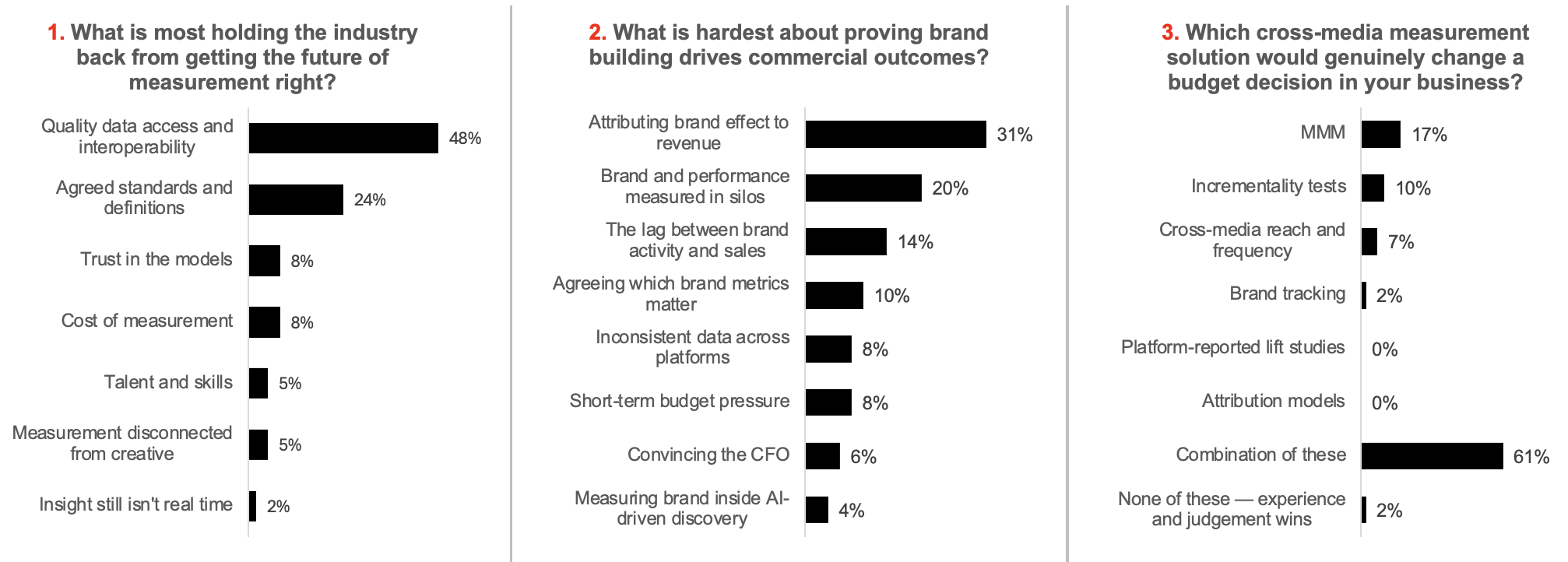
Monks set three thought-provoking questions for the audience that ran across the day:
Better data, better measurement
If there was one message that came through loud and clear, it was that the industry doesn’t need more measurement methods — it needs better foundations on which to use them.
IAB Australia unveiled the first wave of findings from its Future of Measurement Report, with a clear headline: confidence falls away when it comes to measuring advertising’s collective impact, and the constraint is increasingly data rather than a shortage of methodologies. The Report calls for shared, standardised data for both media planning and assessing effectiveness.
That finding was reinforced by the first of three Monks-sponsored audience polls, with 48% of the room identifying quality data access and interoperability, and a further 24% saying agreed standards and definitions, are the biggest things holding the industry back from getting the future of measurement right.
Megan Brownlow moderated an insightful discussion with Sally Hellyer from WPP Media and Brett Camilleri from Monks. The discussion covered current confidence in measurement, data foundations, longer-term brand impact, AI’s role in measurement, creative effectiveness and their excitement and fears for the future. On current confidence levels for holistic measurement, Brett didn’t mince words:
“Data was a massive problem 20 years ago. It’s still the biggest constraint we have. There are so many amazing techniques out there — with open source, with AI, it’s even quicker, easier and accessible to build these solutions. But data is holding us back. There are inconsistent taxonomies, definitions… any measurement project that is super delayed is due to data, normally. It’s not the methodology; it’s the data issue, and I think that’s a whole-of-industry problem.”
Brett Camilleri, Monks
In this period of fiscal restraint brand advertising can be sacrificed in favour of sugar hits. To enable us to hold firm on brand advertising, Sally said:
“We need to convert brand tracking percentages back to an outcome. We are seeing MMM advance now with brand tracking being able to be fed into models. It’s key that we start to fuel our CMOs with data outside historical views of how brand tracking has contributed to outcomes and provide predictions going forward. Being able to say that if we raise awareness, we predict that will generate x in dollar value. That will get trust and confidence from Boards.”
Sally Hellyer, WPP Media
David Cohen, CEO at IAB US made his first trip to Australia for MeasureUp and in conversation with Gai Le Roy, CEO at IAB Australia, offered a memorable diagnosis of the industry’s tendency to chase the next big thing:
“One of the things that we suffer from is that we are a shiny penny industry. We get very smitten with the new and the next, and we move off from things that we haven’t figured out already.”
David Cohen, CEO, IAB US
As marketers move on to “agentic AI, and generative AI, and creator, and commerce”, David’s message was simple: the industry needs some discipline around solving the measurement problems it already has.
David also introduced IAB US Project Eidos, a multi-year effort to modernise marketing measurement, including its new Campaign Data Standards 1.0 — a shared framework for describing advertising experiences and inventory across platforms, channels and campaign systems. Initiatives like this offer a potential foundation for more reliable attribution, incrementality and MMM through better data inputs.
Measurement’s shift to business outcomes
The next challenge is making sure measurement actually helps marketers understand — and improve — business outcomes. In Building Brands for Commercial Outcomes in the Agentic Search Era, Google’s Angus Boulton framed the shift: “When AI agents act as the new gatekeepers of discovery, consumers aren’t browsing straight lines anymore.” Eduardo Maia from Google made the case that brand equity remains the marketer’s ultimate moat, showing how brands can directly drive lower-funnel revenue in an AI world. Drawing on new 2026 research from Google and Tracksuit, Eduardo said:
“When you have a strong brand, consumers will search for your brand and not the category… for those with lower to moderate awareness, the impact of increasing awareness on share of search is roughly linear. For every +5pp gained Brand Awareness yields +5pp Share of Search. There is a lot to gain from investing in a brand early on. And that means a gain in future demand and market share.”
Eduardo Maia, Google
The second Monks-sponsored audience poll highlighted the challenge of proving that connection. The room identified attributing brand effect to revenue, and the siloing of brand and performance measurement, as the biggest barriers to proving that brand building drives commercial outcomes.
The conversation then turned to moving beyond using a single measurement source. In Moving Beyond Attribution: Proving Incremental Sales Impact, Tom Gregory from Lifesight moderated a discussion with Peter Roberge from Goodr, Sonja Popovic from VGW, and Mark Echo, formerly of IAG. Peter explained that three elements (MTA, MMM and platform reporting) make up the core pillars of Goodr’s measurement and how they use a consensus driven approach to scale up or scale back media spend. MMM is calibrated via geo-lift experiments and then MMM is used to calibrate the attribution. Peter said:
“These reviews to discover those consensus driven decisions happen with increasing frequency but come out with every new MMM update, typically a monthly cycle.”
Peter Roberge, Goodr
In determining what to trust for decision making he said:
“We take a zero-trust policy at Goodr, anything in a vacuum is treated just as a signal. The points of difference across the three measurement methodologies are some of the most interesting to dig into to figure out why (could be things like timing, poor deployment, sample size).”
Peter Roberge, Goodr
While Goodr are seeking automation of the consensus approach, human oversight was also flagged as vital in the process.
In Proving ROI in an Evolving AI Marketing Ecosystem, Eby Jose from Meta argued that measurement systems need to evolve alongside how media exposure and influence work today — capturing true business impact through incrementality and then operationalising those results through the measurement and decision stack with AI. Eby said:
“Your first experiments will give you the ground truth to validate what your other models are telling you. This is the beginning of embracing incrementality. Calibrate your existing models to those results. You may have strong incrementality data from your experiments, but if your MTA or MMM doesn’t reflect those learnings, your day-to-day reporting may still be over- or under-valuing channels.”
Eby Jose, Meta
Eby was joined by Andy Ford from Canva, who shared how Canva is embedding incrementality across its measurement ecosystem.
The third Monks-sponsored audience poll asked which cross-media measurement solution would genuinely change a budget decision. Most of the audience selected a combination of tools — MMM, experiments, attribution, reach and frequency, and brand tracking — rather than a single solution.
In her first visit to Sydney, Alyson Sprague, Global VP of Measurement Science at Samba, was joined by Jon-Paul Stift from TikTok, announcing a market first launch of Samba’s entertainment outcomes measurement product, in their session Watch It. Love It. Tune In. In a proof-of-concept study, Samba and TikTok joined the dots between platform ad exposure from a mobile device to the action of tune-in for households watching two Netflix programs. Using ad exposure data directly from TikTok, actual viewership from Samba’s ACR technology and a causal machine learning model to identify the propensity of households to watch the Netflix shows, enabled the measurement of incremental lift in tune-in. For the launch of Squid Game S3 the advertising drove a 19% tune-in lift, or an additional 17,500 tune-ins. Alyson said:
“The next generation is not just measurement that it worked or why it worked but how do we use that to predict and how do we use that to target the next viewers to those platforms.”
Alyson Sprague, Samba
Media works better together
A recurring theme throughout MeasureUp was that media should not be evaluated solely channel by channel. Understanding how channels work together is becoming increasingly important.
In Proving Cross-Media in a Fragmented Stream, Jan Bojko from Spotify shared a new blend of methodologies demonstrating the lift generated by pairing digital audio with out-of-home and online video. The research showed strong synergies between Spotify and both OOH and online video, including stronger memory retention for Spotify + OOH and Spotify + Prime Video. Multi-channel exposure also lifted conversion efficiency in DSP reporting when Spotify was paired with both.
In The Point of Influence, Lauren Mullane from Scentre Group BrandSpace and Paul Sinkinson from Analytic Partners shared new research into Retail OOH that showed environmental receptivity to be a significant — and previously underexplored — driver of performance, with Retail OOH delivering strong standalone returns while also lifting other channels. The message: effectiveness is shaped not only by proximity to purchase, but by the audience’s mindset and receptivity within an environment.
Sharon Hilton then presented Kantar analysis in Measuring Media Synergy: 10 Years of Cross-Media Evidence on Campaign Effectiveness, showing that the contribution of channels working together has almost doubled — from 23% of campaign impact in 2014 and earlier to 45% today. Synergy matters most for building motivation, persuasion and brand equity — outcomes that drive long-term demand. Steve Weaver added the Publicis Groupe perspective, identifying five unlocks:
- Expanding channel breadth
- Understanding how channels contribute differently
- Identifying the strongest pairings
- Tailoring synergy to objectives
- Using creative to connect experiences across channels
Our third international speaker for the day, coming all the way from Denmark, was founder of AudienceProject, Mogens Storgaard Jakobsen. Mogens drew on 15+ years of global cross-media experience and challenged three industry myths: that TV only reaches older audiences, that more media always means more value, and that channels compete in a zero-sum game. His message was to look beyond volume to who is reached, how efficiently, and how channels complement one another:
“Advertisers and media owners don’t need a perfect cross-media view to make better decisions — they need enough reliable data to act with greater speed and confidence.”
Mogens Storgaard Jakobsen, AudienceProject
Creative meets culture and consumer mindsets
The final part of the day moved the conversation to consider creative, the biggest driver of advertising effectiveness, along with attention, culture, influence and the quality of advertising impact.
In The 2.5-Second Survival Guide: How to Fix the Attention Gap in Australian Advertising, Daren Poole and Ed Harrison from Ipsos explored the role of memorable attention — ensuring ads aren’t simply seen but encoded into memory to shape perceptions and behaviour. With US advertisers now spending eight times more than in 2012 to achieve the same recognition, Ipsos’ findings pointed to the importance of engaging creative, including entertainment, uniqueness and talkability. Daren and Ed showed us examples of distinctive, emotionally engaging and unmistakably branded advertising that compounded attention across touchpoints to break through the 2.5-second barrier.
Nicola Harvey and Nikki Katsenos from The Guardian Australia looked at changing consumer behaviour in Shift Happens: Turning Cultural Trends into Premium Brand Insights. Drawing on Guardian-commissioned research into five key consumer shifts, they highlighted opportunities for brands to be part of the rituals that restore, the tools that save time, the communities that connect, and the experiences that make life memorable.
And in From Influence to Impact: What Actually Drives Brand Impact in Creator Marketing, Irene Joshy from Kantar and Brittanie English from The Content Division challenged the industry to look beyond the metrics that are easiest to measure. With creator marketing spend surging, likes, views and engagement rate can too easily become proxies for effectiveness. Their call was to focus instead on emotional resonance, cultural relevance and creative craft — choosing creators for brand-voice fit over fame, giving creators the freedom to “break the brief”, and building durable brand associations rather than one-off transactions.
MeasureUp winners
Kirsten Riolo from Nielsen, on behalf of the IAB Ad Effectiveness Council, launched The Essential Marketing Effectiveness Reading List — the Council’s pick of the most essential body of knowledge for anyone serious about how marketing works. A huge thank you to Nielsen for sponsoring the random seat prize, with one lucky attendee taking home the full set of essential books.
And congratulations to Steve Weaver, Dan Cravero, James Pick, Varsha Nimalendran and Ross Hanson, who each asked a cracking audience question and walked away with a pair of Adidas Sambas from our sponsor Samba.
And if MeasureUp 2026 has sparked an idea for next year, start shaping your pitch now — and talk to us. We can’t wait to see what you bring to MeasureUp 2027.
Thank you to our MeasureUp 2026 sponsors: Google, IAS, Meta, Monks, Samba and Nielsen.