A local clock change, a podcast sponsorship and a booking that stalled. See inside the Australian pilot testing of how advertising agents handle details of a deal.
New to this? Start here · What’s been done · What we’ve found · What to do now · FAQs
Purchase twelve weeks of advertising in Sydney and you’d expect the proposal to show twelve weeks, even if the clocks change halfway through. In an early check of the proposed trading rules, a draft industry standard for describing advertising offers, the calculation came back at eleven. We tried two fictional Sydney campaign periods against the revised rules. Both came back at twelve.
Catching key minor details like that before anyone relies upon them is the responsibility of the agentic advertising pilot IAB Australia announced in September. Before a buyer or seller can rely on an agent, some ordinary questions need clear answers. Which price did the buyer approve? Who can agree to a change? Do those terms reach the booking system? Those are questions the Australian pilot can test.
Don’t be misled or distracted by the noisy sales pitches related to agentic – it’s still very early days and we need to get the foundational operational disciplines correct before we proceed to the commercial executions. This requires diligent testing of the meaningful details that can enable the conventions of media buying and selling to flourish through the new age enabled by agentic standards that meet the proven requirements that we know and rely upon today.
12
Organisations enrolled
2 full-track sellers, 4 readiness-first sellers and 6 observers.
34
Reports filed
With IAB Tech Lab on its open-source seller and buyer agents since July. 19 since closed.
17
OpenProposal threads
Public discussions of the draft specifications with meaningful Australian inputs.
$0.0
Live media spend
The pilot runs in a sandbox using synthetic data against fictional data points.
As at 11th November 2026. Reports are counted once each across both agents’ public repositories on GitHub, and include IAB Australia’s lab work before the pilot began. A closed report isn’t necessarily a released fix.
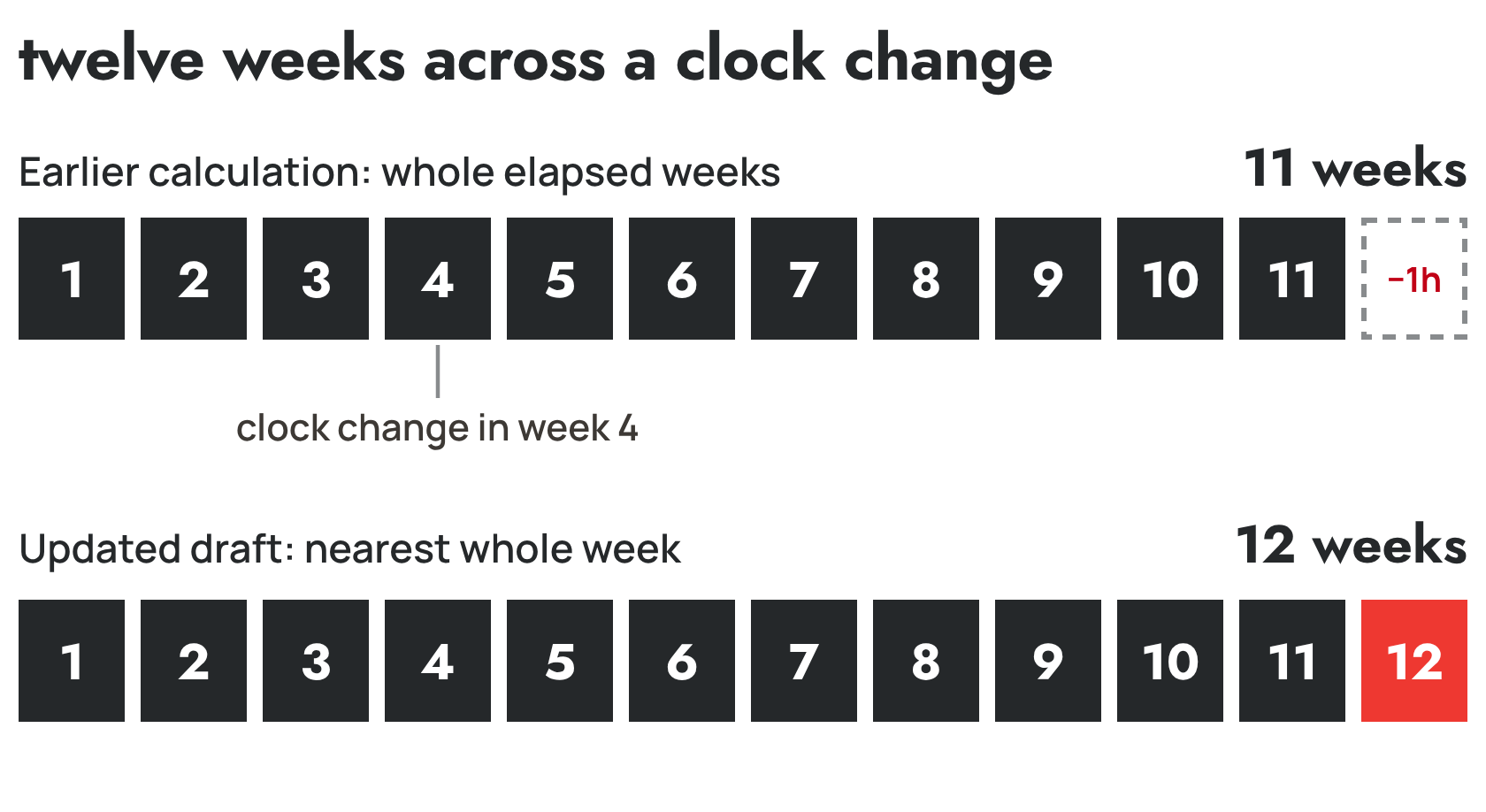
A fictional Sydney campaign, Monday 7th September to Sunday 29th November 2026: twelve calendar weeks. Clocks go forward on 4th October, so it runs one hour short of twelve full weeks, and counting whole elapsed weeks gave eleven. Under the updated draft rules, this period and one across the autumn clock change both counted as twelve, and the draft’s example checker rejected the earlier eleven-week result. Source: IAB Australia lab tests of the draft OpenProposal rules.
What’s an advertising agent?
“What can you offer us for this budget?” Today, someone reads the brief, checks what’s available, finds the agreed rate and works out who can approve a discount. The answer often arrives in a spreadsheet for someone else to re-key.
An advertising agent is software that can carry out several of those steps on someone’s behalf. A planner might ask a buyer agent to shortlist suitable ad space. A publisher might let its seller agent quote an agreed rate and refer a larger discount to the sales manager. Giving software permission to take the next step is what people mean by agentic advertising.
From brief to booking: today, and with agents
| Step | Today: email, PDFs and endless re-keying | With agents: within rules that people can set |
|---|---|---|
| 1 | Brief arrives by email | Buyer agent sends the brief |
| 2 | Someone checks availability and rates | Seller agent answers from the seller’s machine-readable catalogue and rules |
| 3 | Proposal built in a spreadsheet or PDF | Exceptions go to a named person |
| 4 | Back and forth by email and phone | Buyer’s team chooses a proposal |
| 5 | Details re-keyed into the ad server | Approved details go to the booking system |
Illustrative workflow. Each business decides what its software can see and do. Software does the chasing, and ultimately people set the rules and make the calls (shown in bold).
Why do the agents need a protocol?
Suppose two websites carry the same weekly rates. Does the price buy a placement on either site or across both? Someone on the sales desk knows. To answer reliably, software needs agreed ways to describe the product, the price and exactly what the seller is promising. A protocol sets out how systems exchange that information.
AAMP stands for Agentic Advertising Management Protocols. This is a key industry initiative from IAB Tech Lab, the non-profit that develops technical standards for the global digital advertising industry, for applying agents to advertising using standards the industry already works with. It includes open-source reference agents: example buyer and seller software that teams can run and inspect. One part, OpenProposal, describes how to express a brief and an offer. That’s where a question as ordinary as “how many weeks?” becomes worth testing.
The Australian pilot in one minute
In September this year, IAB Australia invited local organisations to test whether buyers and sellers could use this software to find, describe and assess Australian inventory. The pilot uses fictional campaigns, products and rates (its documents call this synthetic data) in a sandbox, a test environment with no live media spend.
The cohort tests one fixed version of the software, the pinned version: the reference agents built for AAMP 2.3. Pinning keeps teams’ results comparable and means nothing changes mid-test. In parallel, IAB Australia checks Australian examples against the draft of AAMP 3.0, which adds OpenProposal. Public comment on that draft closed on 10th November 2026.
There are three ways to take part:
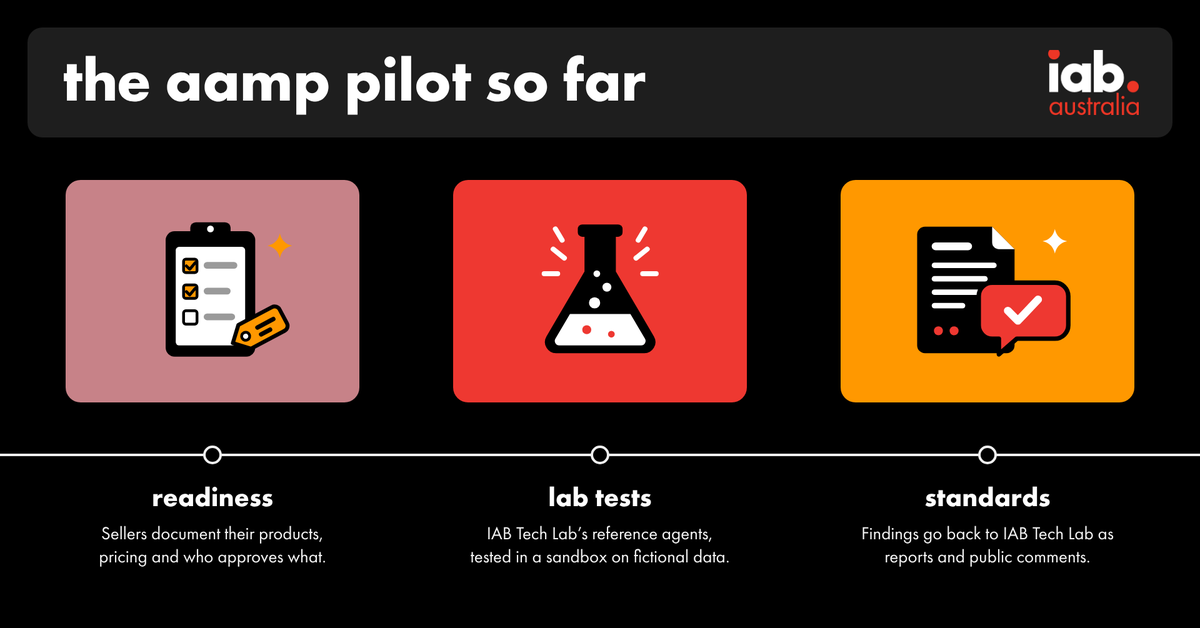
Sellers on the Full Track run the reference seller agent in their own sandbox.
Readiness-first sellers start by documenting their products, pricing policies and approvals, without deploying an agent.
Observers contribute a buyer’s brief or explain what evidence their teams would need before trusting a proposal. The lab findings below come from IAB Australia’s tests.
Taking part
2 full-track sellers · 4 readiness-first sellers · 6 observers.
What’s been done so far?
Much of the work happens before two agents ever even exchange a message. Commercial teams know which terms can change. Operations teams know what has to reach the booking system. Practitioners know when a product description could mean two quite different things. Here’s where that knowledge is showing up…
The pilot so far, and what’s planned
| When | What | Status |
|---|---|---|
| Late July | IAB Australia starts testing IAB Tech Lab’s reference agents in its own lab and files its first report. | Done |
| 22nd September | The pilot is announced. The same day, IAB Tech Lab opens public comment on AAMP 3.0 and OpenProposal. | Done |
| 30th September | Expressions of interest close. | Done |
| 19th to 26th October | Kickoff sessions with each seller team. Observers’ sessions follow. | Done |
| Early November | First lab tests of the seller agent’s AI review, on fictional proposals. | Done |
| 6th November | A digital out-of-home media owner joins on the readiness-first track. | Done |
| 10th November | Public comment on the OpenProposal draft closes, with Australian input on 11 threads. | Done |
| Now | Readiness work: sellers document their products, pricing rules and approvals. | Now |
| Mid-Late November | Readiness sign-off, then the first full-track seller agents running in a sandbox. | Planned |
| December | Full-track sellers run the agent on their own fictional catalogues. | Planned |
| Mid-December into January | Summer pause. | Planned |
| From January 2027 | Sandbox transaction scenarios, including observers’ briefs. | Planned |
| To follow | Findings report, Australian Seller Playbook and a member showcase. | Planned |
Planned steps are the current plan and may move
The cohort
6 seller teams, 6 observers
Kickoff sessions with the first five seller teams finished on 26 October. A sixth seller joined on 6 November.
Seller readiness
Rates stay with the seller
Workbooks cover inventory, product classifications and selling authority. Floors (the lowest prices a seller will accept) and exceptions go in a private workbook.
The lab
34 reports, 2 changes merged
The proposal-to-booking sequence has been exercised with fictional data, and the lab guide now checks whether the AI review actually ran. Two small changes we proposed were merged in August.
The standards
11 OpenProposal threads
Australian examples have gone back to Tech Lab with the conditions tested and the results, from a weekly rate across daylight saving to a share of a screen network.
The buy side
2 buy-side workbooks
An observer’s brief has been run through the reference buyer agent. Two observers asked to go further, so workbooks now map a fictional brief, field by field, to the OpenProposal draft.
Trust and governance
Pseudonyms in shared records
Teams keep their own commercial policies. Sellers name the person who can approve an exception and check what record that decision leaves.
What have we found so far?
First, how to read this section. The software under test is a reference implementation: example code IAB Tech Lab publishes so the industry can run it, question it and improve it. Each finding describes what we observed in a sandbox, with fictional data, on a specific version. None of it describes a production system. Some runs replace the AI model with a stand-in, a fixed answer, so they test the steps around the AI and not its judgement.
We report what we see to IAB Tech Lab on GitHub, where anyone can read it. Of the 34 reports filed since July 2026, 19 have since been closed by the maintainers. Closed doesn’t always mean fixed in a release, so newer software is checked in IAB Australia’s own lab before the cohort is asked to move to it.
What happens after a person says yes?
In one fictional lab campaign, the buyer agent found suitable options and a person chose one. At booking, another part of the software looked in a different directory and couldn’t find the seller. We traced the handover and tested local changes. The software could then reach the seller and obtain a quote. The follow-up checks stopped at the quote.
The figure in that quote price field differed from the discounted figure described in its explanation. A planner reading the explanation and a booking system reading the number could come away with different expectations. Comparing those two views gives us a practical way to test the next offer. This is what genuine pilot testing is all about, no product pitches – but meaningful operational validation.
Three seller-side findings at a glance
| Finding | What worked in our tests | What we reported |
|---|---|---|
| Approval | The seller agent paused and waited for a named person before it agreed to a proposal. | That approval covered one decision. A later quote, booking or price change wasn’t sent back to a person. |
| AI review | When the AI review failed, the seller still answered, using its built-in rules. | Nothing in the response or the approval request said the rules had answered in place of the AI. |
| Floor price | A counter from the AI review was held to the seller’s floor. Below-floor accepts were held for a person’s approval. | An accept from the AI review wasn’t checked against the floor. |
Sandbox tests with fictional data. The versions tested differ by finding. The detail below gives each version, the conditions and the exact wording we reported.
Where the approval applied in our tests
| Step | What we saw |
|---|---|
| 1. Proposal decision | Approval gate: a named person decides, at the terms in front of them |
| 2. Quote | Not covered by that approval in our tests |
| 3. Negotiation | Not covered by that approval in our tests |
| 4. Booking | Not covered by that approval in our tests |
Tested on the version of the seller software the pilot uses (v2.4.2) plus one fix merged after that release, and on a later development version. Synthetic data, with a stand-in in place of the AI review.
The three findings in detail: versions, conditions and exact wording
Approval covers one decision
The reference seller agent can pause and wait for a named person before it agrees to a proposal, and in our tests that pause worked. But the approval covered that one decision. What came next (a quote, a booking or a price change) wasn’t sent back to a person.
What to do about it: sellers should write down which steps need a person, not just the first one, and buyers should know exactly which terms a person signed off. The pilot asks every seller to name approvers for each event that matters to them, booking included, even where today’s software can’t yet enforce it.
The precise finding, as reported
The approval gate pauses the proposal decision, at the terms in front of the approver. In our tests it didn’t govern a later quote or booking by the same buyer, and a price change after approval didn’t raise a new approval request. On the upstream commit we tested, the negotiation path could link a deal to a proposal whose approval was pending or rejected (#129).
When the AI step fails, the rules answer quietly
The reference seller agent uses an AI review to assess a buyer’s proposal, with built-in rules as a backstop. At the version we’re pinned to, if the AI review fails (a missing or rejected credential, a provider error such as a rate limit, or the time budget running out), the seller answers with its built-in rules instead, and nothing in the response or the approval request says so. We’ve reported it to IAB Tech Lab as #118.
In the lab, we check which path decided against the seller’s log and proposal records, proposal by proposal, and record it as uncertain where the records can’t tell us. The lab guide asks testers to make the same check.
What to do about it: a buyer can’t tell from the response which path answered. Before relying on any agent, sellers should ask how it flags a fallback, and check what their own records show.
The precise finding, as reported
At the version we’re pinned to, if the AI review fails (a missing or rejected credential, a provider error such as a rate limit, or the time budget running out), the seller answers with its built-in rules instead, and nothing in the response or the approval request says so. We’ve reported it as #118. In the lab we check the deciding path against the seller’s log and the proposal records, and record it as uncertain where attribution is inconclusive.
Every “yes” needs checking against the floor
At the pinned version, when the AI review countered a buyer’s offer, the counter was held to the seller’s floor price. When it accepted, that check was skipped. In our synthetic tests, those below-floor accepts were held for a person’s approval, and the seller’s own evaluation flagged the price as below its minimum. We tested a small change that checks every AI accept against the floor, and offered it to the maintainers.
What to do about it: write your floors down and ask how your software enforces them. Floors that are written down and enforced by the software, not just held in people’s heads, are a core part of being ready. It’s why pricing policy sits at the centre of the readiness work below.
The precise findings, as reported
At the pinned version, an accept from the AI review isn’t checked against the seller’s floor. A counter is held to the floor; an accept skips that step. In our synthetic tests, below-floor accepts were saved as proposals pending approval, and the approval record showed the seller’s own evaluation marking the price as below its minimum. The approval record also carries text the buyer wrote, alongside the seller’s evaluation; we didn’t examine how clearly an approver is shown which is which. We didn’t test what an approver would decide.
We tested a small change that checks an AI accept against the effective floor, including an agreement price the seller holds, and turns a below-floor accept into a counter. It blocked every below-floor accept in a replay of recorded decisions and in a small live sample, in one environment, and in those tests it let every legitimate accept through. It enforces the floor; it doesn’t keep an agreement’s price: in the live sample, where the review countered at the agreement minimum, the seller saved its own counter price above it. It’s a pilot patch on the pinned version, and isn’t in the lab pack.
What exactly has the seller promised?
Take a digital out-of-home campaign. On one screen, a buyer could buy ten seconds in every sixty-second loop. Across a group of screens, the agreement might instead be for a share of the impressions delivered by the group. Both offers can be described as “share of voice”. A buyer comparing them needs to know what the share is measured against specifically.
Two promises, one name: “share of voice”
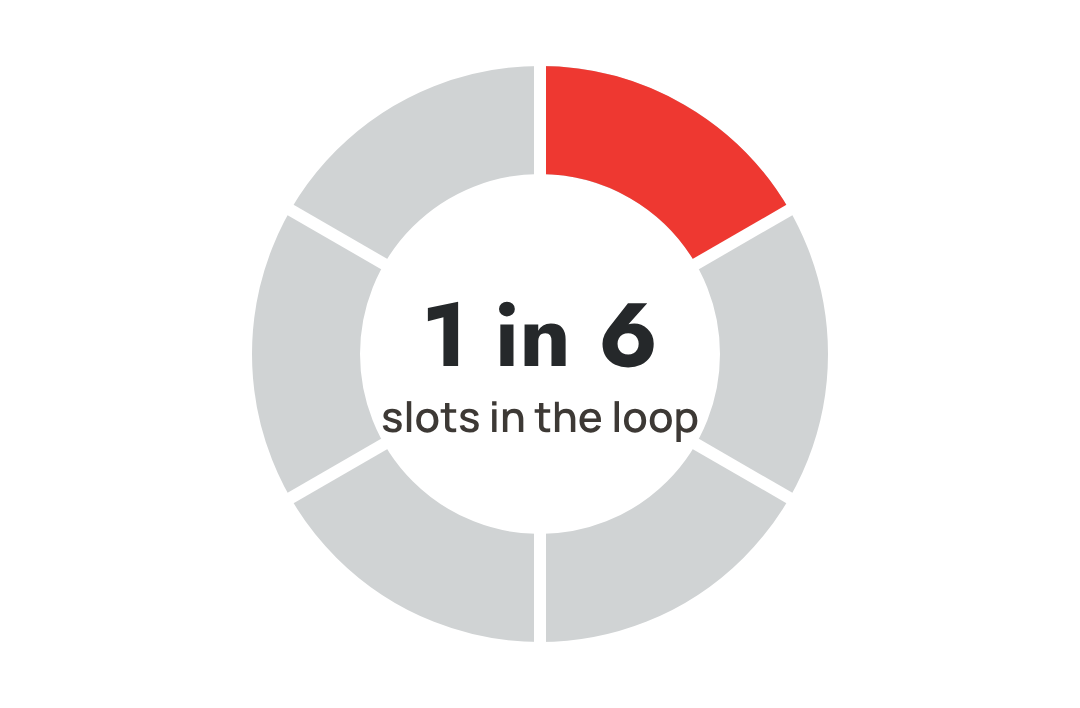
A share of the loop
For example, one 10-second slot in a 60-second loop on a single screen: a fixed share of the time.
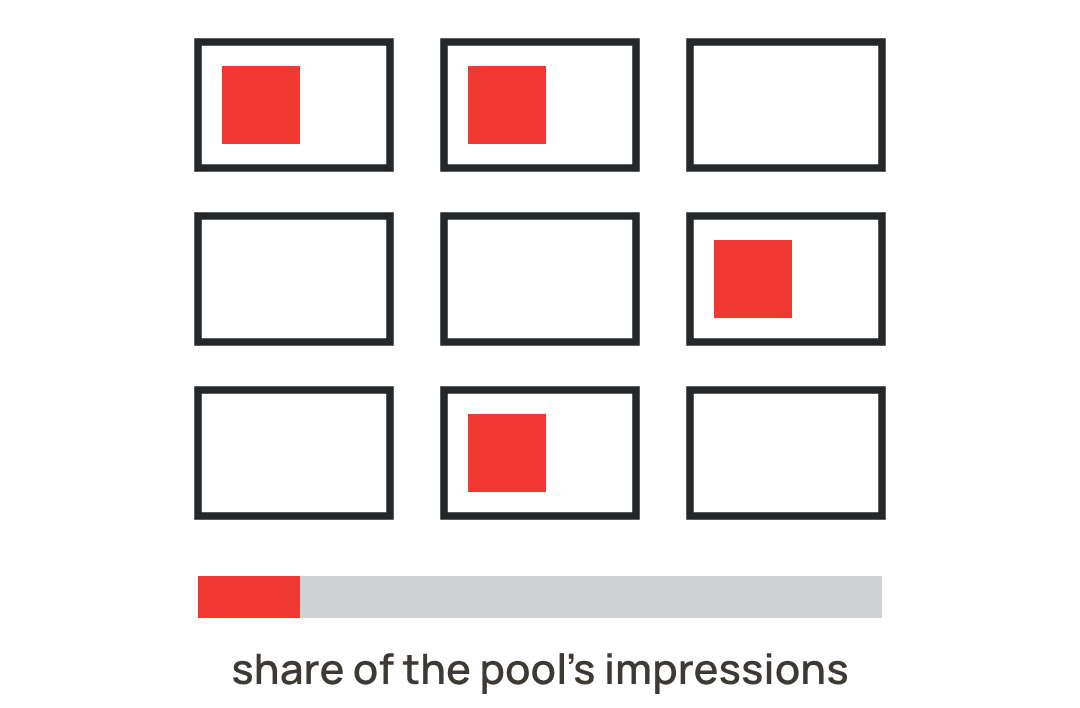
A share of impressions
For example, a percentage of all impressions across a network of screens, with no fixed slot on any one of them.
Illustrative figures only. The open question is which promise a proposal makes, and how it’s stated.
We tested how a fictional screen offer carried details such as the venue, screen and loop length, and reported the gaps we found in the version tested. Practitioners helped distinguish a fixed slot from a commitment across a pool of screens. That distinction changes what a buyer can expect to receive.
Audio and publisher packages
A host-read podcast sponsorship and an ad inserted into a stream can both appear as “audio” in a catalogue. A fictional host-read scenario gave practitioners a way to examine which terms the proposal needs to carry. A similar question came up for sales houses. A shared rate across two sites tells you very little about whether those sites must be bought together. We’ve drawn up workbook changes so sellers can record which properties are included and who has authority to sell them.
A one-day booking at a weekly rate
The counting rule behind the twelve-week example has another edge. We tried one day at a weekly rate. With no minimum specified, the checker (a script published with the draft that tests example files against its rules) accepted a total of zero. We took that question back to the people writing the specification. Should a seller have to enter a minimum, or should the rules already provide one? It’s an easier conversation to have over a test file than over an invoice.
What does this mean for sellers, buyers and tech vendors?
Agents can only work with what’s written down in a form they can read: what’s for sale, at what price and on whose authority. What that means in practice depends on where you sit.
What’s at stake, and where to start
Sellers
Publishers, broadcasters, out of home, audio and sales houses
When software builds the shortlist, inventory it can’t read isn’t weighed up at all. As the pilot’s FAQs put it, such inventory “is not disadvantaged in that process. It is missing.”
Start now. Time one recent brief-to-order cycle. Write down your floors and who approves exceptions. Then find your level on the ladder below.
Buyers & agencies
Agencies, advertisers and trading desks
The test is trust: which price is binding, which terms a person approved, and what’s committed rather than estimated. Those are the points the pilot’s lab is checking.
Start now. Note the one question you always ask before agreeing a deal. Could you answer it from the offer alone? Observers bring questions like that, and a fictional brief, to the pilot.
Tech vendors
Ad servers, SSPs, DSPs, measurement and verification
The open questions sit at the handovers: whether a price, an approval or a commitment survives the trip from proposal to booking, and what record each step leaves.
Start now. Browse the open issues on IAB Tech Lab’s GitHub, then tell us what your APIs would need to answer an agent safely.
For sellers, the pilot’s readiness ladder is a quick self-check. Most Australian sellers are expected to start at level 0 or 1, and level 3 needs no agent at all.
The agentic-readiness ladder: where does your business sit?
| Level | What it looks like | Where it fits |
|---|---|---|
| 0 Manual | PDF or slide media kit; pricing lives in people’s heads and email threads | Where most sellers start |
| 1 Structured | Inventory catalogued with consistent products, formats and specs | Where most sellers start |
| 2 Classified | Priority inventory mapped to IAB content, ad product and audience taxonomies | A win on its own for smaller sellers |
| 3 Machine-readable | Media kit, pricing and approval policy in structured form. A spreadsheet is enough | No agent needed yet |
| 4 Registered | Organisation registered with IAB Tech Lab’s Tools Portal; agent entry drafted | Readiness-first target |
| 5 Operational | A seller agent answers, quotes and transacts in a sandbox, within your guardrails | Full-track target |
From the pilot’s guidance for participants. Participating sellers are scored at the start and end of the pilot.
What comes next?
The timeline above shows the plan. The lessons go into a findings report and an Australian Seller Playbook, and any change to the cohort’s software baseline goes through a checkpoint.
Seller places for this cohort were confirmed in October. If you’re an IAB Australia member and would like to observe, or to start the readiness work in your own business, contact us and we’ll tell you what’s possible at this stage.
If you sell media, pick a package and ask whether a new planner could tell exactly what the rate buys. If you buy media, ask whether you could identify the price and terms you approved when the order comes back. If you build the systems between them, trace what happens to those details at the handover. Those are the examples we’d like to hear about.
Thank you to the commercial, operations and technical teams making time to document rules, contribute briefs and challenge the examples. A term clarified in a workbook can change the question that goes to a global standards group.
More questions?
The pilot FAQs have been updated alongside this article: how AAMP compares with AdCP, whether an agent with a brief can spend a budget, who can see your rates, and how to get involved.