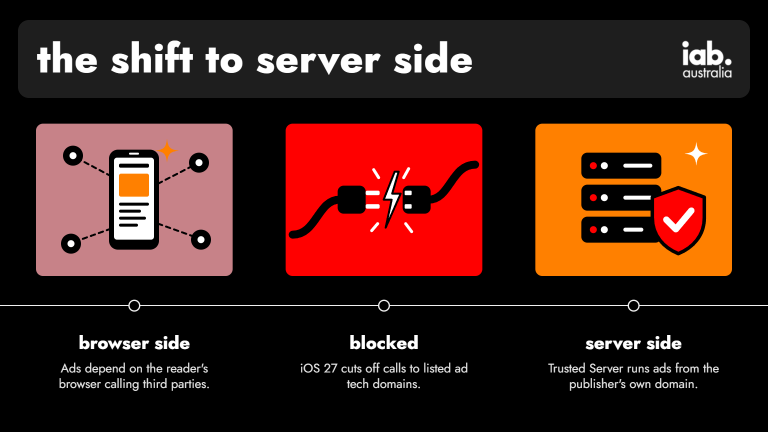
Increasingly, our industry now works with three practical deployment models for inserting advertising into video streams – namely client-side ad insertion (CSAI), server-side ad insertion (SSAI) and the newer hybrid server-guided ad insertion (SGAI).
The choice between these different options can shape viewer experience, measurement accuracy, ad-quality signalling, scalability and monetisation, particularly across the broadcaster video on demand (BVOD), connected TV (CTV) and live-streaming environments used by Australian broadcasters and publishers.
So we wanted to put together a brief explainer on what SGAI is, how it compares to the other two common video ad insertion methods as hopefully useful practical reference guidance for buyers, agencies, publishers and platform operators on how ads get into a video stream, and what each method means for measurement, scale and viewer experience. We hope you find it useful, and please feedback on anything missing, incorrect or confusing (simply contact us).
What is SGAI?
SGAI is best understood as a hybrid architecture that pairs server-controlled ad-break signalling with client-side ad resolution. It is an emerging implementation pattern rather than a settled category, and terminology still varies between vendors: several established platforms now offer server-guided modes, and some run SSAI and SGAI on the same infrastructure with per-session selection. It is more useful to treat the three as a spectrum of where the decisioning, insertion and measurement work happens than as three separate worlds.
Comparing The Three Models
As it’s a hybrid approach, the best way to help explain SGAI is to directly compare it to SSAI and CSAI. The descriptions in the table below reflect typical implementations as of August 2026 and behaviour often varies by vendor and integration choice, so always validate against your own environments.
| Aspect | CSAI (client-side ad insertion) | SSAI (server-side ad insertion) | SGAI (server-guided ad insertion) |
|---|---|---|---|
| How it works | The player on the viewer’s device requests each ad separately from the content and inserts it at playback time. Content and ads travel as separate requests. | The server composes a session-specific playback experience (typically through manifest manipulation and separately prepared ad segments) so that content and ads play as one continuous stream to the viewer. | The server marks ad-break opportunities in the manifest. The player detects the marker, requests a personalised ad pod, then resolves and plays it, commonly stitching on-device at playback. A hybrid of server orchestration and client execution. |
| Typical use cases | Desktop web and mobile in-app video. Widely used across web players and by the large video and social platforms, which run their own proprietary variants. | BVOD, CTV and smart-TV apps, and live linear. Widely used by broadcasters for CTV and smart-TV distribution. | Modern CTV apps, low-latency live sport, premium VOD and extended DVR or catch-up windows. Now running in production at major broadcasters, not just in trials. |
| Ad experience | The player pauses content to load the ad; a slow load can cause a gap or a jarring transition. Skipping is straightforward. | Can deliver more seamless, TV-like transitions, though playback quality still depends on encoding, ad preparation, CDN behaviour and the player. Skipping is harder. | Seamless, player-optimised transitions comparable to SSAI, while also supporting newer formats such as L-bars, squeezebacks, side-by-side and overlays. |
| Personalisation & targeting | High. Real-time decisioning using full client context, device signals and first-party data. | Capable of per-viewer personalisation. The constraint is complexity and cost rather than capability, as per-session manifest generation scales. | High. Ad requests are triggered from the client at the exact break, combining server decisioning with client context and first-party data, at lower manifest overhead than personalised SSAI. |
| Measurement & verification | Richest environment. DSP pixels, verification tags and OM SDK can fire directly from the player, so impression counting is comparatively straightforward. | Often depends on server-side logs and beacons, particularly in CTV apps where JavaScript cannot run or OM SDK is not present. OM SDK coverage across CTV continues to grow. | Can support richer player-side measurement where OM SDK or an equivalent client integration is present; otherwise it falls back to server-side beaconing. Fidelity is an implementation choice, not an automatic property of SGAI. |
| Discrepancy risk | Often easiest to reconcile, because buyer and seller can observe the same player-side events, though consent state, player SDKs and VAST wrappers still create variance. | Moderate, arising from differences between server beaconing, player telemetry and buyer-side counting methodologies. | Typically lower than pure SSAI where player-side signals are retained, but the outcome depends on player implementation and measurement-partner support. |
| Ad-blocker resistance | Weakest. The separate ad call is comparatively easy to identify, intercept and block. | Generally the most resistant, because ads are delivered as part of the playback workflow and are hard to strip without disrupting content. Resistant rather than immune: manifest, CDN and domain-level blocking remain possible. | Good, but conditional. Manifest cues and player-side execution are harder to intercept than a pure CSAI ad call, but ad or asset-list URLs served from a recognisable ad domain can still be blocked. Not as invisible as a fully stitched SSAI stream. |
| Scalability, cost & start-up time | Lowest server-side burden, since insertion runs on the viewer’s device. Loading ads up front can lengthen video start time. | Carries real server-side cost for ad preparation and per-session manifest generation, most acute during live peaks. Significant, but well managed by mature vendors. | Content manifests stay cacheable and ads resolve just-in-time, reducing central processing and improving start time and total cost of ownership. The trade-off: just-in-time resolution concentrates ad calls into a narrow window at the break, which can stress ad servers and SSPs without prefetch and pacing. |
| Live & low-latency suitability | Moderate. Separate ad loading can introduce latency, making it less ideal for premium low-latency live. | Workable for live linear, but latency budgeting is complex because server-side work adds processing delay. | Can suit low-latency live well, and enables dynamic ad replacement on DVR and seek-back, monetising catch-up viewing that often goes unfilled. Latency still depends on decisioning, ad preparation, CDN placement and player design. |
| Advanced & interactive formats | Strong. Overlays, interactive units, shoppable formats and companion experiences are straightforward via the player. | Limited. Non-linear and interactive formats generally require an additional client-side layer over the stitched stream. | Strong. L-bars, squeezebacks, double-box and side-by-side, overlays and shoppable formats can run within player-controlled insertion. |
| Device compatibility & player requirements | Broad, but subject to browser, operating-system and player-SDK fragmentation. Relies on mature player SDKs and standard VAST tags. | Broadest reach, because the device receives a single continuous stream, so even constrained or legacy CTV devices are covered. A key reason publishers retain it. | Requires modern players that support interstitial or alternative-manifest signalling. Legacy CTV support varies and some devices may never qualify. Vendors increasingly offer per-session SSAI/SGAI fallback as a hybrid option. |
How SGAI is signalled
SGAI is the first insertion model built substantially on open streaming standards. The server exposes ad opportunities inside the media manifest and the player acts on them.
- HLS Interstitials (Apple). An interstitial scheduling mechanism using EXT-X-DATERANGE tags carrying the com.apple.hls.interstitial class and an asset-list reference, resolved late at the break. Introduced by Apple in 2021 and now the most widely used foundation for SGAI, though not the only one.
- MPEG-DASH and DASH-IF guidance. DASH-based approaches to break signalling, manifest updates and ad insertion, including alternative-manifest and manifest-patch events. These were reworked through 2024–2025 for closer alignment with HLS. DASH-IF interoperability guidance covers both SSAI and SGAI. Implementation support varies by player and device.
- Ad-break cueing. For live and broadcast-derived streams, ad opportunities are commonly signalled with SCTE-35. VOD and client-driven workflows may instead use manifest metadata, VMAP, CMS metadata or player-side timelines. Where SCTE-35 is in use, preserving those cues intact through the encoding and packaging chain is a hard prerequisite.
Critically, these standards govern how ads are signalled and stitched, not how impressions are counted, which is why measurement needs to be designed separately.
Why SGAI is emerging now
SGAI attempts to combine the strengths of the other two models while softening their trade-offs:
-
- the seamless, linear-like viewing experience and ad-block resistance of SSAI;
- the richer player-side measurement and real-time personalisation associated with CSAI;
- support for advanced, non-disruptive formats such as L-bars, squeezebacks, side-by-side and shoppable units;
- lower manifest-personalisation cost and faster video start times through cacheable content manifests; and
- monetisation of previously hard-to-fill inventory, notably dynamic ad replacement within live DVR and seek-back windows.
Ecosystem support has moved quickly. Apple’s HLS Interstitials provide the foundation. Google offers server-guided insertion through Google Ad Manager DAI Pod Serving, with on-device stitching of Google-provided ad breaks. AWS Elemental MediaTailor supports SGAI via HLS Interstitials alongside its existing SSAI, including a per-session hybrid mode so publishers can select insertion type by session. Specialist DAI and player vendors, open-source projects and the SVTA’s standardisation work are pushing implementation maturity further.
SGAI in production
SGAI moved decisively out of the trial phase during the 2026 FIFA World Cup. Belgian broadcaster RTBF, its sales house RMB and technology partner Ad Insertion Platform deployed SGAI on the Auvio platform, notably during the Belgium–Egypt match on 15 June 2026, delivering synchronised ad-break replacement across both live and replay content.
AIP describes it as the first publicly documented SGAI deployment at a major broadcaster using a commercially available platform rather than a bespoke in-house build. That is a useful distinction, given that large streamers such as Disney+ had already deployed server-guided approaches at scale using their own technology.
For Australian publishers the significance is less the specific vendor combination than the proof point: server-guided insertion has now been operated through a major live sporting event, on both live and replay inventory, using commercially available components.
Measurement and verification in SGAI
SGAI standards primarily govern ad-break signalling and playback, not a universal method for counting impressions, measuring viewability or performing third-party verification. For supported environments, IAB Tech Lab’s Open Measurement SDK (OM SDK) is the strongest route to player-side measurement, allowing approved measurement partners to receive standardised signals from web, app and CTV playback.
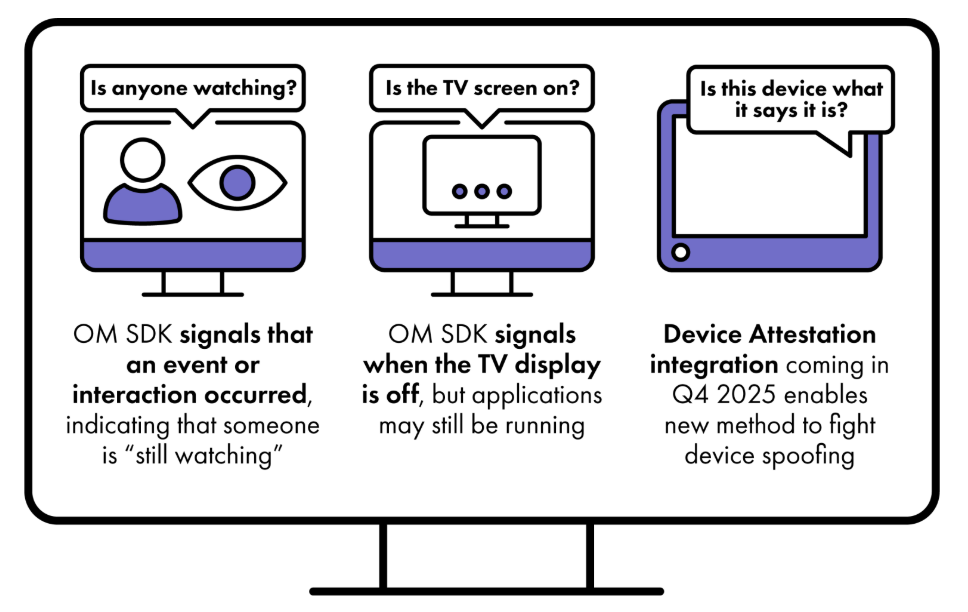
IAB Tech Lab’s OM SDK for CTV aims to address the issue of fragmentation of measurement signals across various platforms by providing a unified framework for measuring CTV-specific viewability signals like is the screen on, device type, and how long since the user has interacted with the TV (see image below).
CMCD v2 can complement this by providing structured client playback telemetry to delivery and analytics systems, including player state and quality-of-experience signals. However, CMCD is not an ad-verification or viewability standard. Where OM SDK cannot be deployed, publishers should combine server-side logs, VAST tracking, device and player telemetry, and agreed reconciliation rules with buyers and verification partners.
The practical principle
SGAI can enable rich, buyer-grade measurement, but it does not guarantee it. The resulting fidelity depends on the player, the endpoint, VAST and verification integrations, consent state, and the commercial definition of a valid impression.
Reconciliation testing with your key DSPs and verification partners is therefore not optional. Agree the impression event definition and the source of truth (server logs, player events, verification partner, ad server, or a defined hierarchy of these) before campaigns launch rather than after the first discrepancy report.
Why SSAI is not going away
For Australian broadcasters, SSAI’s enduring advantages are device reach and simplicity. The device receives a single continuous stream, so even constrained or older CTV devices are covered, and that stream remains the hardest to ad-block. SGAI depends on modern players supporting interstitial signalling, which is not yet universal and may never reach some legacy devices.
The pragmatic path most platforms are taking is hybrid: SSAI for broadest legacy reach, SGAI for premium, live and interactive inventory, with per-session fallback between the two. Framing this as a migration from one to the other misreads how the market is actually operating.
What the industry is doing about it
It helps to separate the open standards from the commercial platforms that implement them.
Standards and specifications
- HLS Interstitials (Apple): the interstitial signalling mechanism underpinning most current SGAI workflows.
- MPEG-DASH and DASH-IF guidance: DASH-side break signalling, manifest updates and ad-insertion architecture, covering both SSAI and SGAI.
- SCTE-35: the prevailing ad-break cue for live and broadcast-derived workflows.
- VAST 4.x: standardises video ad responses, ad pods, tracking and verification hand-offs. Actual measurement capability still depends on player and measurement-provider support.
- OM SDK: the primary route to standardised player-side impression and viewability measurement. Version 1.5 extended CTV coverage to Samsung and LG TVs through the web video SDK, which matters for the Australian smart-TV base; OMID 1.6 is the current API version.
- Device Attestation in OM SDK (IAB Tech Lab, late 2025, OM SDK 1.6): manufacturer-verified device authenticity using an adaptation of the IETF Privacy Pass protocol, initially on Apple and Fire TV devices, to address device spoofing in CTV. It provides evidence that the device is authentic; it is not proof that a person was watching.
- CMCD v2: structured client playback and delivery telemetry. Useful for reconciliation and quality-of-experience analysis, but not a substitute for ad measurement or verification.
- MRC SSAI and OTT measurement guidance: relevant background when defining what counts as a valid impression in server-influenced environments.
- IAB Tech Lab LEAP (Live Event Ad Playbook): a five-phase initiative for scalable live ad delivery. The Concurrent Streams API is final at v1.0; the Forecasting API completed public comment on 20 March 2026 with finalisation pending; standardised ad pre-fetching and creative readiness phases are still to come. Two points are directly relevant here: the ad pre-fetching phase speaks to the just-in-time request surges SGAI can create, and in the Concurrent Streams API, SGAI streams are currently counted within SSAI streams rather than reported separately, which is worth knowing when reconciling numbers.
- SVTA server-guided ad insertion work: maintains a formal SGAI definition and ongoing signalling harmonisation across HLS and DASH.
Platforms and products
Named as illustrative examples of current capability, not as endorsements:
- Google Ad Manager DAI (Pod Serving): server-guided mode with on-device stitching and client-computed verification pings.
- AWS Elemental MediaTailor: SGAI via HLS Interstitials alongside SSAI, with per-session hybrid selection and server-side beaconing options.
- Specialist DAI and player vendors: including Yospace, castLabs, Bitmovin, Dolby OptiView, Ad Insertion Platform and Penthera, with SGAI or interstitial support.
- Open-source tooling: including SGAI ad proxies and VAST-to-interstitial converters, useful for proofs of concept.
Relevance to Australian BVOD and CTV publishers
Australian broadcasters have largely standardised on SSAI for CTV and smart-TV distribution, delivering a seamless, TV-like experience across a wide device range while maximising ad-block resistance. That remains a sound strategy for broad reach and core linear-like inventory.
SGAI is a practical evolution rather than a replacement. It allows publishers to retain or improve seamlessness and scalability while unlocking richer player-side measurement, real-time personalisation and higher-value interactive formats, particularly for live sport, premium VOD and extended replay windows. As modern player SDKs with interstitial support reach more of the local device base, SGAI becomes increasingly viable for narrowing measurement discrepancies and lifting advertiser confidence.
The context matters commercially. BVOD accounted for approximately $500 million of Australia’s $5.4 billion video advertising market in calendar year 2025, growing 7.1% year-on-year, and IAB Australia’s own research has identified measurement as a persistent gap in the video market. Insertion architecture is one of the levers that gap responds to. Continued investment in authenticated, logged-in first-party audiences complements SGAI and helps offset the loss of third-party device signals in a privacy-compliant way, while VOZ and VOZ Streaming provide the cross-platform measurement layer that sits above the insertion question.
Implementation checklist
For publishers and platform teams evaluating SGAI, or operating a hybrid model:
- Player and device audit. Map interstitial and alternative-manifest support across your full app and device portfolio, and identify where it is absent.
- Ad server and DAI support. Confirm server-guided workflow support, and whether per-session SSAI/SGAI fallback is available.
- Cue integrity. Verify SCTE-35 cue preservation end-to-end through encoding and packaging where SCTE-35 is in use.
- Measurement design, decided up front. Choose your instrumentation (OM SDK, an equivalent client integration, or a defined server-side approach) rather than assuming SGAI measures by default.
- Commercial measurement agreement. Define the impression event and the source of truth with buyers and verification partners before launch.
- Consent and privacy. Specify how consent state, limited-ad-tracking signals and first-party identifiers are passed or withheld across content, decisioning, measurement and verification calls.
- Creative readiness. Address codec, bitrate ladder, audio loudness, frame rate, aspect ratio, captions, DRM compatibility and ad-duration tolerance. These are frequent causes of failed or poor-quality breaks.
- Fallback behaviour. Define what happens on no-fill, decision timeout, incompatible creative, beacon failure, unsupported player, seek, rewind and ad-block detection.
- Pod rules. Confirm how frequency capping, competitive separation and sequencing are enforced when server, player and ad server share responsibility.
- Live scale planning. Implement prefetch and pacing so just-in-time resolution does not overwhelm ad servers and SSPs at the break.
- Reconciliation testing. Run end-to-end reconciliation with key DSPs and verification partners before shifting material spend.
The central point holds across all three models: SGAI expands the design options available to publishers, but it does not remove the need for player capability, creative preparation, consent handling and measurement reconciliation.
References
- Apple: HLS Interstitials and HTTP Live Streaming: developer.apple.com/streaming
- DASH-IF: Interoperability Guidelines (ad insertion): dashif.org/guidelines/iop-v5
- Google Ad Manager: Server-guided DAI: developers.google.com/ad-manager/dynamic-ad-insertion/server-guided
- AWS Elemental MediaTailor: HLS Interstitials and SGAI support: aws.amazon.com/blogs/media
- AWS: Server-side tracking with SGAI: docs.aws.amazon.com/mediatailor
- IAB Tech Lab: Open Measurement SDK: iabtechlab.com/standards/open-measurement-sdk
- IAB Tech Lab: Device Attestation in OM SDK: iabtechlab.com/press-releases
- IAB Tech Lab: Live Event Ad Playbook (LEAP): iabtechlab.com/standards/leap
- SVTA: Enhancing and standardising server-guided ad insertion: university.svta.org
- Yospace: SGAI and SSAI: a guide for dynamic ad insertion: yospace.com/blog
This comparison is intended as a practical reference for buyers, agencies, publishers and platform operators and implementations will often differ by vendor and integration choice. Stakeholders should conduct technical due diligence and pilot programs tailored to their audience, device mix and commercial objectives. Vendor and platform names appear as illustrative examples only and do not constitute endorsement by IAB Australia.