

This is the third article in the Perspectives on Retail Media Series brought to you by the Retail Media Council.
Written by Jonathan Case, Commercial Strategy & Growth, TechMedia
__________________________
I’ve spent the better part of three decades in and around retail, including fifteen years at Westfield watching some of the world’s best brands fight for attention in some of the world’s most visited destinations. Yet the observation I keep returning to is this: while our stores have evolved dramatically, much of the thinking, content and operating model behind them has not.
In-Store Screens Are a Digital Channel. It Is Time to Start Treating Them Like One.
Over the past decade, the retail industry has invested heavily in digital infrastructure. Screens are now commonplace throughout shopping centres and store environments. They appear within aisles, on endcaps, at service counters, above checkout areas and throughout customer journeys. Yet despite this investment, many retail screen networks continue to be planned, measured and managed in ways that resemble traditional media channels rather than digital ones.
This presents a significant missed opportunity.
Retailers possess a unique combination of assets that few other media owners can replicate. They operate at the point of purchase, maintain increasingly sophisticated first-party customer data, understand purchasing behaviour at a transactional level and have direct visibility of customer movement through physical environments. In theory, these advantages should make in-store screens one of the most effective and contextually relevant media channels available to brands.
In practice, this potential often remains underutilised.
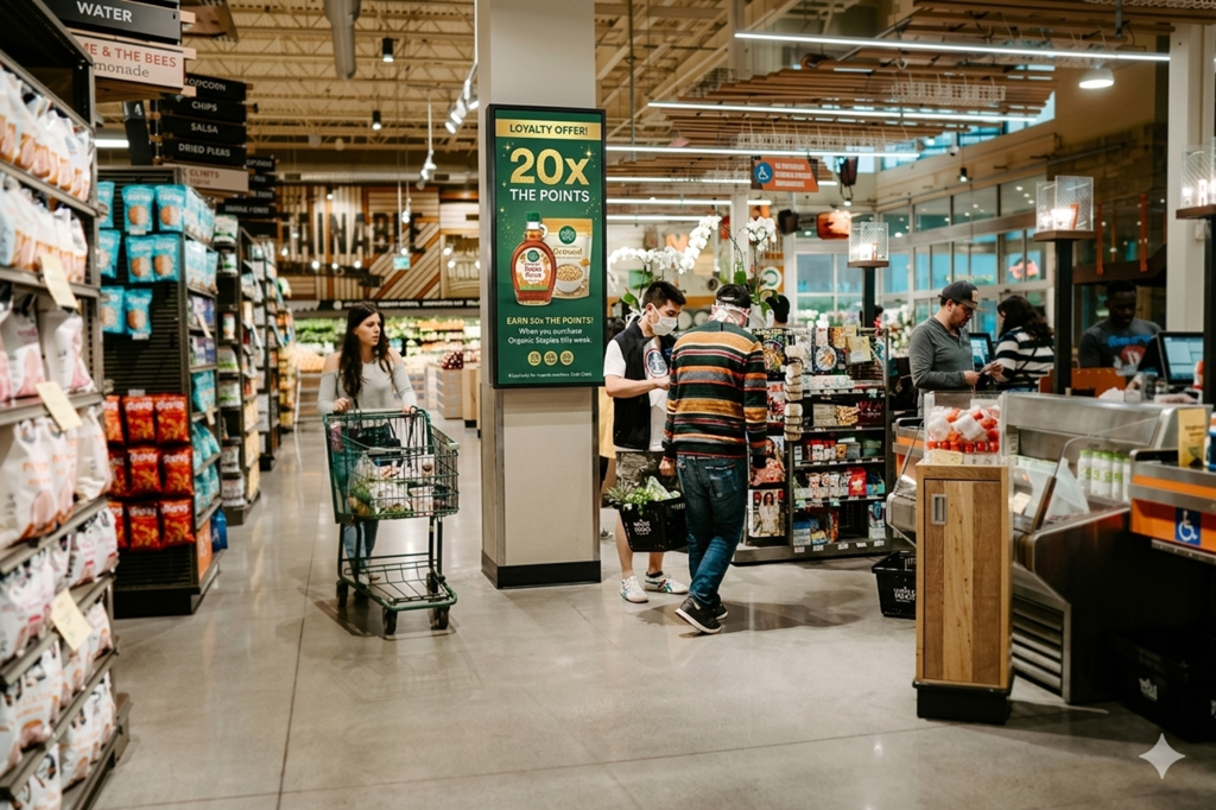
Many retail media networks continue to rely on generic creative, repurposed television advertising, broad category messaging or promotional content that is often disconnected from customer intent, location or stage within the purchase journey. Meanwhile, retailers are collecting customer signals through loyalty programs, mobile applications, online browsing behaviour and transaction histories that could support far more relevant and effective communication.
The challenge is not primarily technological. The capabilities required to create more connected retail experiences already exist. Rather, the limitation appears to be organisational. Retail media, store operations, digital commerce, customer data and marketing functions frequently operate independently despite sharing a common customer outcome. The result is often a fragmented experience where the customer encounters multiple channels, but little evidence of a coordinated strategy.
A Retail Media Network Should Be Designed Around Shopper Experiences
A fundamental question facing the industry is whether many retail media networks have been designed primarily to improve shopper experiences or to maximise media inventory.
Most retail media networks have emerged from a logical commercial opportunity. Retailers recognise the value of customer attention within their stores and seek to monetise that attention through advertising. There is nothing inherently problematic about this approach. However, when media monetisation becomes the primary objective, the shopper experience can become secondary.
Over time, this creates risk for both retailers and advertisers.
The long-term value of any retail media network is ultimately determined by its ability to influence purchasing behaviour. If content is not relevant, contextual, or useful to shoppers, attention declines and media effectiveness follows. Revenue may continue to grow in the short term, but the underlying value proposition weakens.
The most successful retail media networks are likely to be those that view media revenue as an outcome of a better customer experience rather than the objective itself.
Connected Retail Requires Connected Thinking
The concept of connected retail has existed for more than a decade. The underlying premise is relatively simple: customers do not distinguish between digital and physical channels, so organisations should not manage them as though they are unrelated.
Despite this, many retailers continue to operate with separate teams responsible for e-commerce, stores, media, loyalty, customer data and technology. While each function may perform effectively within its own domain, the customer experiences the combined outcome of all of them.
In-store screens often sit at the intersection of these functions without being fully owned by any of them.
This can result in situations where a customer demonstrates interest in a category through digital interactions, enters a physical store, and receives messaging that bears little relationship to their previous behaviour or likely purchase intent. The data exists. The opportunity exists. The connection between the two is often missing.
This should not be viewed as a technology failure. More commonly, it reflects organisational structures, governance frameworks and planning processes that have not evolved at the same pace as the underlying technology.
The Store Remains a Decision Environment
One of the most important characteristics of physical retail is that purchasing decisions continue to be heavily influenced within the store environment.
Research consistently suggests that a significant proportion of purchase decisions are made at or near the point of purchase. While exact figures vary by category, the broader implication remains unchanged: stores are not simply fulfilment locations for decisions made elsewhere. They remain active decision-making environments.
This has important implications for in-store media.
The value of an in-store screen is not that it displays content. Its value lies in its ability to influence customer engagement & purchase decisions.
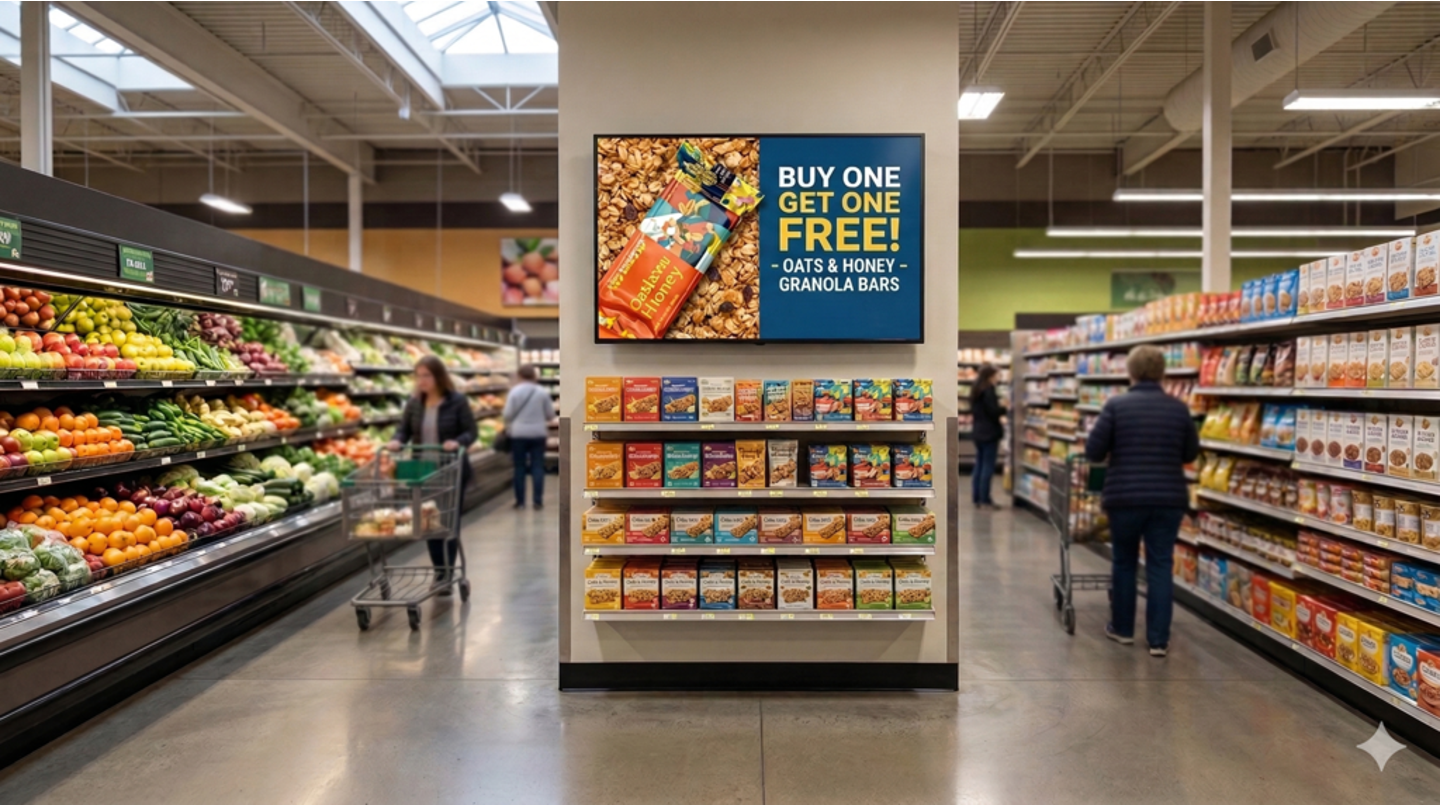
A customer standing in the wine aisle on a Friday evening may require entirely different information, prompts, or recommendations than a customer browsing the same category on a Tuesday morning. Similarly, a loyal customer with an established purchase history may require a different communication strategy than a first-time visitor.
The objective should not be personalisation for its own sake. Rather, it should be relevance. Effective retail media recognises the context in which a decision is being made and responds accordingly.
This is the same principle that underpins effective digital commerce. There is little reason it should not apply equally within physical retail environments.
Scentre Group’s Westfield network offers a working example of this principle in practice. Partnering with Optus and audience intelligence platform Quividi on the Samsung Galaxy S10 launch, BrandSpace triggered different creative for different audience segments in real time, based on who was actually standing in front of the screen. The targeted centres delivered six times more watchers per play and a 29% uplift in attention time from the target audience, versus the generic creative running in the control centres (Quividi, Scentre Group BrandSpace and Optus case study).
Brands Should Expect More From In-Store Media
For advertisers, the continued growth of retail media presents significant opportunities. However, it also creates a responsibility to demand greater sophistication from the channel.
Many retailers now possess first-party customer datasets that rival or exceed the quality of audience intelligence available through traditional media channels. This information has the potential to improve audience targeting, campaign planning, content strategy and measurement.
Yet access to data alone does not create value.
Brands should be asking how customer insights are influencing content decisions, how in-store media aligns with broader customer journeys, and how campaign outcomes are being measured beyond exposure metrics.
The objective should not simply be to purchase access to an audience. It should be to influence behaviour in a measurable and commercially meaningful way.
Measurement Remains the Industry’s Most Significant Challenge
Perhaps the most important issue facing in-store retail media is measurement. IAB Europe’s Commerce Media Measurement Standards, updated to V2 in January 2026, now set concrete industry definitions for attribution windows, gross versus net sales, and incrementality testing. This is real infrastructure, not just intent.
What is still missing in many organisations is not the technical capability, but the willingness to prioritise meaningful measurement and establish the commercial frameworks required to make it work. Delivering genuine accountability requires retailers, brands and agencies to align around shared objectives, shared data and shared definitions of success.
However, many organisations continue to rely heavily on impressions, plays and audience estimates as primary indicators of success. These metrics have value, but they should be understood as inputs rather than outcomes.
The more important question is whether in-store media influences customer behaviour, purchasing decisions, category growth or incremental sales. These are ultimately the outcomes that justify investment from both retailers and advertisers.
As retail media continues its rapid expansion, the industry’s credibility will increasingly depend on its ability to demonstrate commercial impact rather than simply audience delivery.
The data required to achieve this is becoming more accessible. Industry standards are emerging. Technology capabilities continue to improve. The remaining challenge is often organisational commitment to measurement, transparency, and shared accountability across retailers, brands, and agencies.
The Opportunity Ahead
In-store screens should not be viewed as digital out-of-home media placed within a retail environment. Nor should they be treated as smaller versions of traditional broadcast channels.
They are digital touchpoints operating within one of the most information-rich and commercially valuable environments available to marketers: the point at which purchasing decisions are being made.
The retailers and brands most likely to succeed in this environment will be those that who connect customer data, content, operations and measurement to influence behaviour, not simply deliver impressions.
The technology required to support this future largely exists today. The more important question is whether organisations are prepared to align their structures, incentives and decision making to take advantage of it.
3 things worth remembering
1. Screen Networks should start with the customer, not the rate card.
The most valuable retail media networks will be those that can demonstrate impact on customer behaviour, revenue will follow impact.
2. In-store screens are decision drivers, not reach drivers.
The value of in-store media is not how many people see it. The value lies in influencing purchasing behaviour where decisions are being made.
3. If you can’t measure the outcome, you’re measuring the wrong thing.
Impressions, plays and audience estimates are useful operational metrics. Commercial impact is the metric that ultimately matters.