
The standards for agentic advertising are being built. IAB Australia is inviting Australian publishers, buyers and tech vendors to help shape them in a sandbox, on the software that exists today, with no live spend.
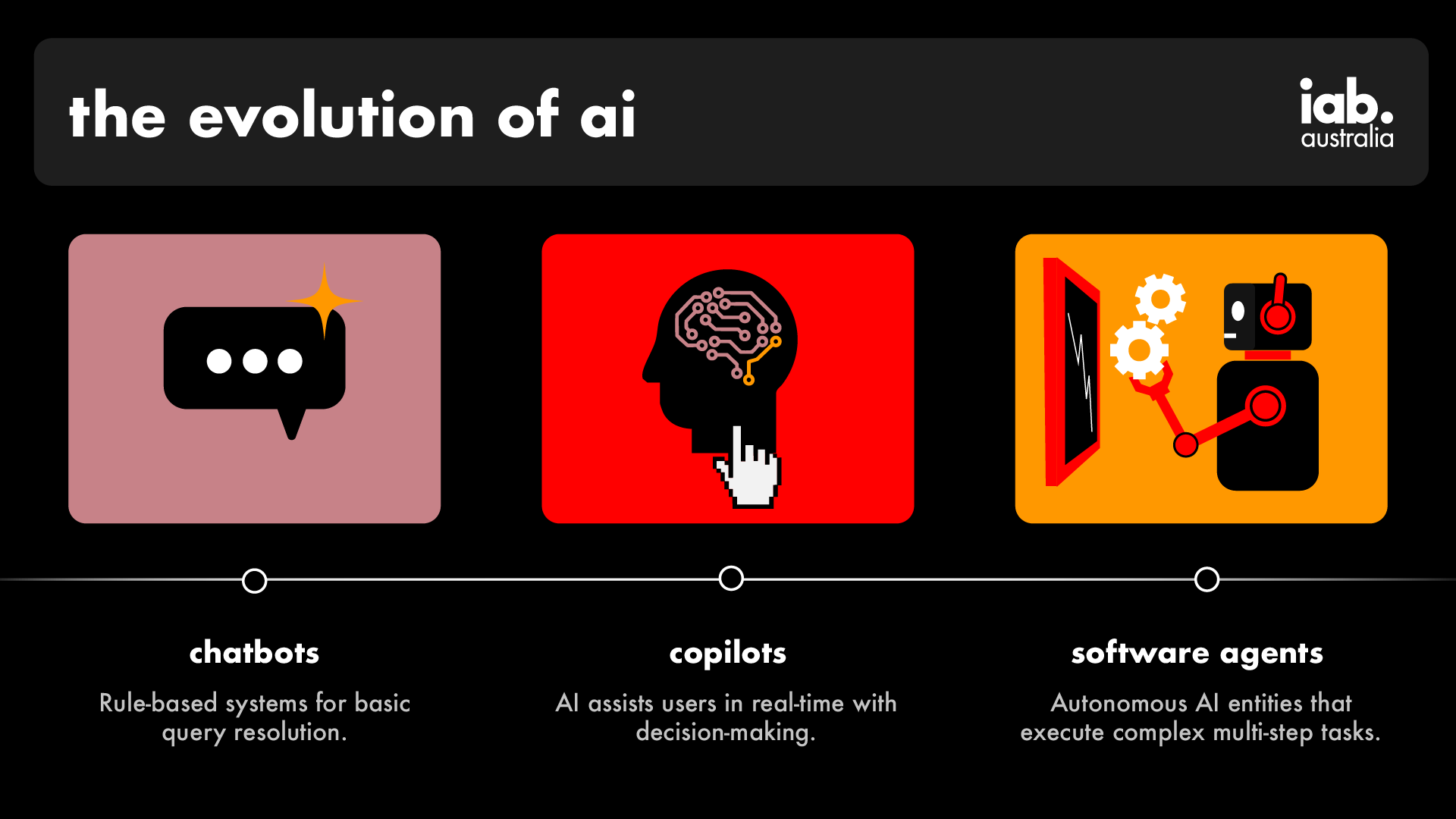
AI has moved from chatbots to copilots to software agents that can carry out a defined job. In this industry that job is the grunt work: trawling emails, checking rate-card PDFs, chasing follow-ups, digesting media kits and pulling together proposals that can meet a brief.
Programmatic solved for execution, but has not resolved everything that goes before it. The path from a brief to a buyable offer still runs on emails, rate-card PDFs and re-keying. As agents mature there is a real opportunity to reduce that friction — provided they work from structured information, clear commercial rules and approval steps that people still own.
IAB Tech Lab has been developing the interoperable protocols this needs. Rather than asking the industry to rebuild everything from scratch, it applies those protocols to standards that already work, including OpenRTB and OpenDirect.
IAB Australia set up a sandbox and has spent the past two months running the reference implementations that exist today. All data is synthetic. There is no live spend. People set the rules and approve the commercial decisions the software puts in front of them.
What agentic advertising is
Agentic advertising is the use of software agents to carry out defined advertising tasks (e.g. finding inventory, reading a media kit, requesting a proposal, preparing a transaction) inside rules and approval steps that people set.
This is not AI buying media unsupervised. The work agents take on is the repetitive coordination that today runs through inboxes, spreadsheets and follow-up calls. Commercial and product teams still decide which products are shown, to whom, at what floor price, with what package rules and acceptable discounts, and at what point the answer is no. Operations teams keep their pre-activation controls.
For a seller, the opportunity is more practical than the headlines suggest: make inventory easy for a buying agent to find, read and assess, without giving up the commercial decisions that are so critical.
Who decides what
Before any conversation
People set the rules
- Which products are visible, and to whom
- Floor prices and rate cards
- Package and discount bands
- The walk-away point
- Who signs off, and above what threshold
Inside those rules
The agent does the coordination
- Reads the brief
- Finds relevant inventory
- Retrieves the media kit
- Assembles a proposal that fits
- Flags anything that does not
Before anything binds
People decide again
- Whether to allow an exception
- Whether the terms are right
- Whether to commit the spend
Those are the boundaries a seller sets. Part of what the pilot tests is how reliably the software honours them.
What is it trying to solve?
What holds the industry back is not simply speed. The path from a brief to a buyable offer still relies on information most systems cannot reliably interpret: rate cards in PDFs, product details scattered across media kits, commercial terms held in individual knowledge, and approvals buried in email or Slack.
That limits how many publishers a planner can assess properly. Many opportunities are not rejected or ranked last; they are never considered at all, because the information required to find, compare and evaluate them is difficult to access, inconsistent or unstructured.
The job is narrower than the headlines. A buying system should be able to discover, compare and propose against inventory it did not already know about, inside rules the seller still owns. Coordination can collapse. Judgement does not.
Without a shared protocol, every buyer–seller pairing is a custom integration, which only the largest sellers can afford to build, and a market of many small sellers is the one that loses. The work that makes a seller readable is the same either way: what you sell in a form a machine can parse, who may see it, where the floor and the no sit, who signs off. That is useful if the demand arrives, useful if the protocol number changes, and useful if it does not arrive at all.
What AAMP is
AAMP (the Agentic Advertising Management Protocols) is IAB Tech Lab’s open-source framework for getting advertising agents to work with one another. It gives buyer and seller systems a common way to discover each other, exchange structured information, make and evaluate proposals, apply commercial rules, and pass any approved outcome into the systems that book and execute the business.
It connects to standards the industry already runs on rather than replacing them. AAMP is not a product. It does not replace a DSP, an SSP or an ad server, and it does not replace the teams who run them. It is the plumbing that lets agents talk to each other over rails that already exist.
Which version is this?
On 22 September IAB Tech Lab announced AAMP 3.0 and OpenProposal, a specification for how sellers represent ad products and respond to buyer briefs. It is in public comment until 22 October 2026. It does not withdraw 2.3, and it is not a requirement of this pilot.
Exists today & what this pilot will run
AAMP 2.3, published in July, is the current protocol release with working reference implementations. The protocol and the software are numbered separately. This pilot is pinned to AAMP 2.3 and to seller-agent / buyer-agent v2.4.2.
In public comment until 22 October
AAMP 3.0 introduces OpenProposal, which will, per IAB Tech Lab, be built into the Buyer and Seller Agent SDK reference implementations. It is not a requirement of the Australian pilot. Details are in the IAB Tech Lab announcement.
The local pilot is pinned to the implementation that exists today, which we have been actively testing since August, so the cohort does not have to wait for a specification still in comment. The first phase (includes work such as inventory modelling, pricing & approval policy and readiness assessment) is not protocol-specific and can transfer if the versions shift. Newer software will be evaluated at cohort checkpoints and tested in IAB Australia’s own lab first, and then based on resulting findings the group will collaboratively decide when best to start testing newer versions.
How a transaction runs
A buying agent can only act on inventory and terms it can read. Seller rules set the boundaries. People keep the decisions that move money.
- Brief: A buyer defines the campaign objective, audience, timing, budget and requirements.
- Discover: The buyer agent identifies relevant seller agents and inventory opportunities.
- Media kit: It retrieves structured information about products, formats, audiences, packages and access conditions.
- Negotiate: Buyer and seller agents exchange proposals within seller-defined floors, packages, discount rules and walk-away points.
- Approve: A person reviews the decisions that require commercial judgement: proposal decisions and price exceptions.
- Transact: The approved outcome is handed to existing direct or programmatic systems.
- Audit: The workflow is designed to record requests, decisions, approvals and state changes.
Why this is important to us
Australian internet advertising was worth $19.8 billion in FY26, up 14.0% on FY25 – the strongest growth since FY22. Valuable supply needs to stay findable by whomever and whatever is doing the finding. Nobody is suggesting agents will intermediate all of it. The point is much narrower: more of that demand will arrive through software reading a catalogue, and inventory that cannot be read cannot be part of that conversation.
Sellers
Stay in the consideration set
- A buying agent shortlists what it can read. Unstructured inventory is not ranked last — it is absent.
- Floors, package rules, price sources, discount policy and approval thresholds stay seller-controlled.
- Human approval sits on the proposal decision and on price exceptions.
- The cheap time to learn the catalogue and the gates is in a sandbox, not in production.
Buyers and agencies
Compare more than a planner can hold
- More publishers can be read against a brief than a manual RFP floor allows.
- A proposal can carry why the seller thinks it fits — not only a price.
- Approval and an auditable record stay on the path to spend.
- Existing planning judgement is not replaced. It is given a larger, structured set.
Ad-tech vendors
Sit on the rails already in market
- Built to use OpenDirect, AdCOM, the Deals API and OpenRTB — not to replace a DSP or SSP.
- See what a seller catalogue actually does when a buying agent reads it.
- Observer track is open: see the work, not participant commercial detail.
- Readiness work transfers if the protocol number moves.
What this does not require
A public rate card. You control what is visible, to whom, and on what terms. What it does require is that the inventory, products and commercial conditions exist in a form a machine can read, which is a capability many sellers are still developing.
Why smaller sellers should care
A well-structured catalogue can be read alongside those from larger media businesses. The advantage is not size; it is whether the inventory can be found and understood.
How IAB Australia will support local industry
This is a controlled way for members to exercise agentic workflows before anyone is asked to run them with real revenue at stake. It is a readiness and sandbox-testing programme, not a trading exercise.
Full track
Stand up a seller agent. Run the scenario suite.
For publishers and sellers ready to deploy the reference agent in a private sandbox against named inventory.
Readiness-first
Catalogue, pricing rules, approval policy.
Inventory model and machine-readable media kit, with facilitated demonstrations. No requirement to run the suite yourself.
Observer
See the work. No deploy.
Open to buyers, agencies, DSPs and measurement firms. You do not receive participant-attributed commercial detail.
Sandbox only
Private test environments. No production writes.
No live spend
No real budget moves.
No fee
Participation costs nothing.
Synthetic data
No personal data, real rates or client terms.
Pinned versions
One baseline, changed only at a checkpoint.
Full track and readiness-first are for sellers. One full-track seat is reserved for a smaller or regional seller. Sell-side ad tech joins either track only against named inventory it owns, or represents with written permission.
Participants leave with a readiness assessment, hands-on experience of the workflow, findings shared across the cohort, and an Australian seller playbook. What we learn also goes back into the global standards effort. That is important, but it is not the main reason to take part. The main reason is to get your own products and gates ready before this becomes something you have to react to.
The programme runs for about fourteen working weeks across roughly twenty-two calendar weeks, with a scheduled pause over the Australian summer.
Express your interest
IAB Australia members: email agentic@iabaustralia.com.au by 5pm AEST Wednesday 30 September 2026. Say whether you are looking at the full track, readiness-first or observer.
Places confirmed by 2 October. Kickoff Tuesday 6 October 2026. Full-track places are capped at six, including one reserved for a smaller or regional seller. We will send you the Framework and Guidance pack, which sets out what we collect and how it is handled.
General information for IAB Australia members. The pilot is a controlled testing and readiness programme; it is not legal, commercial or technical implementation advice for any specific organisation.